

Result and discussion
75
Results and discussion :
The results indicate that the application of chitosan hydrochloride solution had a positive impact
on root development in the spider plant. The treated plant (B) exhibited several advantageous
characteristics compared to the plant treated with purified water (A).
Table 23:Plant observation results
Root growth
Root size
Water absorption
✓ (B) displayed longer
roots compared to (A).
This suggests that
chitosan
has
the
potential to stimulate
root elongation and
promote overall root
growth
✓ The roots of (B) plant
were larger in size. This
indicates that chitosan
may contribute to
increased root biomass,
which
can
have
beneficial effects on
nutrient uptake and
plant health.
✓ (B) exhibited an absorbent
felt, indicating improved
water absorption capacity
of the roots. Chitosan has
been reported to have
water-holding properties,
which may help retain
moisture in the root zone,
promoting better hydration
and nutrient uptake.
The observed effects of chitosan hydrochloride solution on root development in the spider plant
support the notion that chitosan can be a beneficial treatment for enhancing root growth in
plants. These findings align with previous research that has demonstrated the positive impact
of chitosan on plant growth and development such as (EL HADRAMI et al., 2010) and
(MARGUERITE and FRANCISCO, 2019) studies.
X. Chitosan Films for food preservation
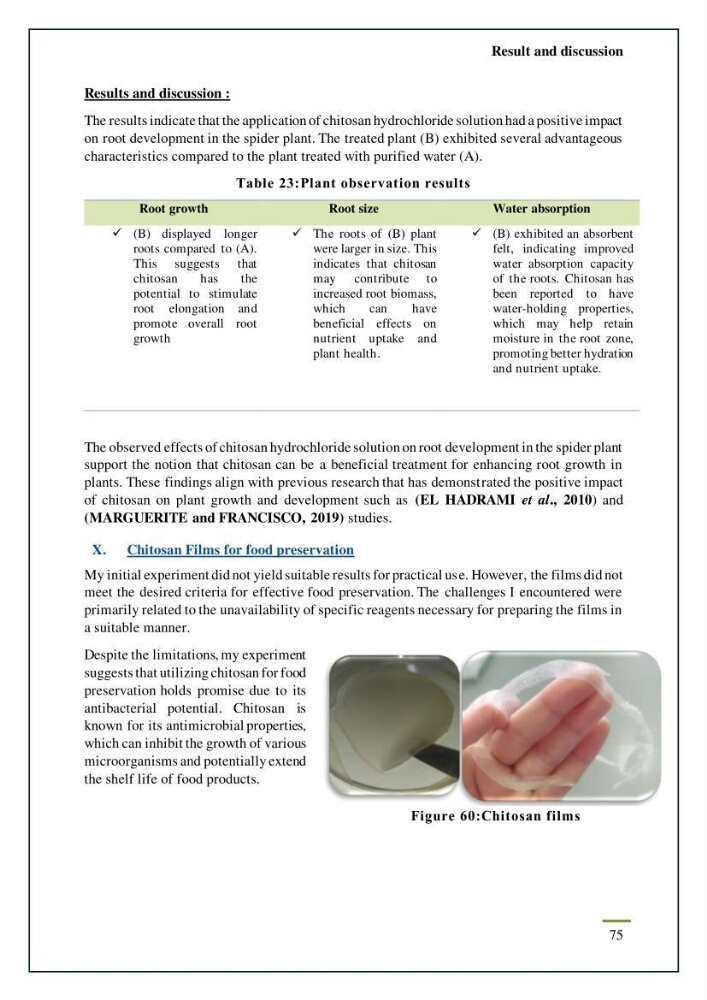
My initial experiment did not yield suitable results for practical use. However, the films did not
meet the desired criteria for effective food preservation. The challenges I encountered were
primarily related to the unavailability of specific reagents necessary for preparing the films in
a suitable manner.
Despite the limitations, my experiment
suggests that utilizing chitosan for food
preservation holds promise due to its
antibacterial potential. Chitosan is
known for its antimicrobial properties,
which can inhibit the growth of various
microorganisms and potentially extend
the shelf life of food products.
Figure 60:Chitosan films
75
Results and discussion :
The results indicate that the application of chitosan hydrochloride solution had a positive impact
on root development in the spider plant. The treated plant (B) exhibited several advantageous
characteristics compared to the plant treated with purified water (A).
Table 23:Plant observation results
Root growth
Root size
Water absorption
✓ (B) displayed longer
roots compared to (A).
This suggests that
chitosan
has
the
potential to stimulate
root elongation and
promote overall root
growth
✓ The roots of (B) plant
were larger in size. This
indicates that chitosan
may contribute to
increased root biomass,
which
can
have
beneficial effects on
nutrient uptake and
plant health.
✓ (B) exhibited an absorbent
felt, indicating improved
water absorption capacity
of the roots. Chitosan has
been reported to have
water-holding properties,
which may help retain
moisture in the root zone,
promoting better hydration
and nutrient uptake.
The observed effects of chitosan hydrochloride solution on root development in the spider plant
support the notion that chitosan can be a beneficial treatment for enhancing root growth in
plants. These findings align with previous research that has demonstrated the positive impact
of chitosan on plant growth and development such as (EL HADRAMI et al., 2010) and
(MARGUERITE and FRANCISCO, 2019) studies.
X. Chitosan Films for food preservation
My initial experiment did not yield suitable results for practical use. However, the films did not
meet the desired criteria for effective food preservation. The challenges I encountered were
primarily related to the unavailability of specific reagents necessary for preparing the films in
a suitable manner.
Despite the limitations, my experiment
suggests that utilizing chitosan for food
preservation holds promise due to its
antibacterial potential. Chitosan is
known for its antimicrobial properties,
which can inhibit the growth of various
microorganisms and potentially extend
the shelf life of food products.
Figure 60:Chitosan films