

Result and discussion
61
3- Water and fat binding capacity
The objective of this study was to assess the water binding capacity (WBC) of chitosan, which
serves as an indicator of its ability to retain water under external pressure. A higher WBC
signifies that chitosan is capable of maintaining its water retention properties even when
subjected to stress.
Regarding for Fat Binding Capacity (FBC) study, is to quantify the quantity of oil assimilated
by chitosan. The FBC properties can be instrumental in preserving fat, taste, and consistency in
diverse applications such as coatings, flavourings, and emulsions (YADA, 2017).
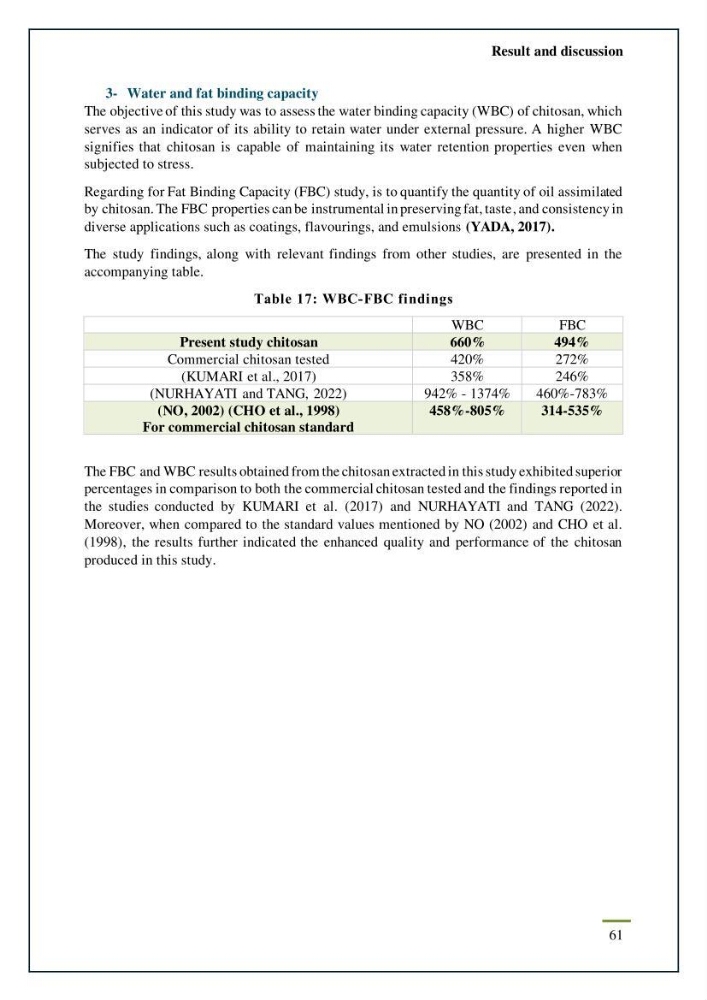
The study findings, along with relevant findings from other studies, are presented in the
accompanying table.
Table 17: WBC-FBC findings
WBC
FBC
Present study chitosan
660%
494%
Commercial chitosan tested
420%
272%
(KUMARI et al., 2017)
358%
246%
(NURHAYATI and TANG, 2022)
942% - 1374%
460%-783%
(NO, 2002) (CHO et al., 1998)
For commercial chitosan standard
458%-805%
314-535%
The FBC and WBC results obtained from the chitosan extracted in this study exhibited superior
percentages in comparison to both the commercial chitosan tested and the findings reported in
the studies conducted by KUMARI et al. (2017) and NURHAYATI and TANG (2022).
Moreover, when compared to the standard values mentioned by NO (2002) and CHO et al.
(1998), the results further indicated the enhanced quality and performance of the chitosan
produced in this study.
61
3- Water and fat binding capacity
The objective of this study was to assess the water binding capacity (WBC) of chitosan, which
serves as an indicator of its ability to retain water under external pressure. A higher WBC
signifies that chitosan is capable of maintaining its water retention properties even when
subjected to stress.
Regarding for Fat Binding Capacity (FBC) study, is to quantify the quantity of oil assimilated
by chitosan. The FBC properties can be instrumental in preserving fat, taste, and consistency in
diverse applications such as coatings, flavourings, and emulsions (YADA, 2017).
The study findings, along with relevant findings from other studies, are presented in the
accompanying table.
Table 17: WBC-FBC findings
WBC
FBC
Present study chitosan
660%
494%
Commercial chitosan tested
420%
272%
(KUMARI et al., 2017)
358%
246%
(NURHAYATI and TANG, 2022)
942% - 1374%
460%-783%
(NO, 2002) (CHO et al., 1998)
For commercial chitosan standard
458%-805%
314-535%
The FBC and WBC results obtained from the chitosan extracted in this study exhibited superior
percentages in comparison to both the commercial chitosan tested and the findings reported in
the studies conducted by KUMARI et al. (2017) and NURHAYATI and TANG (2022).
Moreover, when compared to the standard values mentioned by NO (2002) and CHO et al.
(1998), the results further indicated the enhanced quality and performance of the chitosan
produced in this study.