

51
IX. In vivo wound healing experimentation
Wound healing is a complex biological process that involves a series of intricate cellular and
molecular events aimed at restoring the structural and functional integrity of damaged tissue.
One common outcome of the healing process is the formation of skin scars, which can have
both cosmetic and functional implications for individuals. The development of effective
strategies to enhance wound healing and minimize scar formation has been an ongoing area of
research. (KARLA et al, 2022).
The utilization of chitosan-based products in vivo holds great potential for improving wound
healing outcomes and reducing scar formation (SINGH et al., 2017). These products can
provide a supportive scaffold for cellular attachment and migration, promote angiogenesis,
modulate the inflammatory response, and enhance the deposition of extracellular matrix
components (UENO et al., 2001) (AZAD et al., 2004). Furthermore, chitosan's
biodegradability allows for its gradual degradation and integration into the healing tissue,
minimizing the need for subsequent interventions. Numerous studies have reported the wound
healing properties of chitosan, including studies by ŞENEL and MCCLURE (2004),
ARCHANA et al. (2013), CASADIDIO et al. (2019), ARANAZ et al. (2021), and
NARAYANA et al. (2023).
In this study, we aim to investigate the effectiveness of a novel chitosan-based product in
promoting wound healing and minimizing scar formation in an in vivo model.
a) Animal selection for in vivo experiment
In this in vivo experiment, the laboratory Albio rabbit was chosen as a model. The selection of
the Albio rabbit was based on several factors, including its physiological similarities to humans,
ease of handling and care, availability, and previous research evidence.
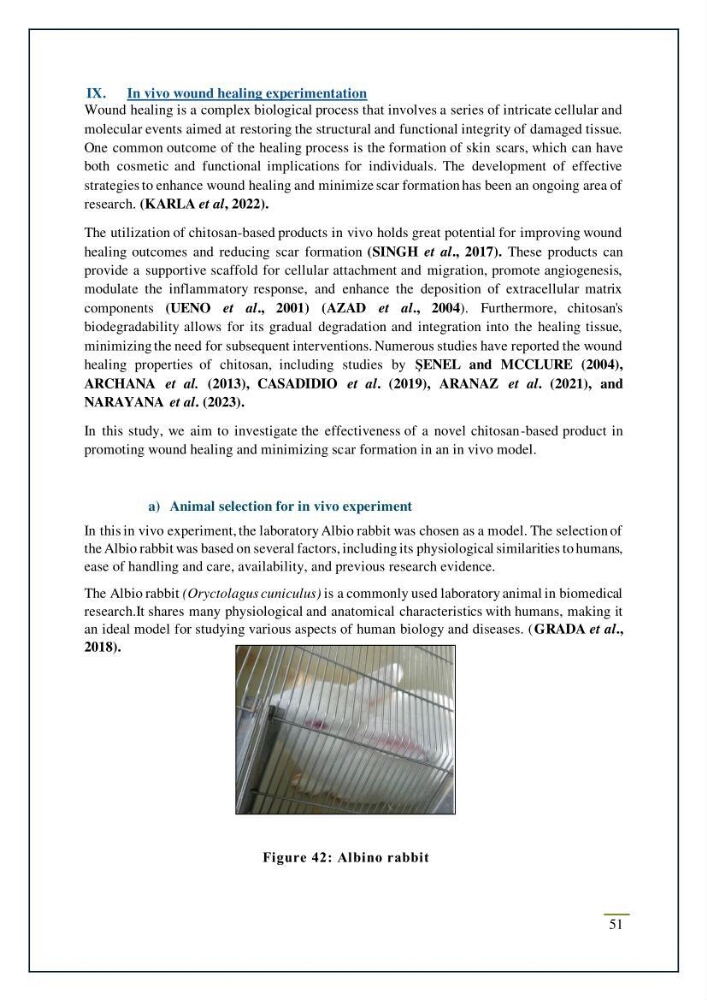
The Albio rabbit (Oryctolagus cuniculus) is a commonly used laboratory animal in biomedical
research.It shares many physiological and anatomical characteristics with humans, making it
an ideal model for studying various aspects of human biology and diseases. (GRADA et al.,
2018).
Figure 42: Albino rabbit
IX. In vivo wound healing experimentation
Wound healing is a complex biological process that involves a series of intricate cellular and
molecular events aimed at restoring the structural and functional integrity of damaged tissue.
One common outcome of the healing process is the formation of skin scars, which can have
both cosmetic and functional implications for individuals. The development of effective
strategies to enhance wound healing and minimize scar formation has been an ongoing area of
research. (KARLA et al, 2022).
The utilization of chitosan-based products in vivo holds great potential for improving wound
healing outcomes and reducing scar formation (SINGH et al., 2017). These products can
provide a supportive scaffold for cellular attachment and migration, promote angiogenesis,
modulate the inflammatory response, and enhance the deposition of extracellular matrix
components (UENO et al., 2001) (AZAD et al., 2004). Furthermore, chitosan's
biodegradability allows for its gradual degradation and integration into the healing tissue,
minimizing the need for subsequent interventions. Numerous studies have reported the wound
healing properties of chitosan, including studies by ŞENEL and MCCLURE (2004),
ARCHANA et al. (2013), CASADIDIO et al. (2019), ARANAZ et al. (2021), and
NARAYANA et al. (2023).
In this study, we aim to investigate the effectiveness of a novel chitosan-based product in
promoting wound healing and minimizing scar formation in an in vivo model.
a) Animal selection for in vivo experiment
In this in vivo experiment, the laboratory Albio rabbit was chosen as a model. The selection of
the Albio rabbit was based on several factors, including its physiological similarities to humans,
ease of handling and care, availability, and previous research evidence.
The Albio rabbit (Oryctolagus cuniculus) is a commonly used laboratory animal in biomedical
research.It shares many physiological and anatomical characteristics with humans, making it
an ideal model for studying various aspects of human biology and diseases. (GRADA et al.,
2018).
Figure 42: Albino rabbit