

Literature review
14
7. Biological properties
Chitosan, a biopolymer obtained from chitin, manifests a plethora of biological properties that
position it as a material with great potential for various applications (AHMED and IKRAM,
2017). Among its significant attributes are the following:
Chitosan is a biocompatible material, due to its inherent biodegradability to normal body
constituents, non-toxicity, and ability to support cell adhesion and proliferation (PELLIS et al.,
2022). Its cationic nature allows for interactions with negatively charged molecules such as cell
membranes and extracellular matrix components, promoting cell attachment and growth
(MOGOSANU and GRUMEZESCU, 2014). Moreover, chitosan's chemical structure can be
modified to enhance its biocompatibility by altering its molecular weight, degree of
deacetylation, and charge density table. (HECTOR et al., 2016) (AHMED and IKRAM,
2017).
Furthermore, its positively charged amino groups enable it to exhibit antibacterial, antiviral,
and hemostatic activities (SHUKLA et al., 2013). It also has fungistatic and antioxidant
properties, as well as antitumor and immunoadjuvant activities (ARANAZ et al., 2021)
(MACKAY and TAIT, 2012).
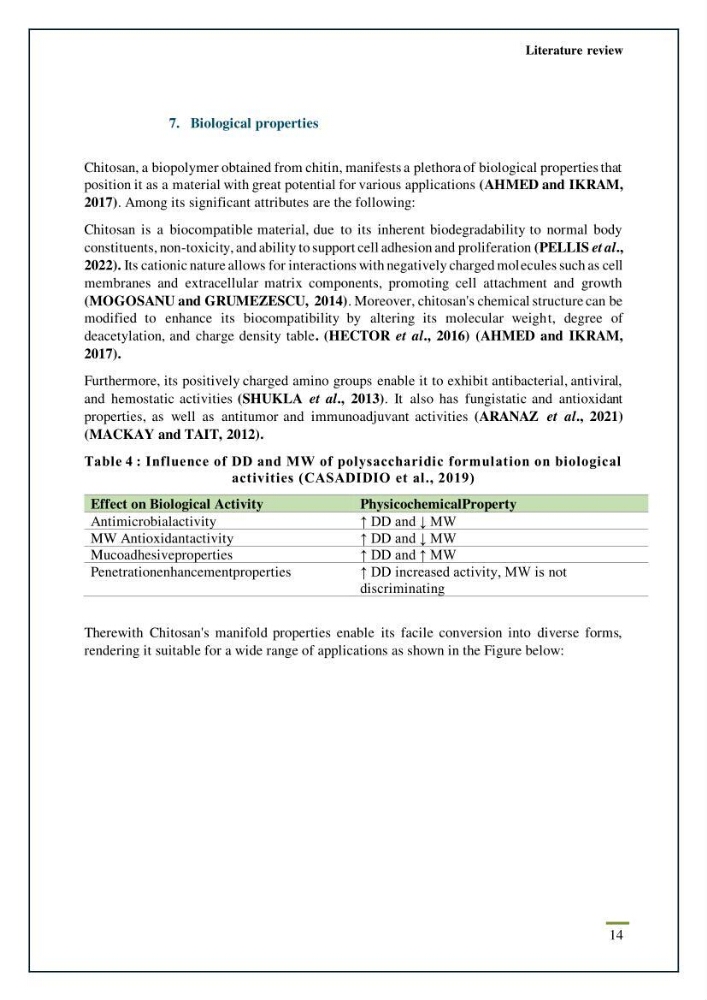
Table 4 : Influence of DD and MW of polysaccharidic formulation on biological
activities (CASADIDIO et al., 2019)
Effect on Biological Activity
PhysicochemicalProperty
Antimicrobialactivity
↑ DD and ↓ MW
MW Antioxidantactivity
↑ DD and ↓ MW
Mucoadhesiveproperties
↑ DD and ↑ MW
Penetrationenhancementproperties
↑ DD increased activity, MW is not
discriminating
Therewith Chitosan's manifold properties enable its facile conversion into diverse forms,
rendering it suitable for a wide range of applications as shown in the Figure below:
14
7. Biological properties
Chitosan, a biopolymer obtained from chitin, manifests a plethora of biological properties that
position it as a material with great potential for various applications (AHMED and IKRAM,
2017). Among its significant attributes are the following:
Chitosan is a biocompatible material, due to its inherent biodegradability to normal body
constituents, non-toxicity, and ability to support cell adhesion and proliferation (PELLIS et al.,
2022). Its cationic nature allows for interactions with negatively charged molecules such as cell
membranes and extracellular matrix components, promoting cell attachment and growth
(MOGOSANU and GRUMEZESCU, 2014). Moreover, chitosan's chemical structure can be
modified to enhance its biocompatibility by altering its molecular weight, degree of
deacetylation, and charge density table. (HECTOR et al., 2016) (AHMED and IKRAM,
2017).
Furthermore, its positively charged amino groups enable it to exhibit antibacterial, antiviral,
and hemostatic activities (SHUKLA et al., 2013). It also has fungistatic and antioxidant
properties, as well as antitumor and immunoadjuvant activities (ARANAZ et al., 2021)
(MACKAY and TAIT, 2012).
Table 4 : Influence of DD and MW of polysaccharidic formulation on biological
activities (CASADIDIO et al., 2019)
Effect on Biological Activity
PhysicochemicalProperty
Antimicrobialactivity
↑ DD and ↓ MW
MW Antioxidantactivity
↑ DD and ↓ MW
Mucoadhesiveproperties
↑ DD and ↑ MW
Penetrationenhancementproperties
↑ DD increased activity, MW is not
discriminating
Therewith Chitosan's manifold properties enable its facile conversion into diverse forms,
rendering it suitable for a wide range of applications as shown in the Figure below: