

Literature review
13
D- Solubility
The quality of chitosan is highly dependent on its solubility, as it is a crucial parameter that
determines the purity of the chitosan produced. Research suggests that higher solubility is
indicative of higher quality chitosan (HOSNEY et al., 2022).
The solubility of chitosan is influenced by several factors, including temperature, alkali
concentration, deacetylation time, particle size of chitin, and the ratio of chitin to alkali solution.
(NURHAYATI and TANG, 2022).
E- pH of Chitosan Solution
The pH of dilute acidic chitosan solutions is typically below 6.0. Although chitosan is a strong
base due to the presence of free –NH2 groups throughout the chain, with a pKa value of 6.3,
the pH of the solution can affect the properties and charge of chitosan as illustrated in the table.
(AHMED and IKRAM, 2017).
Table 2 : The effect of PH on Chitosan solution
At low pH
At high pH values above 6.0
Reference
> The free –NH2 groups become
protonated and acquire a
positive charge, rendering
chitosan
a
cationic
polyelectrolyte and watersoluble. Moreover, it can form
quaternary salts with nitrogen
at low pH values
> The amino groups become
deprotonated, resulting in
the insolubility of chitosan
> (Ahmed
and Ikram,
2017)
F- Water-binding capacity and fat-binding capacity
Chitosan's water and fat binding capacities are critical factors that determine its potential
application as a food ingredient. The water binding capacity of chitosan is attributed to the
presence of hydrophilic -OH and -NH2 groups in its structure, while the fat binding capacity is
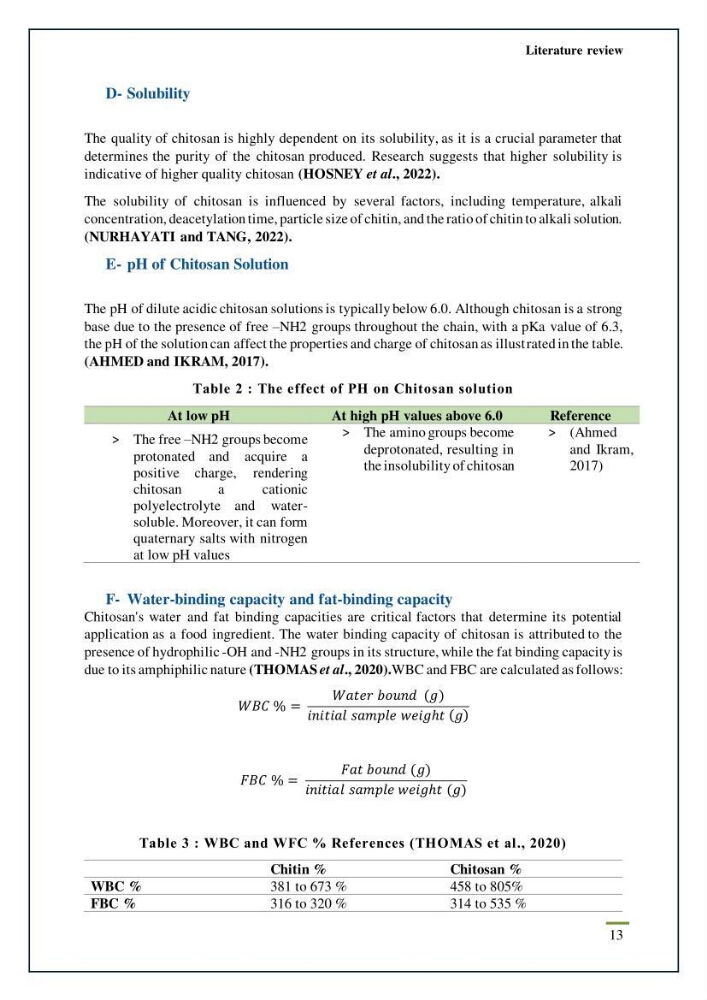
due to its amphiphilic nature (THOMAS et al., 2020).WBC and FBC are calculated as follows:
í µí±í µí°µí µí°¶ % =
í µí±í µí±í µí±¡í µí±í µí± í µí±í µí±í µí±¢í µí±í µí± (í µí±)
í µí±í µí±í µí±í µí±¡í µí±í µí±í µí± í µí± í µí±í µí±í µí±í µí±í µí± í µí±¤í µí±í µí±í µí±ℎí µí±¡ (í µí±)
í µí°¹í µí°µí µí°¶ % =
í µí°¹í µí±í µí±¡ í µí±í µí±í µí±¢í µí±í µí± (í µí±)
í µí±í µí±í µí±í µí±¡í µí±í µí±í µí± í µí± í µí±í µí±í µí±í µí±í µí± í µí±¤í µí±í µí±í µí±ℎí µí±¡ (í µí±)
Table 3 : WBC and WFC % References (THOMAS et al., 2020)
Chitin %
Chitosan %
WBC %
381 to 673 %
458 to 805%
FBC %
316 to 320 %
314 to 535 %
13
D- Solubility
The quality of chitosan is highly dependent on its solubility, as it is a crucial parameter that
determines the purity of the chitosan produced. Research suggests that higher solubility is
indicative of higher quality chitosan (HOSNEY et al., 2022).
The solubility of chitosan is influenced by several factors, including temperature, alkali
concentration, deacetylation time, particle size of chitin, and the ratio of chitin to alkali solution.
(NURHAYATI and TANG, 2022).
E- pH of Chitosan Solution
The pH of dilute acidic chitosan solutions is typically below 6.0. Although chitosan is a strong
base due to the presence of free –NH2 groups throughout the chain, with a pKa value of 6.3,
the pH of the solution can affect the properties and charge of chitosan as illustrated in the table.
(AHMED and IKRAM, 2017).
Table 2 : The effect of PH on Chitosan solution
At low pH
At high pH values above 6.0
Reference
> The free –NH2 groups become
protonated and acquire a
positive charge, rendering
chitosan
a
cationic
polyelectrolyte and watersoluble. Moreover, it can form
quaternary salts with nitrogen
at low pH values
> The amino groups become
deprotonated, resulting in
the insolubility of chitosan
> (Ahmed
and Ikram,
2017)
F- Water-binding capacity and fat-binding capacity
Chitosan's water and fat binding capacities are critical factors that determine its potential
application as a food ingredient. The water binding capacity of chitosan is attributed to the
presence of hydrophilic -OH and -NH2 groups in its structure, while the fat binding capacity is
due to its amphiphilic nature (THOMAS et al., 2020).WBC and FBC are calculated as follows:
í µí±í µí°µí µí°¶ % =
í µí±í µí±í µí±¡í µí±í µí± í µí±í µí±í µí±¢í µí±í µí± (í µí±)
í µí±í µí±í µí±í µí±¡í µí±í µí±í µí± í µí± í µí±í µí±í µí±í µí±í µí± í µí±¤í µí±í µí±í µí±ℎí µí±¡ (í µí±)
í µí°¹í µí°µí µí°¶ % =
í µí°¹í µí±í µí±¡ í µí±í µí±í µí±¢í µí±í µí± (í µí±)
í µí±í µí±í µí±í µí±¡í µí±í µí±í µí± í µí± í µí±í µí±í µí±í µí±í µí± í µí±¤í µí±í µí±í µí±ℎí µí±¡ (í µí±)
Table 3 : WBC and WFC % References (THOMAS et al., 2020)
Chitin %
Chitosan %
WBC %
381 to 673 %
458 to 805%
FBC %
316 to 320 %
314 to 535 %