

Literature review
9
II. Chitin main derivative: Chitosan
1. History
Chitosan has a history dating back to 1859, when C. Rouget
treated chitin with strong alkali to create a new substance
that could be dissolved in acidic aqueous solutions. This
product was called "chitinemodifiée," or modified chitin
(CRINI and Lichtfouse, 2019).
In the 1930s, X-ray diffraction was used to characterize the
structure of chitin and chitosan. In 1936, Rigby obtained two
patents for producing chitosan from chitin and for making
films and fibres from chitosan, which led to the first use of
chitosan in the papermaking industry (MUZZARELLI et
al,2012).
Since the 1970s, many manufacturers have produced and
marketed chitin and chitosan products, resulting in
numerous patents and a wealth of scientific literature.
Today, there are over 2000 applications of chitin, chitosan,
and their derivatives in hypes of fields (BEREZINA ,2016),
(ANNU et al,2017), and (KARTHIK et al ,2017).
2. Structure
Chitosan, which is the primary derivative of chitin, is a natural biopolymer that is obtained
through N-deacetylation of chitin under alkaline conditions. This linear polysaccharide is
composed of D-glucosamine units, which are 2-amino-2-deoxy-(1-4)-β-D-glucopyranose
residues (AHMED and IKRAM, 2017).
There is a naming convention that distinguishes between chitin and chitosan based on the degree
of N-deacetylation. The structures of chitin and chitosan and the naming convention are shown
in the figure 06 (THOMAS et al., 2020).
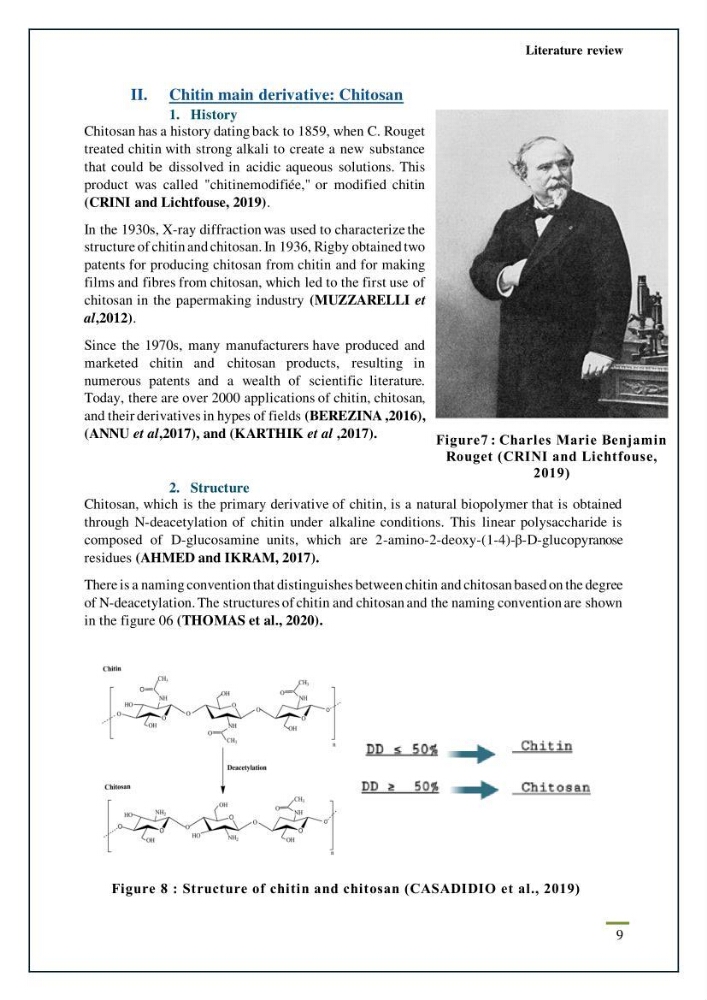
Figure7 : Charles Marie Benjamin
Rouget (CRINI and Lichtfouse,
2019)
Figure 8 : Structure of chitin and chitosan (CASADIDIO et al., 2019)
9
II. Chitin main derivative: Chitosan
1. History
Chitosan has a history dating back to 1859, when C. Rouget
treated chitin with strong alkali to create a new substance
that could be dissolved in acidic aqueous solutions. This
product was called "chitinemodifiée," or modified chitin
(CRINI and Lichtfouse, 2019).
In the 1930s, X-ray diffraction was used to characterize the
structure of chitin and chitosan. In 1936, Rigby obtained two
patents for producing chitosan from chitin and for making
films and fibres from chitosan, which led to the first use of
chitosan in the papermaking industry (MUZZARELLI et
al,2012).
Since the 1970s, many manufacturers have produced and
marketed chitin and chitosan products, resulting in
numerous patents and a wealth of scientific literature.
Today, there are over 2000 applications of chitin, chitosan,
and their derivatives in hypes of fields (BEREZINA ,2016),
(ANNU et al,2017), and (KARTHIK et al ,2017).
2. Structure
Chitosan, which is the primary derivative of chitin, is a natural biopolymer that is obtained
through N-deacetylation of chitin under alkaline conditions. This linear polysaccharide is
composed of D-glucosamine units, which are 2-amino-2-deoxy-(1-4)-β-D-glucopyranose
residues (AHMED and IKRAM, 2017).
There is a naming convention that distinguishes between chitin and chitosan based on the degree
of N-deacetylation. The structures of chitin and chitosan and the naming convention are shown
in the figure 06 (THOMAS et al., 2020).
Figure7 : Charles Marie Benjamin
Rouget (CRINI and Lichtfouse,
2019)
Figure 8 : Structure of chitin and chitosan (CASADIDIO et al., 2019)