

Literature review
6
A- Chemical extraction
The basic steps for chitin isolation from crustacean shells are as follows:
• Demineralization (acid removal of calcium carbonate).
• Deproteinization (removal of proteins).
• Depigmentation (removal of pigment).
Demineralisation:
Demineralization of source material (crustacean shells) starts with the removal of minerals such
as calcium carbonate (CaCO3), The most common reagents are HCl, HNO3, H2SO4,
CH3COOH, and HCOOH, generally HCl seems to be best one. Then the demineralized shell is
filtered under vacuum and washed with distilled water. (THOMAS et al,2020)
The process of demineralization varies depending on various factors such as the type of shells,
extraction time, temperature, size of the shell, concentration of acid, and the ratio of solute to
solvent. However, it is important to note that a high concentration of acid, prolonged process
time, and high temperature can have a negative impact on the properties of chitin. (HASAN et
al., 2022),(ZAINOL ABIDIN et al., 2020).
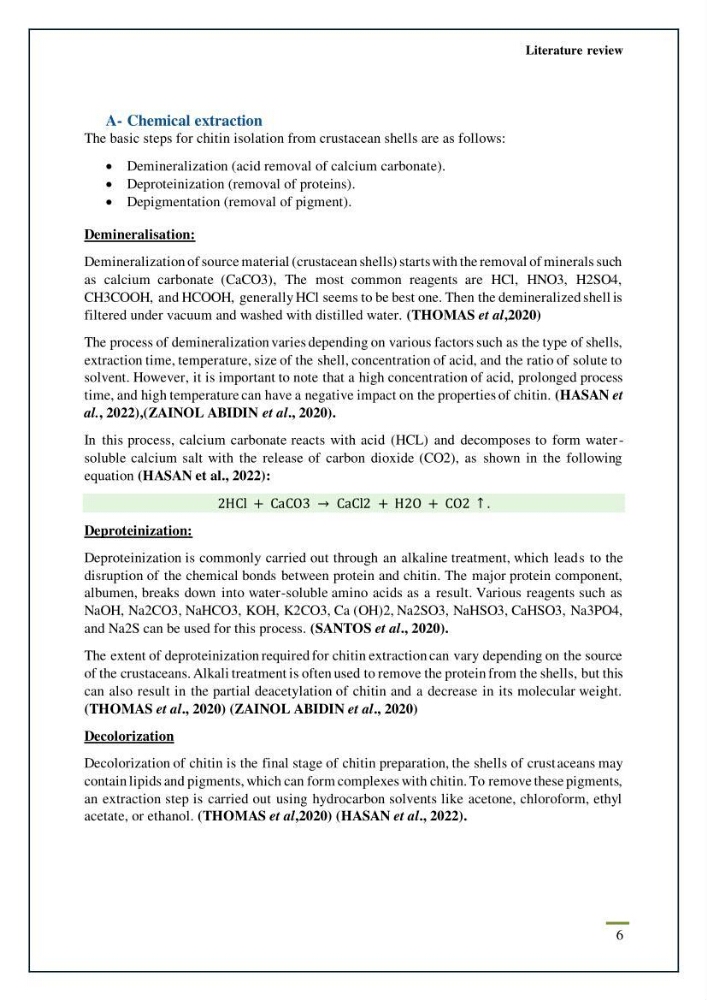
In this process, calcium carbonate reacts with acid (HCL) and decomposes to form water -
soluble calcium salt with the release of carbon dioxide (CO2), as shown in the following
equation (HASAN et al., 2022):
2HCl + CaCO3 → CaCl2 + H2O + CO2 ↑ .
Deproteinization:
Deproteinization is commonly carried out through an alkaline treatment, which leads to the
disruption of the chemical bonds between protein and chitin. The major protein component,
albumen, breaks down into water-soluble amino acids as a result. Various reagents such as
NaOH, Na2CO3, NaHCO3, KOH, K2CO3, Ca (OH)2, Na2SO3, NaHSO3, CaHSO3, Na3PO4,
and Na2S can be used for this process. (SANTOS et al., 2020).
The extent of deproteinization required for chitin extraction can vary depending on the source
of the crustaceans. Alkali treatment is often used to remove the protein from the shells, but this
can also result in the partial deacetylation of chitin and a decrease in its molecular weight.
(THOMAS et al., 2020) (ZAINOL ABIDIN et al., 2020)
Decolorization
Decolorization of chitin is the final stage of chitin preparation, the shells of crust aceans may
contain lipids and pigments, which can form complexes with chitin. To remove these pigments,
an extraction step is carried out using hydrocarbon solvents like acetone, chloroform, ethyl
acetate, or ethanol. (THOMAS et al,2020) (HASAN et al., 2022).
6
A- Chemical extraction
The basic steps for chitin isolation from crustacean shells are as follows:
• Demineralization (acid removal of calcium carbonate).
• Deproteinization (removal of proteins).
• Depigmentation (removal of pigment).
Demineralisation:
Demineralization of source material (crustacean shells) starts with the removal of minerals such
as calcium carbonate (CaCO3), The most common reagents are HCl, HNO3, H2SO4,
CH3COOH, and HCOOH, generally HCl seems to be best one. Then the demineralized shell is
filtered under vacuum and washed with distilled water. (THOMAS et al,2020)
The process of demineralization varies depending on various factors such as the type of shells,
extraction time, temperature, size of the shell, concentration of acid, and the ratio of solute to
solvent. However, it is important to note that a high concentration of acid, prolonged process
time, and high temperature can have a negative impact on the properties of chitin. (HASAN et
al., 2022),(ZAINOL ABIDIN et al., 2020).
In this process, calcium carbonate reacts with acid (HCL) and decomposes to form water -
soluble calcium salt with the release of carbon dioxide (CO2), as shown in the following
equation (HASAN et al., 2022):
2HCl + CaCO3 → CaCl2 + H2O + CO2 ↑ .
Deproteinization:
Deproteinization is commonly carried out through an alkaline treatment, which leads to the
disruption of the chemical bonds between protein and chitin. The major protein component,
albumen, breaks down into water-soluble amino acids as a result. Various reagents such as
NaOH, Na2CO3, NaHCO3, KOH, K2CO3, Ca (OH)2, Na2SO3, NaHSO3, CaHSO3, Na3PO4,
and Na2S can be used for this process. (SANTOS et al., 2020).
The extent of deproteinization required for chitin extraction can vary depending on the source
of the crustaceans. Alkali treatment is often used to remove the protein from the shells, but this
can also result in the partial deacetylation of chitin and a decrease in its molecular weight.
(THOMAS et al., 2020) (ZAINOL ABIDIN et al., 2020)
Decolorization
Decolorization of chitin is the final stage of chitin preparation, the shells of crust aceans may
contain lipids and pigments, which can form complexes with chitin. To remove these pigments,
an extraction step is carried out using hydrocarbon solvents like acetone, chloroform, ethyl
acetate, or ethanol. (THOMAS et al,2020) (HASAN et al., 2022).