

Literature review
5
4. Chitin isolation
The cuticles of various marine crustaceans such as crabs, shrimps, and lobsters, as well as fish
scales, are the major sources for the large-scale production of chitin and chitosan due to the
abundance of low-cost by-products of seafood processing industry (ZAINOL ABIDIN et al.,
2020). These sources contain chitin (15-40%), along with proteins (20-40%) and calcium
carbonate (20-50%) as the two major components. Other minor components include pigments,
lipids, and minerals like metals and salts (THOMAS et al., 2020).
Crustacean shells contain a matrix of protein and chitin that is covalently bonded and
extensively calcified to produce tough shells. Chitin can be extracted from these shells using
either a chemical or a biological (enzymatic) process. However, the biological process requires
a longer reaction time for deproteinization compared to the chemical process, making the
chemical process more suitable for large-scale production of chitin. (HASAN et al., 2022).
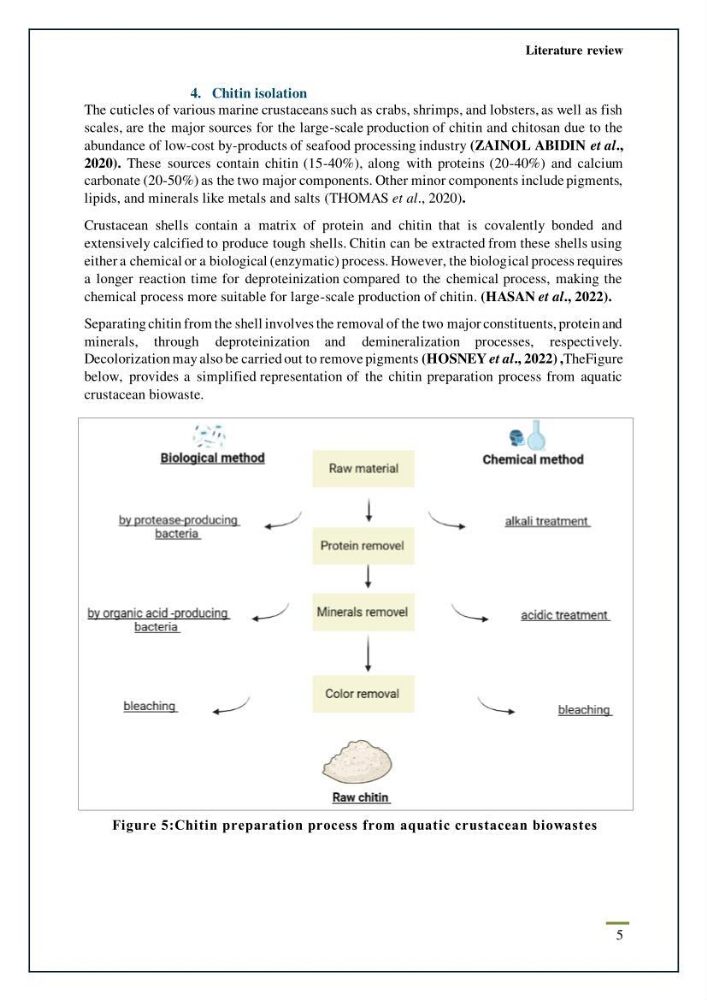
Separating chitin from the shell involves the removal of the two major constituents, protein and
minerals, through deproteinization and demineralization processes, respectively.
Decolorization may also be carried out to remove pigments (HOSNEY et al., 2022) ,TheFigure
below, provides a simplified representation of the chitin preparation process from aquatic
crustacean biowaste.
Figure 5:Chitin preparation process from aquatic crustacean biowastes
5
4. Chitin isolation
The cuticles of various marine crustaceans such as crabs, shrimps, and lobsters, as well as fish
scales, are the major sources for the large-scale production of chitin and chitosan due to the
abundance of low-cost by-products of seafood processing industry (ZAINOL ABIDIN et al.,
2020). These sources contain chitin (15-40%), along with proteins (20-40%) and calcium
carbonate (20-50%) as the two major components. Other minor components include pigments,
lipids, and minerals like metals and salts (THOMAS et al., 2020).
Crustacean shells contain a matrix of protein and chitin that is covalently bonded and
extensively calcified to produce tough shells. Chitin can be extracted from these shells using
either a chemical or a biological (enzymatic) process. However, the biological process requires
a longer reaction time for deproteinization compared to the chemical process, making the
chemical process more suitable for large-scale production of chitin. (HASAN et al., 2022).
Separating chitin from the shell involves the removal of the two major constituents, protein and
minerals, through deproteinization and demineralization processes, respectively.
Decolorization may also be carried out to remove pigments (HOSNEY et al., 2022) ,TheFigure
below, provides a simplified representation of the chitin preparation process from aquatic
crustacean biowaste.
Figure 5:Chitin preparation process from aquatic crustacean biowastes