

Chapter V
Hydraulic Performance
67
V.4. Overtopping
The overtopping discharge is mostly related to the wave run-up, which represent the average
amount of water that is discharged per linear meter by waves over a protection structure (e.g.,
breakwater, dike) whose crest is higher than the still water level (SWL). (Dan S. et al 2020).
usually expressed as a specific discharge per meter run along the crest, q (m³/s per m length or l/s
per m length). (CETMEF, 2009).
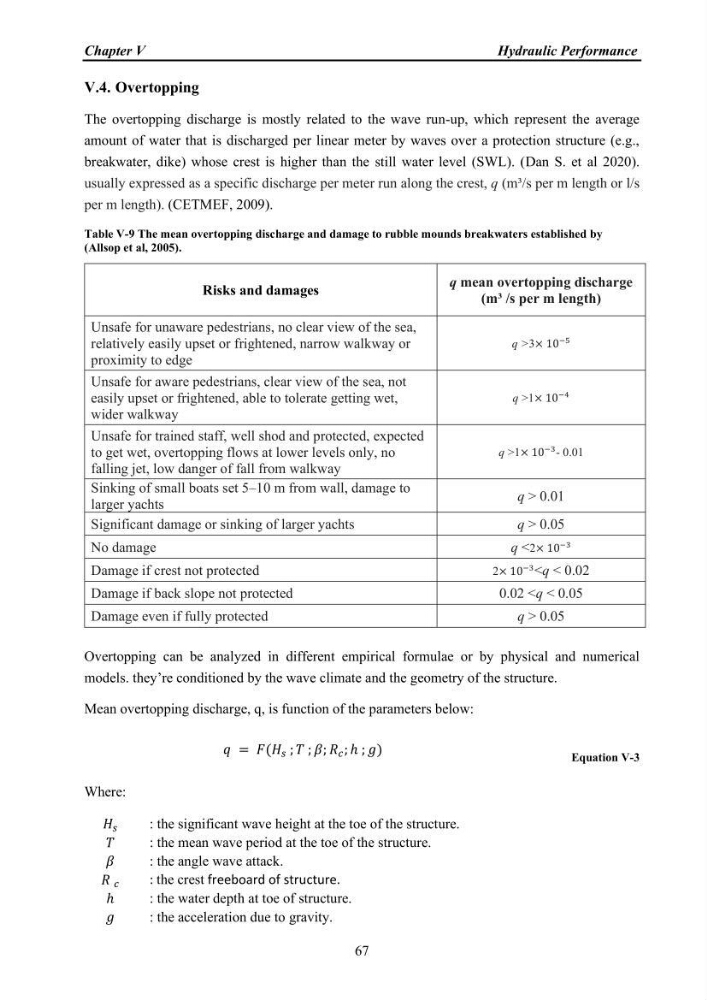
Table V-9 The mean overtopping discharge and damage to rubble mounds breakwaters established by
(Allsop et al, 2005).
Risks and damages
q mean overtopping discharge
(m³ /s per m length)
Unsafe for unaware pedestrians, no clear view of the sea,
relatively easily upset or frightened, narrow walkway or
proximity to edge
q >3× 10
−5
Unsafe for aware pedestrians, clear view of the sea, not
easily upset or frightened, able to tolerate getting wet,
wider walkway
q >1× 10
−4
Unsafe for trained staff, well shod and protected, expected
to get wet, overtopping flows at lower levels only, no
falling jet, low danger of fall from walkway
q >1× 10
−3
- 0.01
Sinking of small boats set 5–10 m from wall, damage to
larger yachts
q > 0.01
Significant damage or sinking of larger yachts
q > 0.05
No damage
q <2× 10
−3
Damage if crest not protected
2× 10
−3
Damage if back slope not protected
0.02 Damage even if fully protected
q > 0.05
Overtopping can be analyzed in different empirical formulae or by physical and numerical
models. they’re conditioned by the wave climate and the geometry of the structure.
Mean overtopping discharge, q, is function of the parameters below:
í µí± = í µí°¹(í µí°» í µí± ; í µí± ; í µí»½; í µí± í µí± ; ℎ ; í µí±)
Equation V-3
Where:
í µí°» í µí±
: the significant wave height at the toe of the structure.
í µí±
: the mean wave period at the toe of the structure.
í µí»½
: the angle wave attack.
í µí± í µí±
: the crest freeboard of structure.
ℎ
: the water depth at toe of structure.
í µí±
: the acceleration due to gravity.
Hydraulic Performance
67
V.4. Overtopping
The overtopping discharge is mostly related to the wave run-up, which represent the average
amount of water that is discharged per linear meter by waves over a protection structure (e.g.,
breakwater, dike) whose crest is higher than the still water level (SWL). (Dan S. et al 2020).
usually expressed as a specific discharge per meter run along the crest, q (m³/s per m length or l/s
per m length). (CETMEF, 2009).
Table V-9 The mean overtopping discharge and damage to rubble mounds breakwaters established by
(Allsop et al, 2005).
Risks and damages
q mean overtopping discharge
(m³ /s per m length)
Unsafe for unaware pedestrians, no clear view of the sea,
relatively easily upset or frightened, narrow walkway or
proximity to edge
q >3× 10
−5
Unsafe for aware pedestrians, clear view of the sea, not
easily upset or frightened, able to tolerate getting wet,
wider walkway
q >1× 10
−4
Unsafe for trained staff, well shod and protected, expected
to get wet, overtopping flows at lower levels only, no
falling jet, low danger of fall from walkway
q >1× 10
−3
- 0.01
Sinking of small boats set 5–10 m from wall, damage to
larger yachts
q > 0.01
Significant damage or sinking of larger yachts
q > 0.05
No damage
q <2× 10
−3
Damage if crest not protected
2× 10
−3
Damage if back slope not protected
0.02 Damage even if fully protected
q > 0.05
Overtopping can be analyzed in different empirical formulae or by physical and numerical
models. they’re conditioned by the wave climate and the geometry of the structure.
Mean overtopping discharge, q, is function of the parameters below:
í µí± = í µí°¹(í µí°» í µí± ; í µí± ; í µí»½; í µí± í µí± ; ℎ ; í µí±)
Equation V-3
Where:
í µí°» í µí±
: the significant wave height at the toe of the structure.
í µí±
: the mean wave period at the toe of the structure.
í µí»½
: the angle wave attack.
í µí± í µí±
: the crest freeboard of structure.
ℎ
: the water depth at toe of structure.
í µí±
: the acceleration due to gravity.