

Chapter V
Hydraulic Performance
63
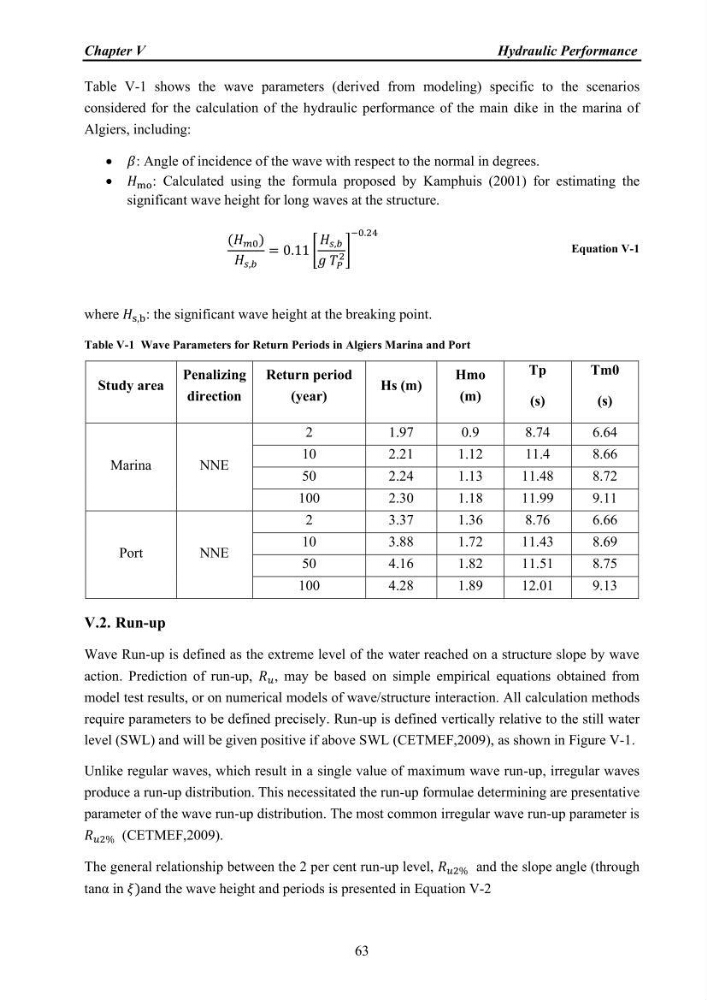
Table V-1 shows the wave parameters (derived from modeling) specific to the scenarios
considered for the calculation of the hydraulic performance of the main dike in the marina of
Algiers, including:
• í µí»½: Angle of incidence of the wave with respect to the normal in degrees.
• í µí°» mo : Calculated using the formula proposed by Kamphuis (2001) for estimating the
significant wave height for long waves at the structure.
(í µí°» í µí±0 )
í µí°» í µí± ,í µí±
= 0.11 [
í µí°» í µí± ,í µí±
í µí± í µí± í µí±
2 ]
−0.24
Equation V-1
where í µí°» s,b : the significant wave height at the breaking point.
Table V-1 Wave Parameters for Return Periods in Algiers Marina and Port
Study area
Penalizing
direction
Return period
(year)
Hs (m)
Hmo
(m)
Tp
(s)
Tm0
(s)
Marina
NNE
2
1.97
0.9
8.74
6.64
10
2.21
1.12
11.4
8.66
50
2.24
1.13
11.48
8.72
100
2.30
1.18
11.99
9.11
Port
NNE
2
3.37
1.36
8.76
6.66
10
3.88
1.72
11.43
8.69
50
4.16
1.82
11.51
8.75
100
4.28
1.89
12.01
9.13
V.2. Run-up
Wave Run-up is defined as the extreme level of the water reached on a structure slope by wave
action. Prediction of run-up, í µí± í µí±¢ , may be based on simple empirical equations obtained from
model test results, or on numerical models of wave/structure interaction. All calculation methods
require parameters to be defined precisely. Run-up is defined vertically relative to the still water
level (SWL) and will be given positive if above SWL (CETMEF,2009), as shown in Figure V-1.
Unlike regular waves, which result in a single value of maximum wave run-up, irregular waves
produce a run-up distribution. This necessitated the run-up formulae determining are presentative
parameter of the wave run-up distribution. The most common irregular wave run-up parameter is
í µí± í µí±¢2% (CETMEF,2009).
The general relationship between the 2 per cent run-up level, í µí± í µí±¢2% and the slope angle (through
tanα in í µí¼)and the wave height and periods is presented in Equation V-2
Hydraulic Performance
63
Table V-1 shows the wave parameters (derived from modeling) specific to the scenarios
considered for the calculation of the hydraulic performance of the main dike in the marina of
Algiers, including:
• í µí»½: Angle of incidence of the wave with respect to the normal in degrees.
• í µí°» mo : Calculated using the formula proposed by Kamphuis (2001) for estimating the
significant wave height for long waves at the structure.
(í µí°» í µí±0 )
í µí°» í µí± ,í µí±
= 0.11 [
í µí°» í µí± ,í µí±
í µí± í µí± í µí±
2 ]
−0.24
Equation V-1
where í µí°» s,b : the significant wave height at the breaking point.
Table V-1 Wave Parameters for Return Periods in Algiers Marina and Port
Study area
Penalizing
direction
Return period
(year)
Hs (m)
Hmo
(m)
Tp
(s)
Tm0
(s)
Marina
NNE
2
1.97
0.9
8.74
6.64
10
2.21
1.12
11.4
8.66
50
2.24
1.13
11.48
8.72
100
2.30
1.18
11.99
9.11
Port
NNE
2
3.37
1.36
8.76
6.66
10
3.88
1.72
11.43
8.69
50
4.16
1.82
11.51
8.75
100
4.28
1.89
12.01
9.13
V.2. Run-up
Wave Run-up is defined as the extreme level of the water reached on a structure slope by wave
action. Prediction of run-up, í µí± í µí±¢ , may be based on simple empirical equations obtained from
model test results, or on numerical models of wave/structure interaction. All calculation methods
require parameters to be defined precisely. Run-up is defined vertically relative to the still water
level (SWL) and will be given positive if above SWL (CETMEF,2009), as shown in Figure V-1.
Unlike regular waves, which result in a single value of maximum wave run-up, irregular waves
produce a run-up distribution. This necessitated the run-up formulae determining are presentative
parameter of the wave run-up distribution. The most common irregular wave run-up parameter is
í µí± í µí±¢2% (CETMEF,2009).
The general relationship between the 2 per cent run-up level, í µí± í µí±¢2% and the slope angle (through
tanα in í µí¼)and the wave height and periods is presented in Equation V-2