

Chapter IV
Design of rubble mounds breakwater
54
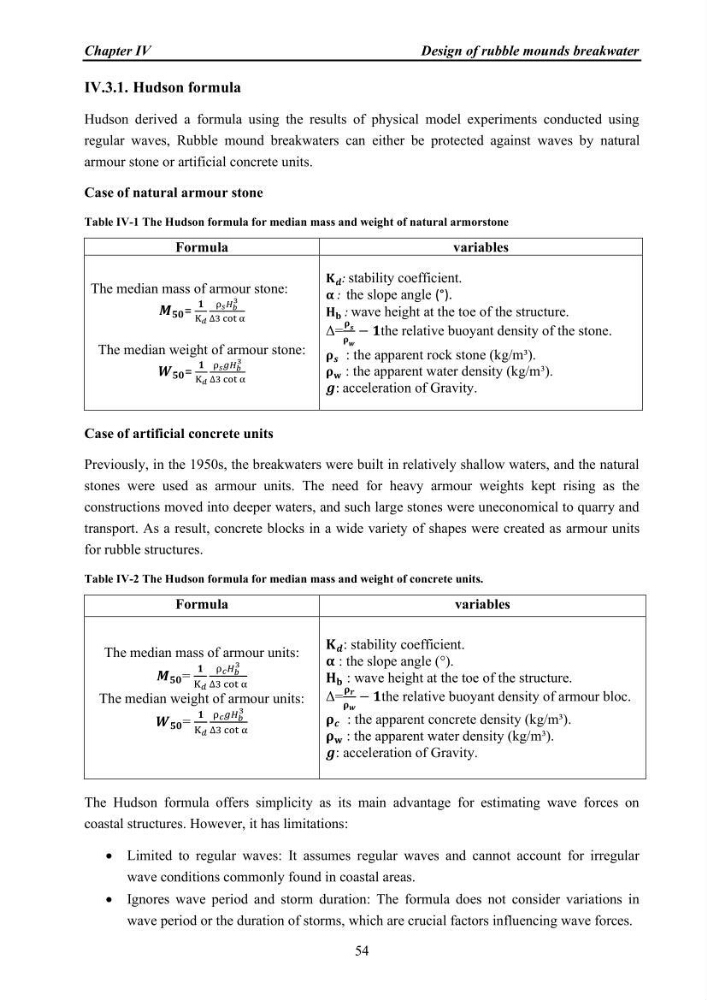
IV.3.1. Hudson formula
Hudson derived a formula using the results of physical model experiments conducted using
regular waves, Rubble mound breakwaters can either be protected against waves by natural
armour stone or artificial concrete units.
Case of natural armour stone
Table IV-1 The Hudson formula for median mass and weight of natural armorstone
Formula
variables
The median mass of armour stone:
í µí±´ í µí¿í µí¿ =
í µí¿
K í µí±
ρ í µí± í µí°» í µí±
3
∆3 cot α
The median weight of armour stone:
í µí±¾ í µí¿í µí¿ =
í µí¿
K í µí±
ρ í µí± í µí±í µí°» í µí±
3
∆3 cot α
í µí° í µí² : stability coefficient.
í µí» : the slope angle (°).
í µí° í µí° : wave height at the toe of the structure.
Δ=
í µí» í µí²
í µí» í µí²
− í µí¿the relative buoyant density of the stone.
í µí» í µí² : the apparent rock stone (kg/m³).
í µí» í µí°° : the apparent water density (kg/m³).
í µí²: acceleration of Gravity.
Case of artificial concrete units
Previously, in the 1950s, the breakwaters were built in relatively shallow waters, and the natural
stones were used as armour units. The need for heavy armour weights kept rising as the
constructions moved into deeper waters, and such large stones were uneconomical to quarry and
transport. As a result, concrete blocks in a wide variety of shapes were created as armour units
for rubble structures.
Table IV-2 The Hudson formula for median mass and weight of concrete units.
Formula
variables
The median mass of armour units:
í µí±´ í µí¿í µí¿ =
í µí¿
K í µí±
ρ í µí± í µí°» í µí±
3
∆3 cot α
The median weight of armour units:
í µí±¾ í µí¿í µí¿ =
í µí¿
K í µí±
ρ í µí± í µí±í µí°» í µí±
3
∆3 cot α
í µí° í µí² : stability coefficient.
í µí» : the slope angle (°).
í µí° í µí° : wave height at the toe of the structure.
Δ=
í µí» í µí²
í µí» í µí²
− í µí¿the relative buoyant density of armour bloc.
í µí» í µí² : the apparent concrete density (kg/m³).
í µí» í µí°° : the apparent water density (kg/m³).
í µí²: acceleration of Gravity.
The Hudson formula offers simplicity as its main advantage for estimating wave forces on
coastal structures. However, it has limitations:
• Limited to regular waves: It assumes regular waves and cannot account for irregular
wave conditions commonly found in coastal areas.
• Ignores wave period and storm duration: The formula does not consider variations in
wave period or the duration of storms, which are crucial factors influencing wave forces.
Design of rubble mounds breakwater
54
IV.3.1. Hudson formula
Hudson derived a formula using the results of physical model experiments conducted using
regular waves, Rubble mound breakwaters can either be protected against waves by natural
armour stone or artificial concrete units.
Case of natural armour stone
Table IV-1 The Hudson formula for median mass and weight of natural armorstone
Formula
variables
The median mass of armour stone:
í µí±´ í µí¿í µí¿ =
í µí¿
K í µí±
ρ í µí± í µí°» í µí±
3
∆3 cot α
The median weight of armour stone:
í µí±¾ í µí¿í µí¿ =
í µí¿
K í µí±
ρ í µí± í µí±í µí°» í µí±
3
∆3 cot α
í µí° í µí² : stability coefficient.
í µí» : the slope angle (°).
í µí° í µí° : wave height at the toe of the structure.
Δ=
í µí» í µí²
í µí» í µí²
− í µí¿the relative buoyant density of the stone.
í µí» í µí² : the apparent rock stone (kg/m³).
í µí» í µí°° : the apparent water density (kg/m³).
í µí²: acceleration of Gravity.
Case of artificial concrete units
Previously, in the 1950s, the breakwaters were built in relatively shallow waters, and the natural
stones were used as armour units. The need for heavy armour weights kept rising as the
constructions moved into deeper waters, and such large stones were uneconomical to quarry and
transport. As a result, concrete blocks in a wide variety of shapes were created as armour units
for rubble structures.
Table IV-2 The Hudson formula for median mass and weight of concrete units.
Formula
variables
The median mass of armour units:
í µí±´ í µí¿í µí¿ =
í µí¿
K í µí±
ρ í µí± í µí°» í µí±
3
∆3 cot α
The median weight of armour units:
í µí±¾ í µí¿í µí¿ =
í µí¿
K í µí±
ρ í µí± í µí±í µí°» í µí±
3
∆3 cot α
í µí° í µí² : stability coefficient.
í µí» : the slope angle (°).
í µí° í µí° : wave height at the toe of the structure.
Δ=
í µí» í µí²
í µí» í µí²
− í µí¿the relative buoyant density of armour bloc.
í µí» í µí² : the apparent concrete density (kg/m³).
í µí» í µí°° : the apparent water density (kg/m³).
í µí²: acceleration of Gravity.
The Hudson formula offers simplicity as its main advantage for estimating wave forces on
coastal structures. However, it has limitations:
• Limited to regular waves: It assumes regular waves and cannot account for irregular
wave conditions commonly found in coastal areas.
• Ignores wave period and storm duration: The formula does not consider variations in
wave period or the duration of storms, which are crucial factors influencing wave forces.