

Chapter III
Numerical Modeling
30
characteristics. With its flexible non-structured mesh grid, MIKE 21 SW offers precise
calculations and considers dissipations due to wave breaking and nonlinear interactions.
The model typically necessitates the following inputs:
• Digitized bathymetry: Essential model parameters that outline the model's scope, such as
the dimensions of the modeled area, the grid spacing on the computational grid, the time
step, and the simulation duration.
• Boundary conditions: The model requires a spectral formulation as an initial condition,
along with specific wave parameters (Significant wave height (í µí°» í µí± ), Peak period (í µí± í µí± ),
Wave direction, and Directional spreading) that need to be provided for all open
boundaries.
Shallow water equations
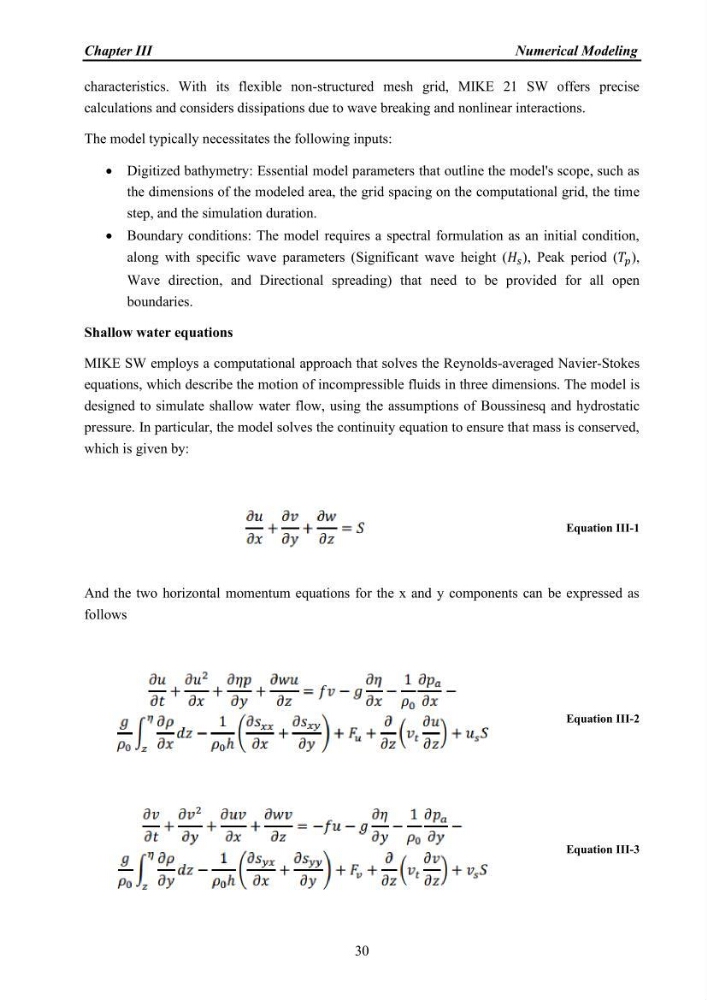
MIKE SW employs a computational approach that solves the Reynolds-averaged Navier-Stokes
equations, which describe the motion of incompressible fluids in three dimensions. The model is
designed to simulate shallow water flow, using the assumptions of Boussinesq and hydrostatic
pressure. In particular, the model solves the continuity equation to ensure that mass is conserved,
which is given by:
Equation III-1
And the two horizontal momentum equations for the x and y components can be expressed as
follows
Equation III-2
Equation III-3
Numerical Modeling
30
characteristics. With its flexible non-structured mesh grid, MIKE 21 SW offers precise
calculations and considers dissipations due to wave breaking and nonlinear interactions.
The model typically necessitates the following inputs:
• Digitized bathymetry: Essential model parameters that outline the model's scope, such as
the dimensions of the modeled area, the grid spacing on the computational grid, the time
step, and the simulation duration.
• Boundary conditions: The model requires a spectral formulation as an initial condition,
along with specific wave parameters (Significant wave height (í µí°» í µí± ), Peak period (í µí± í µí± ),
Wave direction, and Directional spreading) that need to be provided for all open
boundaries.
Shallow water equations
MIKE SW employs a computational approach that solves the Reynolds-averaged Navier-Stokes
equations, which describe the motion of incompressible fluids in three dimensions. The model is
designed to simulate shallow water flow, using the assumptions of Boussinesq and hydrostatic
pressure. In particular, the model solves the continuity equation to ensure that mass is conserved,
which is given by:
Equation III-1
And the two horizontal momentum equations for the x and y components can be expressed as
follows
Equation III-2
Equation III-3