

Chapter I
Climatological data for the study area
7
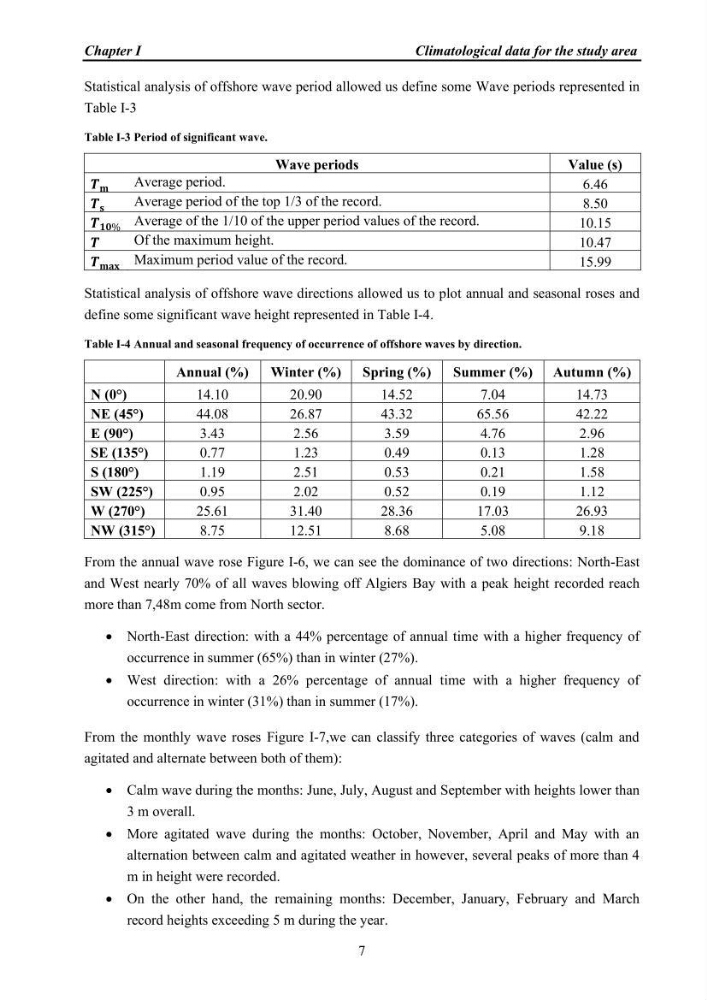
Statistical analysis of offshore wave period allowed us define some Wave periods represented in
Table I-3
Table I-3 Period of significant wave.
Wave periods
Value (s)
í µí±» í µí°¦
Average period.
6.46
í µí±» í µí°Average period of the top 1/3 of the record.
8.50
í µí±» í µí¿í µí¿% Average of the 1/10 of the upper period values of the record.
10.15
í µí±»
Of the maximum height.
10.47
í µí±» í µí°¦í µí°í µí°± Maximum period value of the record.
15.99
Statistical analysis of offshore wave directions allowed us to plot annual and seasonal roses and
define some significant wave height represented in Table I-4.
Table I-4 Annual and seasonal frequency of occurrence of offshore waves by direction.
Annual (%)
Winter (%) Spring (%)
Summer (%) Autumn (%)
N (0°)
14.10
20.90
14.52
7.04
14.73
NE (45°)
44.08
26.87
43.32
65.56
42.22
E (90°)
3.43
2.56
3.59
4.76
2.96
SE (135°)
0.77
1.23
0.49
0.13
1.28
S (180°)
1.19
2.51
0.53
0.21
1.58
SW (225°)
0.95
2.02
0.52
0.19
1.12
W (270°)
25.61
31.40
28.36
17.03
26.93
NW (315°)
8.75
12.51
8.68
5.08
9.18
From the annual wave rose Figure I-6, we can see the dominance of two directions: North-East
and West nearly 70% of all waves blowing off Algiers Bay with a peak height recorded reach
more than 7,48m come from North sector.
• North-East direction: with a 44% percentage of annual time with a higher frequency of
occurrence in summer (65%) than in winter (27%).
• West direction: with a 26% percentage of annual time with a higher frequency of
occurrence in winter (31%) than in summer (17%).
From the monthly wave roses Figure I-7,we can classify three categories of waves (calm and
agitated and alternate between both of them):
• Calm wave during the months: June, July, August and September with heights lower than
3 m overall.
• More agitated wave during the months: October, November, April and May with an
alternation between calm and agitated weather in however, several peaks of more than 4
m in height were recorded.
• On the other hand, the remaining months: December, January, February and March
record heights exceeding 5 m during the year.
Climatological data for the study area
7
Statistical analysis of offshore wave period allowed us define some Wave periods represented in
Table I-3
Table I-3 Period of significant wave.
Wave periods
Value (s)
í µí±» í µí°¦
Average period.
6.46
í µí±» í µí°Average period of the top 1/3 of the record.
8.50
í µí±» í µí¿í µí¿% Average of the 1/10 of the upper period values of the record.
10.15
í µí±»
Of the maximum height.
10.47
í µí±» í µí°¦í µí°í µí°± Maximum period value of the record.
15.99
Statistical analysis of offshore wave directions allowed us to plot annual and seasonal roses and
define some significant wave height represented in Table I-4.
Table I-4 Annual and seasonal frequency of occurrence of offshore waves by direction.
Annual (%)
Winter (%) Spring (%)
Summer (%) Autumn (%)
N (0°)
14.10
20.90
14.52
7.04
14.73
NE (45°)
44.08
26.87
43.32
65.56
42.22
E (90°)
3.43
2.56
3.59
4.76
2.96
SE (135°)
0.77
1.23
0.49
0.13
1.28
S (180°)
1.19
2.51
0.53
0.21
1.58
SW (225°)
0.95
2.02
0.52
0.19
1.12
W (270°)
25.61
31.40
28.36
17.03
26.93
NW (315°)
8.75
12.51
8.68
5.08
9.18
From the annual wave rose Figure I-6, we can see the dominance of two directions: North-East
and West nearly 70% of all waves blowing off Algiers Bay with a peak height recorded reach
more than 7,48m come from North sector.
• North-East direction: with a 44% percentage of annual time with a higher frequency of
occurrence in summer (65%) than in winter (27%).
• West direction: with a 26% percentage of annual time with a higher frequency of
occurrence in winter (31%) than in summer (17%).
From the monthly wave roses Figure I-7,we can classify three categories of waves (calm and
agitated and alternate between both of them):
• Calm wave during the months: June, July, August and September with heights lower than
3 m overall.
• More agitated wave during the months: October, November, April and May with an
alternation between calm and agitated weather in however, several peaks of more than 4
m in height were recorded.
• On the other hand, the remaining months: December, January, February and March
record heights exceeding 5 m during the year.