

77
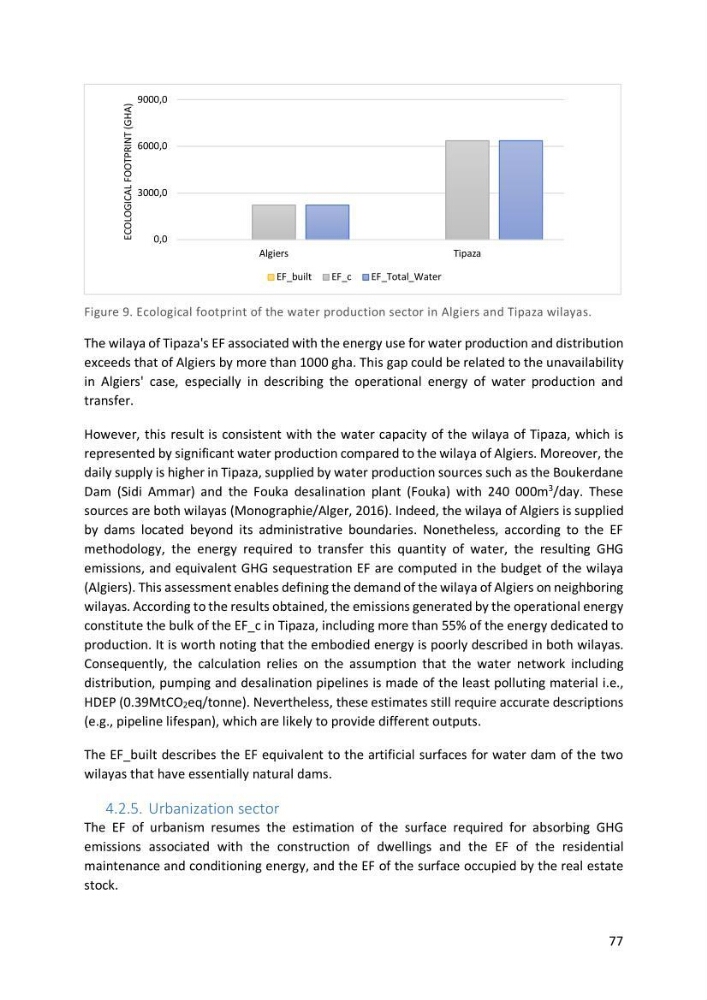
The wilaya of Tipaza's EF associated with the energy use for water production and distribution
exceeds that of Algiers by more than 1000 gha. This gap could be related to the unavailability
in Algiers' case, especially in describing the operational energy of water production and
transfer.
However, this result is consistent with the water capacity of the wilaya of Tipaza, which is
represented by significant water production compared to the wilaya of Algiers. Moreover, the
daily supply is higher in Tipaza, supplied by water production sources such as the Boukerdane
Dam (Sidi Ammar) and the Fouka desalination plant (Fouka) with 240 000m
3
/day. These
sources are both wilayas (Monographie/Alger, 2016). Indeed, the wilaya of Algiers is supplied
by dams located beyond its administrative boundaries. Nonetheless, according to the EF
methodology, the energy required to transfer this quantity of water, the resulting GHG
emissions, and equivalent GHG sequestration EF are computed in the budget of the wilaya
(Algiers). This assessment enables defining the demand of the wilaya of Algiers on neighboring
wilayas. According to the results obtained, the emissions generated by the operational energy
constitute the bulk of the EF_c in Tipaza, including more than 55% of the energy dedicated to
production. It is worth noting that the embodied energy is poorly described in both wilayas.
Consequently, the calculation relies on the assumption that the water network including
distribution, pumping and desalination pipelines is made of the least polluting material i.e.,
HDEP (0.39MtCO2eq/tonne). Nevertheless, these estimates still require accurate descriptions
(e.g., pipeline lifespan), which are likely to provide different outputs.
The EF_built describes the EF equivalent to the artificial surfaces for water dam of the two
wilayas that have essentially natural dams.
4.2.5. Urbanization sector
The EF of urbanism resumes the estimation of the surface required for absorbing GHG
emissions associated with the construction of dwellings and the EF of the residential
maintenance and conditioning energy, and the EF of the surface occupied by the real estate
stock.
Figure 9. Ecological footprint of the water production sector in Algiers and Tipaza wilayas.
0,0
3000,0
6000,0
9000,0
Algiers
Tipaza
ECOLOGICAL FOOTPRINT (GHA)
EF_built
EF_c
EF_Total_Water
The wilaya of Tipaza's EF associated with the energy use for water production and distribution
exceeds that of Algiers by more than 1000 gha. This gap could be related to the unavailability
in Algiers' case, especially in describing the operational energy of water production and
transfer.
However, this result is consistent with the water capacity of the wilaya of Tipaza, which is
represented by significant water production compared to the wilaya of Algiers. Moreover, the
daily supply is higher in Tipaza, supplied by water production sources such as the Boukerdane
Dam (Sidi Ammar) and the Fouka desalination plant (Fouka) with 240 000m
3
/day. These
sources are both wilayas (Monographie/Alger, 2016). Indeed, the wilaya of Algiers is supplied
by dams located beyond its administrative boundaries. Nonetheless, according to the EF
methodology, the energy required to transfer this quantity of water, the resulting GHG
emissions, and equivalent GHG sequestration EF are computed in the budget of the wilaya
(Algiers). This assessment enables defining the demand of the wilaya of Algiers on neighboring
wilayas. According to the results obtained, the emissions generated by the operational energy
constitute the bulk of the EF_c in Tipaza, including more than 55% of the energy dedicated to
production. It is worth noting that the embodied energy is poorly described in both wilayas.
Consequently, the calculation relies on the assumption that the water network including
distribution, pumping and desalination pipelines is made of the least polluting material i.e.,
HDEP (0.39MtCO2eq/tonne). Nevertheless, these estimates still require accurate descriptions
(e.g., pipeline lifespan), which are likely to provide different outputs.
The EF_built describes the EF equivalent to the artificial surfaces for water dam of the two
wilayas that have essentially natural dams.
4.2.5. Urbanization sector
The EF of urbanism resumes the estimation of the surface required for absorbing GHG
emissions associated with the construction of dwellings and the EF of the residential
maintenance and conditioning energy, and the EF of the surface occupied by the real estate
stock.
Figure 9. Ecological footprint of the water production sector in Algiers and Tipaza wilayas.
0,0
3000,0
6000,0
9000,0
Algiers
Tipaza
ECOLOGICAL FOOTPRINT (GHA)
EF_built
EF_c
EF_Total_Water