

73
Livestock
38833 65879 Head
34
1.3*10
4
1.5*10
4
Operational
Energy
Fuel
consumption
421.8 298.6 Liters
34153.5 45492.9 1.1*10
4
1.5*10
4
Embodied
Energy
Fertilizers
12
48 10
3
Tonnes
8.82*10
3
1.77*10
4
2.9*10
3
5.9*10
3
Total Energy
42975.8 63239.9 1.4*10
4
2.1*10
4
Built land
2.83 17.27 Ha
2.63
16.1
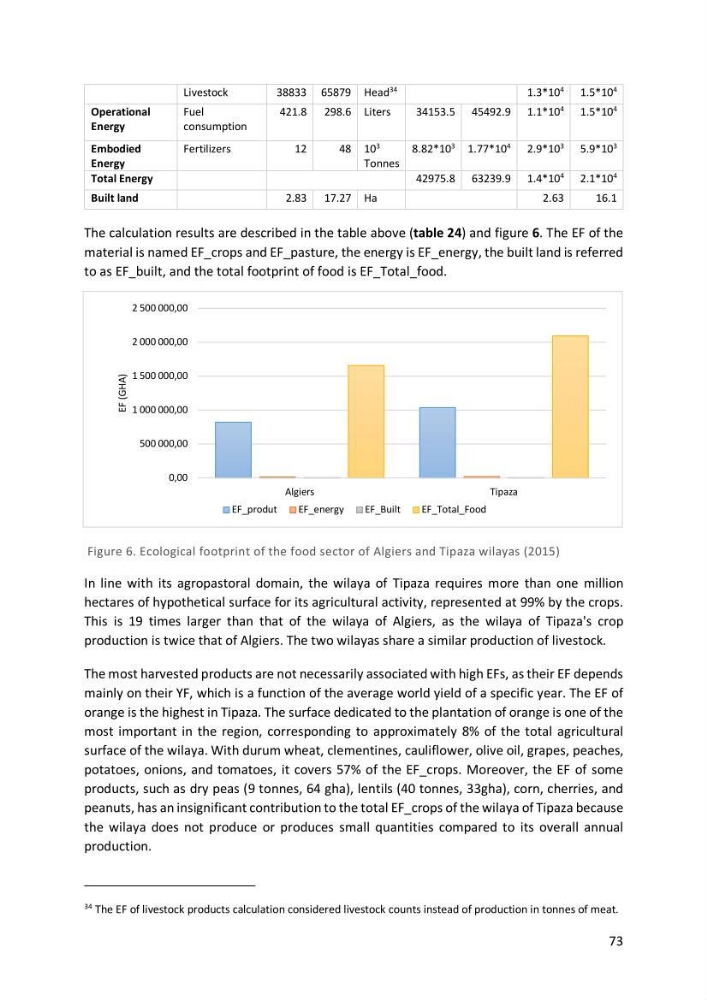
The calculation results are described in the table above (table 24) and figure 6. The EF of the
material is named EF_crops and EF_pasture, the energy is EF_energy, the built land is referred
to as EF_built, and the total footprint of food is EF_Total_food.
In line with its agropastoral domain, the wilaya of Tipaza requires more than one million
hectares of hypothetical surface for its agricultural activity, represented at 99% by the crops.
This is 19 times larger than that of the wilaya of Algiers, as the wilaya of Tipaza's crop
production is twice that of Algiers. The two wilayas share a similar production of livestock.
The most harvested products are not necessarily associated with high EFs, as their EF depends
mainly on their YF, which is a function of the average world yield of a specific year. The EF of
orange is the highest in Tipaza. The surface dedicated to the plantation of orange is one of the
most important in the region, corresponding to approximately 8% of the total agricultural
surface of the wilaya. With durum wheat, clementines, cauliflower, olive oil, grapes, peaches,
potatoes, onions, and tomatoes, it covers 57% of the EF_crops. Moreover, the EF of some
products, such as dry peas (9 tonnes, 64 gha), lentils (40 tonnes, 33gha), corn, cherries, and
peanuts, has an insignificant contribution to the total EF_crops of the wilaya of Tipaza because
the wilaya does not produce or produces small quantities compared to its overall annual
production.
34
The EF of livestock products calculation considered livestock counts instead of production in tonnes of meat.
0,00
500 000,00
1 000 000,00
1 500 000,00
2 000 000,00
2 500 000,00
Algiers
Tipaza
EF (GHA)
EF_produt
EF_energy
EF_Built
EF_Total_Food
Figure 6. Ecological footprint of the food sector of Algiers and Tipaza wilayas (2015)
Livestock
38833 65879 Head
34
1.3*10
4
1.5*10
4
Operational
Energy
Fuel
consumption
421.8 298.6 Liters
34153.5 45492.9 1.1*10
4
1.5*10
4
Embodied
Energy
Fertilizers
12
48 10
3
Tonnes
8.82*10
3
1.77*10
4
2.9*10
3
5.9*10
3
Total Energy
42975.8 63239.9 1.4*10
4
2.1*10
4
Built land
2.83 17.27 Ha
2.63
16.1
The calculation results are described in the table above (table 24) and figure 6. The EF of the
material is named EF_crops and EF_pasture, the energy is EF_energy, the built land is referred
to as EF_built, and the total footprint of food is EF_Total_food.
In line with its agropastoral domain, the wilaya of Tipaza requires more than one million
hectares of hypothetical surface for its agricultural activity, represented at 99% by the crops.
This is 19 times larger than that of the wilaya of Algiers, as the wilaya of Tipaza's crop
production is twice that of Algiers. The two wilayas share a similar production of livestock.
The most harvested products are not necessarily associated with high EFs, as their EF depends
mainly on their YF, which is a function of the average world yield of a specific year. The EF of
orange is the highest in Tipaza. The surface dedicated to the plantation of orange is one of the
most important in the region, corresponding to approximately 8% of the total agricultural
surface of the wilaya. With durum wheat, clementines, cauliflower, olive oil, grapes, peaches,
potatoes, onions, and tomatoes, it covers 57% of the EF_crops. Moreover, the EF of some
products, such as dry peas (9 tonnes, 64 gha), lentils (40 tonnes, 33gha), corn, cherries, and
peanuts, has an insignificant contribution to the total EF_crops of the wilaya of Tipaza because
the wilaya does not produce or produces small quantities compared to its overall annual
production.
34
The EF of livestock products calculation considered livestock counts instead of production in tonnes of meat.
0,00
500 000,00
1 000 000,00
1 500 000,00
2 000 000,00
2 500 000,00
Algiers
Tipaza
EF (GHA)
EF_produt
EF_energy
EF_Built
EF_Total_Food
Figure 6. Ecological footprint of the food sector of Algiers and Tipaza wilayas (2015)