

25
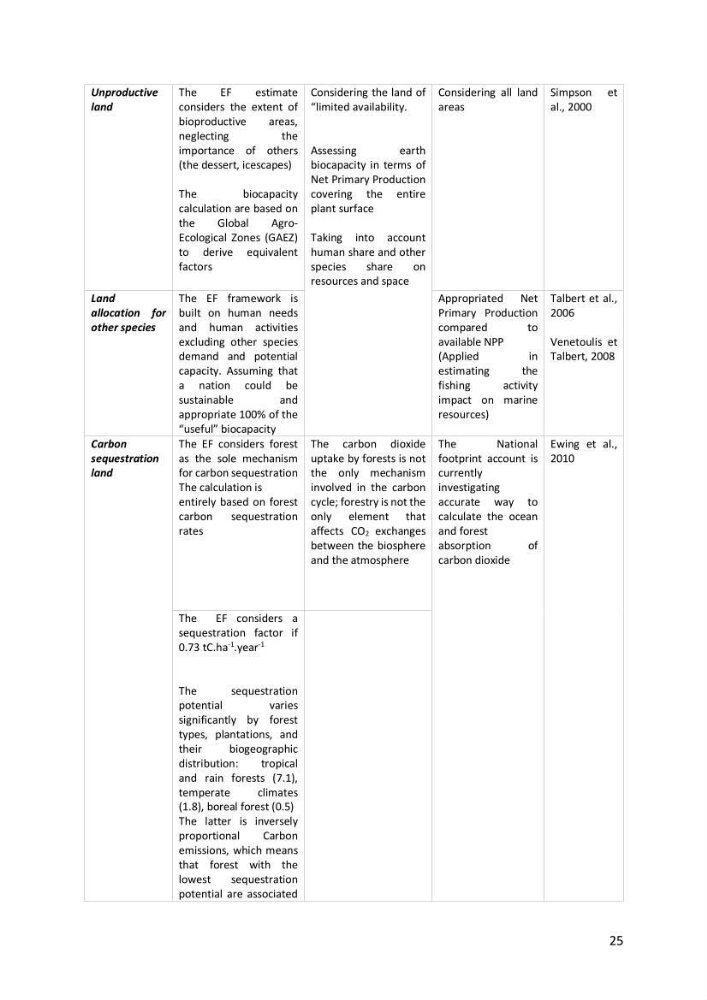
Unproductive
land
The
EF
estimate
considers the extent of
bioproductive
areas,
neglecting
the
importance of others
(the dessert, icescapes)
The
biocapacity
calculation are based on
the
Global
AgroEcological Zones (GAEZ)
to derive equivalent
factors
Considering the land of
“limited availability.
Assessing
earth
biocapacity in terms of
Net Primary Production
covering the entire
plant surface
Taking into account
human share and other
species
share
on
resources and space
Considering all land
areas
Simpson et
al., 2000
Land
allocation for
other species
The EF framework is
built on human needs
and human activities
excluding other species
demand and potential
capacity. Assuming that
a nation could be
sustainable
and
appropriate 100% of the
“useful” biocapacity
Appropriated Net
Primary Production
compared
to
available NPP
(Applied
in
estimating
the
fishing
activity
impact on marine
resources)
Talbert et al.,
2006
Venetoulis et
Talbert, 2008
Carbon
sequestration
land
The EF considers forest
as the sole mechanism
for carbon sequestration
The calculation is
entirely based on forest
carbon
sequestration
rates
The carbon dioxide
uptake by forests is not
the only mechanism
involved in the carbon
cycle; forestry is not the
only element that
affects CO2 exchanges
between the biosphere
and the atmosphere
The
National
footprint account is
currently
investigating
accurate way to
calculate the ocean
and forest
absorption
of
carbon dioxide
Ewing et al.,
2010
The
EF considers a
sequestration factor if
0.73 tC.ha
-1
.year
-1
The
sequestration
potential
varies
significantly by forest
types, plantations, and
their
biogeographic
distribution:
tropical
and rain forests (7.1),
temperate
climates
(1.8), boreal forest (0.5)
The latter is inversely
proportional
Carbon
emissions, which means
that forest with the
lowest
sequestration
potential are associated
Unproductive
land
The
EF
estimate
considers the extent of
bioproductive
areas,
neglecting
the
importance of others
(the dessert, icescapes)
The
biocapacity
calculation are based on
the
Global
AgroEcological Zones (GAEZ)
to derive equivalent
factors
Considering the land of
“limited availability.
Assessing
earth
biocapacity in terms of
Net Primary Production
covering the entire
plant surface
Taking into account
human share and other
species
share
on
resources and space
Considering all land
areas
Simpson et
al., 2000
Land
allocation for
other species
The EF framework is
built on human needs
and human activities
excluding other species
demand and potential
capacity. Assuming that
a nation could be
sustainable
and
appropriate 100% of the
“useful” biocapacity
Appropriated Net
Primary Production
compared
to
available NPP
(Applied
in
estimating
the
fishing
activity
impact on marine
resources)
Talbert et al.,
2006
Venetoulis et
Talbert, 2008
Carbon
sequestration
land
The EF considers forest
as the sole mechanism
for carbon sequestration
The calculation is
entirely based on forest
carbon
sequestration
rates
The carbon dioxide
uptake by forests is not
the only mechanism
involved in the carbon
cycle; forestry is not the
only element that
affects CO2 exchanges
between the biosphere
and the atmosphere
The
National
footprint account is
currently
investigating
accurate way to
calculate the ocean
and forest
absorption
of
carbon dioxide
Ewing et al.,
2010
The
EF considers a
sequestration factor if
0.73 tC.ha
-1
.year
-1
The
sequestration
potential
varies
significantly by forest
types, plantations, and
their
biogeographic
distribution:
tropical
and rain forests (7.1),
temperate
climates
(1.8), boreal forest (0.5)
The latter is inversely
proportional
Carbon
emissions, which means
that forest with the
lowest
sequestration
potential are associated