

24
1.3.2. Criticism and evolution
The EF is yet to be globally recognized. However, its accounting system has been considered
and integrated into the initiatives of 12 governments (Japan, Switzerland, Belgium), and
numerous nongovernmental organizations (Whitby et al., 2014). The popularity and the
various use of the EF has not been immune to criticism by users that Wackernagel and other
experts define as vital to the development of the ecological footprint concept (Ewing et al.,
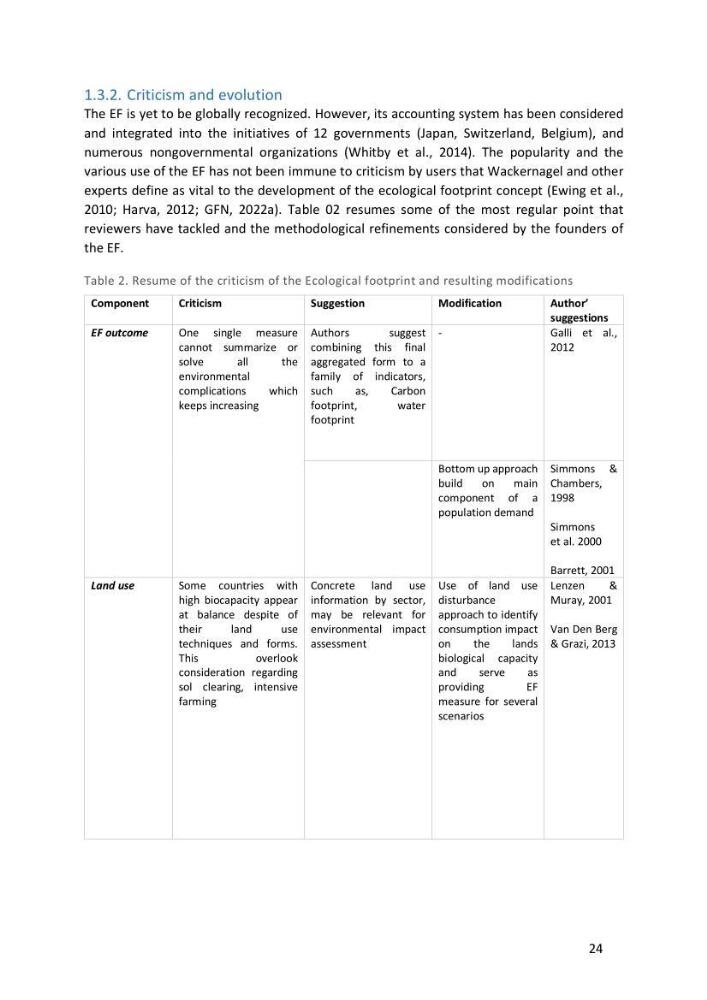
2010; Harva, 2012; GFN, 2022a). Table 02 resumes some of the most regular point that
reviewers have tackled and the methodological refinements considered by the founders of
the EF.
Table 2. Resume of the criticism of the Ecological footprint and resulting modifications
Component
Criticism
Suggestion
Modification
Author’
suggestions
EF outcome
One single measure
cannot summarize or
solve
all
the
environmental
complications
which
keeps increasing
Authors
suggest
combining this final
aggregated form to a
family of indicators,
such
as,
Carbon
footprint,
water
footprint
-
Galli et al.,
2012
Bottom up approach
build
on
main
component of a
population demand
Simmons &
Chambers,
1998
Simmons
et al. 2000
Barrett, 2001
Land use
Some countries with
high biocapacity appear
at balance despite of
their
land
use
techniques and forms.
This
overlook
consideration regarding
sol clearing, intensive
farming
Concrete land use
information by sector,
may be relevant for
environmental impact
assessment
Use of land use
disturbance
approach to identify
consumption impact
on
the
lands
biological capacity
and
serve
as
providing
EF
measure for several
scenarios
Lenzen
&
Muray, 2001
Van Den Berg
& Grazi, 2013
1.3.2. Criticism and evolution
The EF is yet to be globally recognized. However, its accounting system has been considered
and integrated into the initiatives of 12 governments (Japan, Switzerland, Belgium), and
numerous nongovernmental organizations (Whitby et al., 2014). The popularity and the
various use of the EF has not been immune to criticism by users that Wackernagel and other
experts define as vital to the development of the ecological footprint concept (Ewing et al.,
2010; Harva, 2012; GFN, 2022a). Table 02 resumes some of the most regular point that
reviewers have tackled and the methodological refinements considered by the founders of
the EF.
Table 2. Resume of the criticism of the Ecological footprint and resulting modifications
Component
Criticism
Suggestion
Modification
Author’
suggestions
EF outcome
One single measure
cannot summarize or
solve
all
the
environmental
complications
which
keeps increasing
Authors
suggest
combining this final
aggregated form to a
family of indicators,
such
as,
Carbon
footprint,
water
footprint
-
Galli et al.,
2012
Bottom up approach
build
on
main
component of a
population demand
Simmons &
Chambers,
1998
Simmons
et al. 2000
Barrett, 2001
Land use
Some countries with
high biocapacity appear
at balance despite of
their
land
use
techniques and forms.
This
overlook
consideration regarding
sol clearing, intensive
farming
Concrete land use
information by sector,
may be relevant for
environmental impact
assessment
Use of land use
disturbance
approach to identify
consumption impact
on
the
lands
biological capacity
and
serve
as
providing
EF
measure for several
scenarios
Lenzen
&
Muray, 2001
Van Den Berg
& Grazi, 2013