

22
capital does not exceed its regenerative capacity (Wernert, 2007). Accordingly, the EF could
be used to define resources exploitation thresholds, as it aligns perfectly with the
sustainability and planetary boundaries principals, which define the tipping points beyond
which irreversible change would occur (Borucke et al., 2013; Rockström, 2015; Attenborough,
2020).
1.3.1.3. Applications
The EF concept has been developed two decades ago, initially by Rees (1992) then Rees and
Wackernagel (Rees & Wackernagel, 1996; Wackernagel & Rees, 1998), aiming to measure
human lifestyle sustainability and its direct and indirect reliance on nature's capacity to
regenerate the resources (Wackernagel & Rees, 1996; EEA., 2016; GFN, 2022a). Collaborating
with the United Nations, which gathers and produces worldwide data sets, the global EF
network has built a large-scale, all-use accounting system for all countries known as National
Footprint Accounts (NFAs) enabling cross-country comparability (Ewing et al., 2009, 2010).
The EF has raised questions since its foundation, mainly because of its structure and intriguing
results. Thus, this tool has been popularized by several users at various scales (regional, local
and individual), following various methods and in different contexts (collaboration, analysis,
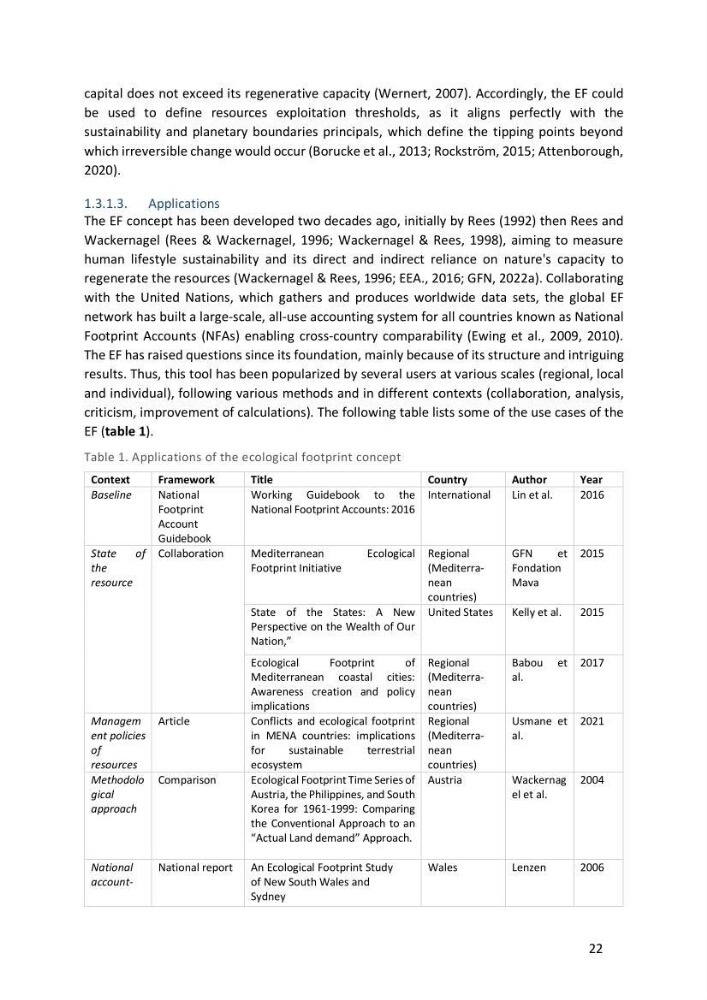
criticism, improvement of calculations). The following table lists some of the use cases of the
EF (table 1).
Table 1. Applications of the ecological footprint concept
Context
Framework
Title
Country
Author
Year
Baseline
National
Footprint
Account
Guidebook
Working Guidebook to the
National Footprint Accounts: 2016
International
Lin et al.
2016
State
of
the
resource
Collaboration
Mediterranean
Ecological
Footprint Initiative
Regional
(Mediterranean
countries)
GFN
et
Fondation
Mava
2015
State of the States: A New
Perspective on the Wealth of Our
Nation,”
United States
Kelly et al.
2015
Ecological
Footprint
of
Mediterranean coastal cities:
Awareness creation and policy
implications
Regional
(Mediterranean
countries)
Babou et
al.
2017
Managem
ent policies
of
resources
Article
Conflicts and ecological footprint
in MENA countries: implications
for
sustainable
terrestrial
ecosystem
Regional
(Mediterranean
countries)
Usmane et
al.
2021
Methodolo
gical
approach
Comparison
Ecological Footprint Time Series of
Austria, the Philippines, and South
Korea for 1961-1999: Comparing
the Conventional Approach to an
“Actual Land demand” Approach.
Austria
Wackernag
el et al.
2004
National
accountNational report
An Ecological Footprint Study
of New South Wales and
Sydney
Wales
Lenzen
2006
capital does not exceed its regenerative capacity (Wernert, 2007). Accordingly, the EF could
be used to define resources exploitation thresholds, as it aligns perfectly with the
sustainability and planetary boundaries principals, which define the tipping points beyond
which irreversible change would occur (Borucke et al., 2013; Rockström, 2015; Attenborough,
2020).
1.3.1.3. Applications
The EF concept has been developed two decades ago, initially by Rees (1992) then Rees and
Wackernagel (Rees & Wackernagel, 1996; Wackernagel & Rees, 1998), aiming to measure
human lifestyle sustainability and its direct and indirect reliance on nature's capacity to
regenerate the resources (Wackernagel & Rees, 1996; EEA., 2016; GFN, 2022a). Collaborating
with the United Nations, which gathers and produces worldwide data sets, the global EF
network has built a large-scale, all-use accounting system for all countries known as National
Footprint Accounts (NFAs) enabling cross-country comparability (Ewing et al., 2009, 2010).
The EF has raised questions since its foundation, mainly because of its structure and intriguing
results. Thus, this tool has been popularized by several users at various scales (regional, local
and individual), following various methods and in different contexts (collaboration, analysis,
criticism, improvement of calculations). The following table lists some of the use cases of the
EF (table 1).
Table 1. Applications of the ecological footprint concept
Context
Framework
Title
Country
Author
Year
Baseline
National
Footprint
Account
Guidebook
Working Guidebook to the
National Footprint Accounts: 2016
International
Lin et al.
2016
State
of
the
resource
Collaboration
Mediterranean
Ecological
Footprint Initiative
Regional
(Mediterranean
countries)
GFN
et
Fondation
Mava
2015
State of the States: A New
Perspective on the Wealth of Our
Nation,”
United States
Kelly et al.
2015
Ecological
Footprint
of
Mediterranean coastal cities:
Awareness creation and policy
implications
Regional
(Mediterranean
countries)
Babou et
al.
2017
Managem
ent policies
of
resources
Article
Conflicts and ecological footprint
in MENA countries: implications
for
sustainable
terrestrial
ecosystem
Regional
(Mediterranean
countries)
Usmane et
al.
2021
Methodolo
gical
approach
Comparison
Ecological Footprint Time Series of
Austria, the Philippines, and South
Korea for 1961-1999: Comparing
the Conventional Approach to an
“Actual Land demand” Approach.
Austria
Wackernag
el et al.
2004
National
accountNational report
An Ecological Footprint Study
of New South Wales and
Sydney
Wales
Lenzen
2006