

21
1.3. The model: The ecological footprint
1.3.1. Conception and use
1.3.1.1. Hypothesis
The EF follows economic welfare principles (availability of resources for humans) and
ecological principles (natural resource conservation), resulting in a sustainable development
indicator (Uhde, 2009). The conception of the ecological footprint was based on the
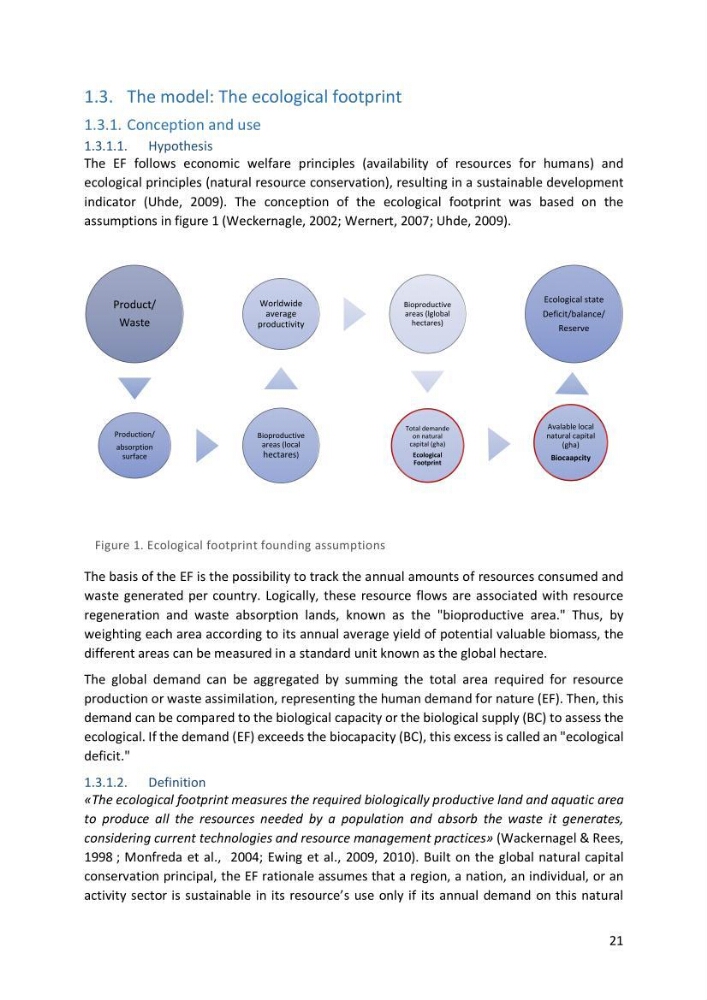
assumptions in figure 1 (Weckernagle, 2002; Wernert, 2007; Uhde, 2009).
The basis of the EF is the possibility to track the annual amounts of resources consumed and
waste generated per country. Logically, these resource flows are associated with resource
regeneration and waste absorption lands, known as the "bioproductive area." Thus, by
weighting each area according to its annual average yield of potential valuable biomass, the
different areas can be measured in a standard unit known as the global hectare.
The global demand can be aggregated by summing the total area required for resource
production or waste assimilation, representing the human demand for nature (EF). Then, this
demand can be compared to the biological capacity or the biological supply (BC) to assess the
ecological. If the demand (EF) exceeds the biocapacity (BC), this excess is called an "ecological
deficit."
1.3.1.2. Definition
«The ecological footprint measures the required biologically productive land and aquatic area
to produce all the resources needed by a population and absorb the waste it generates,
considering current technologies and resource management practices» (Wackernagel & Rees,
1998 ; Monfreda et al., 2004; Ewing et al., 2009, 2010). Built on the global natural capital
conservation principal, the EF rationale assumes that a region, a nation, an individual, or an
activity sector is sustainable in its resource’s use only if its annual demand on this natural
Product/
Waste
Production/
absorption
surface
Bioproductive
areas (local
hectares)
Worldwide
average
productivity
Bioproductive
areas (lglobal
hectares)
Total demande
on natural
capital (gha)
Ecological
Footprint
Avalable local
natural capital
(gha)
Biocaapcity
Ecological state
Deficit/balance/
Reserve
Figure 1. Ecological footprint founding assumptions
1.3. The model: The ecological footprint
1.3.1. Conception and use
1.3.1.1. Hypothesis
The EF follows economic welfare principles (availability of resources for humans) and
ecological principles (natural resource conservation), resulting in a sustainable development
indicator (Uhde, 2009). The conception of the ecological footprint was based on the
assumptions in figure 1 (Weckernagle, 2002; Wernert, 2007; Uhde, 2009).
The basis of the EF is the possibility to track the annual amounts of resources consumed and
waste generated per country. Logically, these resource flows are associated with resource
regeneration and waste absorption lands, known as the "bioproductive area." Thus, by
weighting each area according to its annual average yield of potential valuable biomass, the
different areas can be measured in a standard unit known as the global hectare.
The global demand can be aggregated by summing the total area required for resource
production or waste assimilation, representing the human demand for nature (EF). Then, this
demand can be compared to the biological capacity or the biological supply (BC) to assess the
ecological. If the demand (EF) exceeds the biocapacity (BC), this excess is called an "ecological
deficit."
1.3.1.2. Definition
«The ecological footprint measures the required biologically productive land and aquatic area
to produce all the resources needed by a population and absorb the waste it generates,
considering current technologies and resource management practices» (Wackernagel & Rees,
1998 ; Monfreda et al., 2004; Ewing et al., 2009, 2010). Built on the global natural capital
conservation principal, the EF rationale assumes that a region, a nation, an individual, or an
activity sector is sustainable in its resource’s use only if its annual demand on this natural
Product/
Waste
Production/
absorption
surface
Bioproductive
areas (local
hectares)
Worldwide
average
productivity
Bioproductive
areas (lglobal
hectares)
Total demande
on natural
capital (gha)
Ecological
Footprint
Avalable local
natural capital
(gha)
Biocaapcity
Ecological state
Deficit/balance/
Reserve
Figure 1. Ecological footprint founding assumptions