

absorption in mussel is by ingestion of food (Sreedevi et al.
1992). Hence, the introduction of contaminated food may significantly increase metal amount in this organ. Further,
metallothioneins proteins that are much abundant in digestive
gland play prominent role in metals bind and contribute to the
excretion of non-essential metals (Sreedevi et al. 1992;
Viarengo et al. 1999; Chandurvelan et al., 2015; Li et al.
2015; Firth et al. 2019).
The gill guarantees feeding (by filtration) and respiration
functions of mussels (Stankovic et al. 2012). Their high metal
contents can be explained by the importance of heavy metal
penetration through the trophic way and their permanent
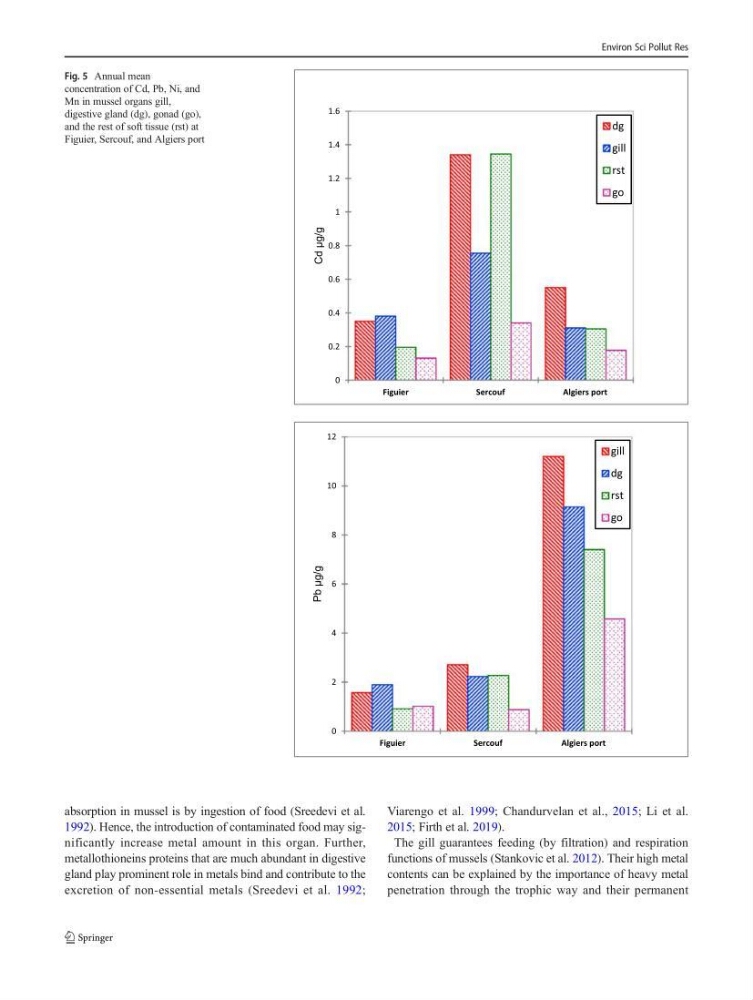
Fig. 5 Annual mean
concentration of Cd, Pb, Ni, and
Mn in mussel organs gill,
digestive gland (dg), gonad (go),
and the rest of soft tissue (rst) at
Figuier, Sercouf, and Algiers port
Environ Sci Pollut Res
1992). Hence, the introduction of contaminated food may significantly increase metal amount in this organ. Further,
metallothioneins proteins that are much abundant in digestive
gland play prominent role in metals bind and contribute to the
excretion of non-essential metals (Sreedevi et al. 1992;
Viarengo et al. 1999; Chandurvelan et al., 2015; Li et al.
2015; Firth et al. 2019).
The gill guarantees feeding (by filtration) and respiration
functions of mussels (Stankovic et al. 2012). Their high metal
contents can be explained by the importance of heavy metal
penetration through the trophic way and their permanent
Fig. 5 Annual mean
concentration of Cd, Pb, Ni, and
Mn in mussel organs gill,
digestive gland (dg), gonad (go),
and the rest of soft tissue (rst) at
Figuier, Sercouf, and Algiers port
Environ Sci Pollut Res