

Algiers port mussels (mostly in gill, digestive gland, and
RST). For Sercouf mussels, great amounts of Cd were found
in RST, gills, and digestive glands.
Individual Mean (Multimetal) Bioaccumulation Index
The IMBI values (Table 3) in gills, digestive glands, RST, and
gonads, respectively, ranged from 0.45 to 0.76, 0.62 to 1, 0.34
to 0.42, and 0.25 to 0.53 (Figuier), 0.39 to 0.87, 0.73 to 1, 0.36
to 0.76, and 0.2 to 0.43 (Sercouf), and 0.71 to 0.84, 0.83 to
0.99, 0.42 to 0.73, and 0.2 to 0.43 (Algiers port). The maximum IMBI value 1 (all maximum concentrations of heavy
metals) was found (3 times) in the digestive gland in summer
and spring at Figuier site and in spring at Sercouf. Generally,
higher metal charge (IMBI) was found in both organs digestive gland and gill compared with remainder organs for mussels sampled at three sampling sites. For RST, highest IMBI
values were found for mussels of Sercouf (in summer and
autumn) and Algiers port (in winter). Only gonad of Figuier
(summer) and Algiers port (autumn) mussels had an IMBI
superior to 0.5.
Health risk assessment
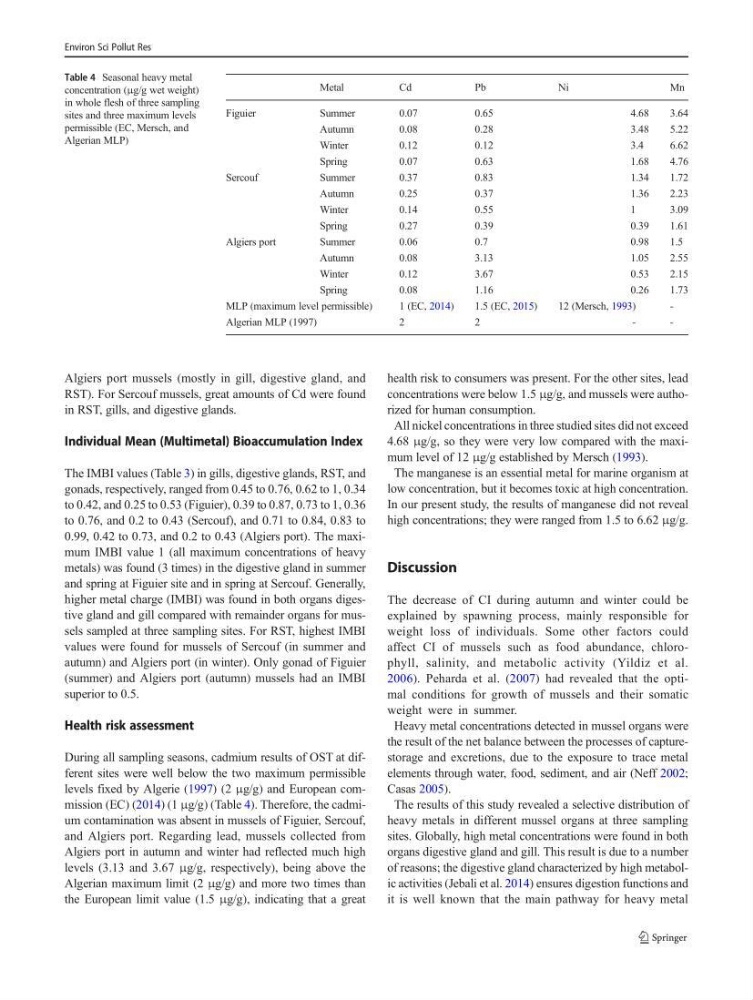
During all sampling seasons, cadmium results of OST at different sites were well below the two maximum permissible
levels fixed by Algerie (1997) (2 μg/g) and European commission (EC) (2014) (1 μg/g) (Table 4). Therefore, the cadmium contamination was absent in mussels of Figuier, Sercouf,
and Algiers port. Regarding lead, mussels collected from
Algiers port in autumn and winter had reflected much high
levels (3.13 and 3.67 μg/g, respectively), being above the
Algerian maximum limit (2 μg/g) and more two times than
the European limit value (1.5 μg/g), indicating that a great
health risk to consumers was present. For the other sites, lead
concentrations were below 1.5 μg/g, and mussels were authorized for human consumption.
All nickel concentrations in three studied sites did not exceed
4.68 μg/g, so they were very low compared with the maximum level of 12 μg/g established by Mersch (1993).
The manganese is an essential metal for marine organism at
low concentration, but it becomes toxic at high concentration.
In our present study, the results of manganese did not reveal
high concentrations; they were ranged from 1.5 to 6.62 μg/g.
Discussion
The decrease of CI during autumn and winter could be
explained by spawning process, mainly responsible for
weight loss of individuals. Some other factors could
affect CI of mussels such as food abundance, chlorophyll, salinity, and metabolic activity (Yildiz et al.
2006). Peharda et al. (2007) had revealed that the optimal conditions for growth of mussels and their somatic
weight were in summer.
Heavy metal concentrations detected in mussel organs were
the result of the net balance between the processes of capturestorage and excretions, due to the exposure to trace metal
elements through water, food, sediment, and air (Neff 2002;
Casas 2005).
The results of this study revealed a selective distribution of
heavy metals in different mussel organs at three sampling
sites. Globally, high metal concentrations were found in both
organs digestive gland and gill. This result is due to a number
of reasons; the digestive gland characterized by high metabolic activities (Jebali et al. 2014) ensures digestion functions and
it is well known that the main pathway for heavy metal
Table 4 Seasonal heavy metal
concentration (μg/g wet weight)
in whole flesh of three sampling
sites and three maximum levels
permissible (EC, Mersch, and
Algerian MLP)
Metal
Cd
Pb
Ni
Mn
Figuier
Summer
0.07
0.65
4.68
3.64
Autumn
0.08
0.28
3.48
5.22
Winter
0.12
0.12
3.4
6.62
Spring
0.07
0.63
1.68
4.76
Sercouf
Summer
0.37
0.83
1.34
1.72
Autumn
0.25
0.37
1.36
2.23
Winter
0.14
0.55
1
3.09
Spring
0.27
0.39
0.39
1.61
Algiers port
Summer
0.06
0.7
0.98
1.5
Autumn
0.08
3.13
1.05
2.55
Winter
0.12
3.67
0.53
2.15
Spring
0.08
1.16
0.26
1.73
MLP (maximum level permissible)
1 (EC, 2014)
1.5 (EC, 2015)
12(Mersch,1993)
-
Algerian MLP (1997)
2
2
-
-
Environ Sci Pollut Res
RST). For Sercouf mussels, great amounts of Cd were found
in RST, gills, and digestive glands.
Individual Mean (Multimetal) Bioaccumulation Index
The IMBI values (Table 3) in gills, digestive glands, RST, and
gonads, respectively, ranged from 0.45 to 0.76, 0.62 to 1, 0.34
to 0.42, and 0.25 to 0.53 (Figuier), 0.39 to 0.87, 0.73 to 1, 0.36
to 0.76, and 0.2 to 0.43 (Sercouf), and 0.71 to 0.84, 0.83 to
0.99, 0.42 to 0.73, and 0.2 to 0.43 (Algiers port). The maximum IMBI value 1 (all maximum concentrations of heavy
metals) was found (3 times) in the digestive gland in summer
and spring at Figuier site and in spring at Sercouf. Generally,
higher metal charge (IMBI) was found in both organs digestive gland and gill compared with remainder organs for mussels sampled at three sampling sites. For RST, highest IMBI
values were found for mussels of Sercouf (in summer and
autumn) and Algiers port (in winter). Only gonad of Figuier
(summer) and Algiers port (autumn) mussels had an IMBI
superior to 0.5.
Health risk assessment
During all sampling seasons, cadmium results of OST at different sites were well below the two maximum permissible
levels fixed by Algerie (1997) (2 μg/g) and European commission (EC) (2014) (1 μg/g) (Table 4). Therefore, the cadmium contamination was absent in mussels of Figuier, Sercouf,
and Algiers port. Regarding lead, mussels collected from
Algiers port in autumn and winter had reflected much high
levels (3.13 and 3.67 μg/g, respectively), being above the
Algerian maximum limit (2 μg/g) and more two times than
the European limit value (1.5 μg/g), indicating that a great
health risk to consumers was present. For the other sites, lead
concentrations were below 1.5 μg/g, and mussels were authorized for human consumption.
All nickel concentrations in three studied sites did not exceed
4.68 μg/g, so they were very low compared with the maximum level of 12 μg/g established by Mersch (1993).
The manganese is an essential metal for marine organism at
low concentration, but it becomes toxic at high concentration.
In our present study, the results of manganese did not reveal
high concentrations; they were ranged from 1.5 to 6.62 μg/g.
Discussion
The decrease of CI during autumn and winter could be
explained by spawning process, mainly responsible for
weight loss of individuals. Some other factors could
affect CI of mussels such as food abundance, chlorophyll, salinity, and metabolic activity (Yildiz et al.
2006). Peharda et al. (2007) had revealed that the optimal conditions for growth of mussels and their somatic
weight were in summer.
Heavy metal concentrations detected in mussel organs were
the result of the net balance between the processes of capturestorage and excretions, due to the exposure to trace metal
elements through water, food, sediment, and air (Neff 2002;
Casas 2005).
The results of this study revealed a selective distribution of
heavy metals in different mussel organs at three sampling
sites. Globally, high metal concentrations were found in both
organs digestive gland and gill. This result is due to a number
of reasons; the digestive gland characterized by high metabolic activities (Jebali et al. 2014) ensures digestion functions and
it is well known that the main pathway for heavy metal
Table 4 Seasonal heavy metal
concentration (μg/g wet weight)
in whole flesh of three sampling
sites and three maximum levels
permissible (EC, Mersch, and
Algerian MLP)
Metal
Cd
Pb
Ni
Mn
Figuier
Summer
0.07
0.65
4.68
3.64
Autumn
0.08
0.28
3.48
5.22
Winter
0.12
0.12
3.4
6.62
Spring
0.07
0.63
1.68
4.76
Sercouf
Summer
0.37
0.83
1.34
1.72
Autumn
0.25
0.37
1.36
2.23
Winter
0.14
0.55
1
3.09
Spring
0.27
0.39
0.39
1.61
Algiers port
Summer
0.06
0.7
0.98
1.5
Autumn
0.08
3.13
1.05
2.55
Winter
0.12
3.67
0.53
2.15
Spring
0.08
1.16
0.26
1.73
MLP (maximum level permissible)
1 (EC, 2014)
1.5 (EC, 2015)
12(Mersch,1993)
-
Algerian MLP (1997)
2
2
-
-
Environ Sci Pollut Res