

80
Chapter 2
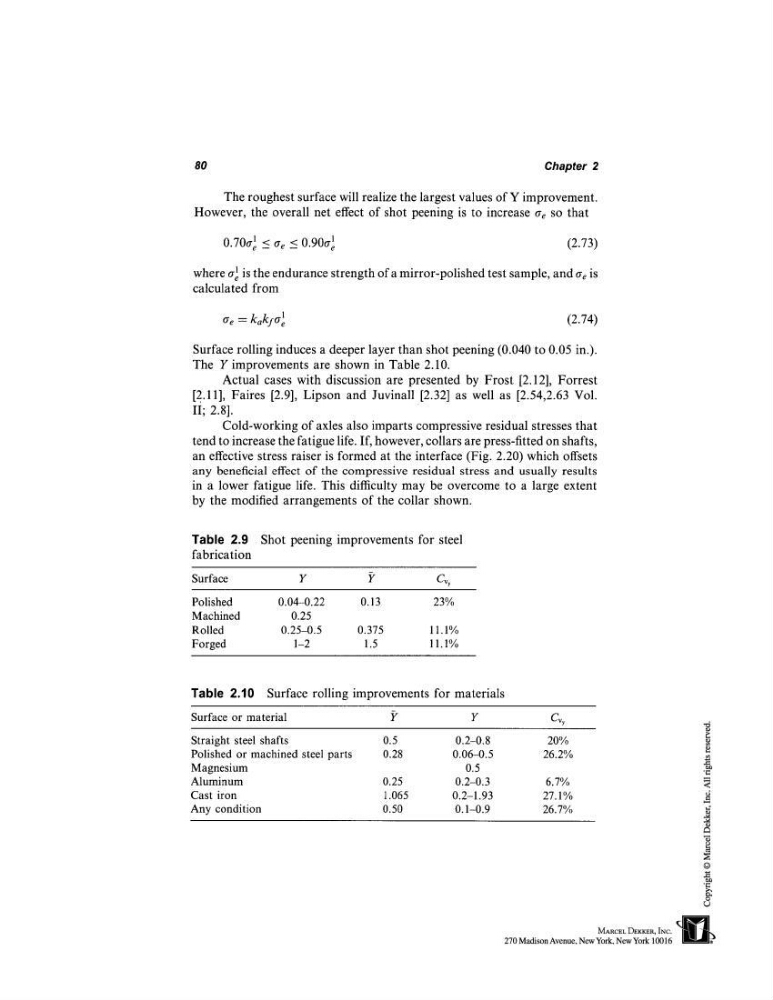
The roughest surface will realize the largest values of Y improvement.
However, the overall net effect of shot peening is to increase ae so that
0.70~r~ _< o" e ~< 0.90~r~
(2.73)
1 is the endurance strength of a mirror-polished test sample, and o- e is
where oe
calculated from
ffe~-kakf~
(2.74)
Surface rolling induces a deeper layer than shot peening (0.040 to 0.05 in.).
The Y improvements are shown in Table 2.10.
Actual cases with discussion are presented by Frost [2.12], Forrest
[2..11], Faires [2.9], Lipson and Juvinall [2.32] as well as [2.54,2.63 Vol.
II; 2.8].
Cold-working of axles also imparts compressive residual stresses that
tend to increase the fatigue life. If, however, collars are press-fitted on shafts,
an effective stress raiser is formed at the interface (Fig. 2.20) which offsets
any beneficial effect of the compressive residual stress and usually results
in a lower fatigue life. This difficulty may be overcome to a large extent
by the modified arrangements of the collar shown.
Table 2.9 Shot peening improvements for steel
fabrication
Surface
Y
~
Cvy
Polished
0.04-0.22
0.13
23%
Machined
0.25
Rolled
0.25-0.5
0.375
11.1%
Forged
1-2
1.5
11.1%
Table 2.10 Surface rolling improvements for materials
Surface or material
~"
Y
Cvy
Straight steel shafts
0.5
0.2-0.8
20%
Polished or machined steel parts
0.28
0.06-0.5
26.2%
Magnesium
0.5
Aluminum
0.25
0.2-0.3
6.7%
Cast iron
1.065
0.2-1.93
27.1%
Any condition
0.50
0.1-0.9
26.7%
Chapter 2
The roughest surface will realize the largest values of Y improvement.
However, the overall net effect of shot peening is to increase ae so that
0.70~r~ _< o" e ~< 0.90~r~
(2.73)
1 is the endurance strength of a mirror-polished test sample, and o- e is
where oe
calculated from
ffe~-kakf~
(2.74)
Surface rolling induces a deeper layer than shot peening (0.040 to 0.05 in.).
The Y improvements are shown in Table 2.10.
Actual cases with discussion are presented by Frost [2.12], Forrest
[2..11], Faires [2.9], Lipson and Juvinall [2.32] as well as [2.54,2.63 Vol.
II; 2.8].
Cold-working of axles also imparts compressive residual stresses that
tend to increase the fatigue life. If, however, collars are press-fitted on shafts,
an effective stress raiser is formed at the interface (Fig. 2.20) which offsets
any beneficial effect of the compressive residual stress and usually results
in a lower fatigue life. This difficulty may be overcome to a large extent
by the modified arrangements of the collar shown.
Table 2.9 Shot peening improvements for steel
fabrication
Surface
Y
~
Cvy
Polished
0.04-0.22
0.13
23%
Machined
0.25
Rolled
0.25-0.5
0.375
11.1%
Forged
1-2
1.5
11.1%
Table 2.10 Surface rolling improvements for materials
Surface or material
~"
Y
Cvy
Straight steel shafts
0.5
0.2-0.8
20%
Polished or machined steel parts
0.28
0.06-0.5
26.2%
Magnesium
0.5
Aluminum
0.25
0.2-0.3
6.7%
Cast iron
1.065
0.2-1.93
27.1%
Any condition
0.50
0.1-0.9
26.7%