

70
Chapter 2
1. Surface Condition, ka
By surface condition is meant the degree of smoothness of the part and the
presence or absence of corrosive effects. In general, a highly polished surface
gives the highest fatigue life, although there is evidence suggesting that the
uniformity of finish is more important than the finish itself. For example,
a single scratch on a highly polished surface would probably lead to a fatigue
life somewhat lower than for a surface containing an even distribution of
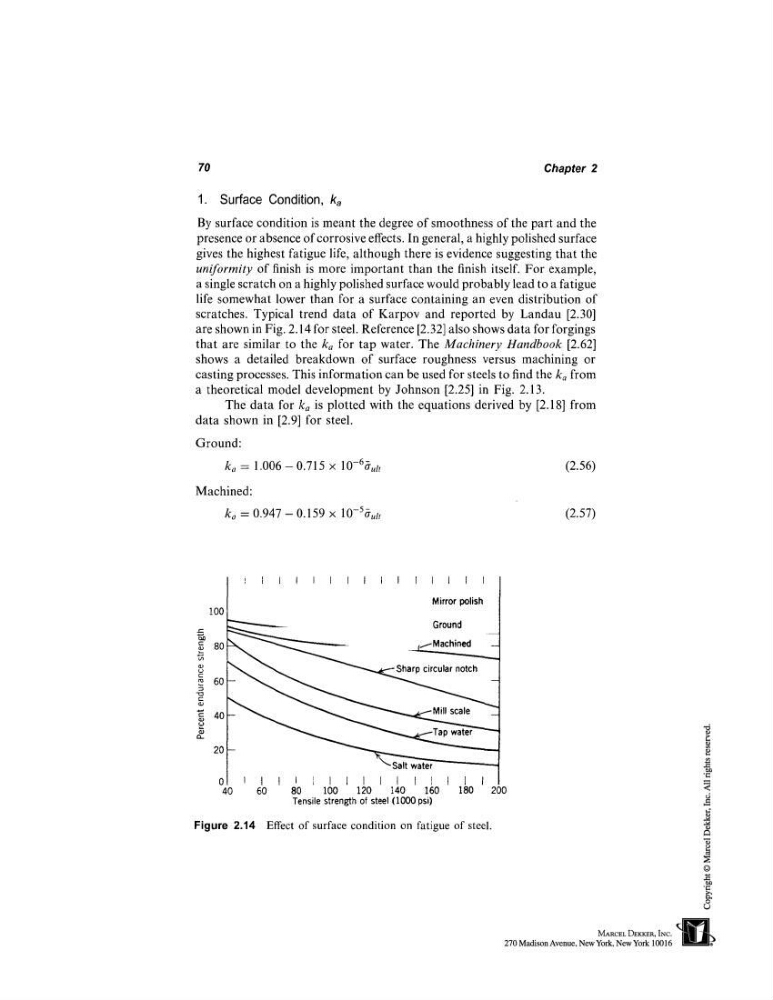
scratches. Typical trend data of Karpov and reported by Landau [2.30]
are shown in Fig. 2.14 for steel. Reference [2.32] also shows data for forgings
that are similar to the ka for tap water. The Machinery Handbook [2.62]
shows a detailed breakdown of surface roughness versus machining or
casting processes. This information can be used for steels to find the ka from
a theoretical model development by Johnson [2.25] in Fig. 2.13.
The data for ka is plotted with the equations derived by [2.18] from
data shown in [2.9] for steel.
Ground:
ka = 1.006 - 0.715 × ]O-6~uh
(2.56)
Machined:
ka = 0.947 - 0.159 x 10-56-,tt
(2.57)
100
i I J I I I I I I I [ I I i I
Mirror polish
80 ~
Ground
I~ ~
~’~.~__~Sharp circular notch
6000
-~
2
40
60
80 I00
120 140 160 180 200
Tensile strength of steel (I000 psi)
Figure 2.14 Effect of surface condition on fatigue of steel.
Chapter 2
1. Surface Condition, ka
By surface condition is meant the degree of smoothness of the part and the
presence or absence of corrosive effects. In general, a highly polished surface
gives the highest fatigue life, although there is evidence suggesting that the
uniformity of finish is more important than the finish itself. For example,
a single scratch on a highly polished surface would probably lead to a fatigue
life somewhat lower than for a surface containing an even distribution of
scratches. Typical trend data of Karpov and reported by Landau [2.30]
are shown in Fig. 2.14 for steel. Reference [2.32] also shows data for forgings
that are similar to the ka for tap water. The Machinery Handbook [2.62]
shows a detailed breakdown of surface roughness versus machining or
casting processes. This information can be used for steels to find the ka from
a theoretical model development by Johnson [2.25] in Fig. 2.13.
The data for ka is plotted with the equations derived by [2.18] from
data shown in [2.9] for steel.
Ground:
ka = 1.006 - 0.715 × ]O-6~uh
(2.56)
Machined:
ka = 0.947 - 0.159 x 10-56-,tt
(2.57)
100
i I J I I I I I I I [ I I i I
Mirror polish
80 ~
Ground
I~ ~
~’~.~__~Sharp circular notch
6000
-~
2
40
60
80 I00
120 140 160 180 200
Tensile strength of steel (I000 psi)
Figure 2.14 Effect of surface condition on fatigue of steel.