

Application of Probability to Mechanical Design
69
In order to generate a design curve, o" e is one of the important factors
formulated by Marin and presented by Shigley [2.51] where
ae=kakbkckdkekf...klkma~,
(2.55)
ae ~ represents data from a smooth polished rotating beam specimen. The k
values can be applied to the stresses or to correct ae. Material data can
have some k values incorporated in the test or no k values at all. When
developing a design curve for combined stresses, it is better to place the
k values with the individual stresses where possible. The factors, k values,
influencing fatigue behavior will be discussed where most of the corrections
are to O" e or O" r. 0"~ will be discussed in Section VI. B.
A. Some Factors Influencing Fatigue Behavior
The number of variables and combinations of variables that have an influence of the fatigue behavior of parts and structures is discouragingly large,
and a thorough discussion concerning this subject is virtually impossible.
At best, the designer can make rough estimates and predictions, but even
to do this requires some knowledge of at least the various principal factors
involved. In the following discussion some high-spot information is presented with the caution that fatigue behavior is extremely complicated
and any data or methods of utilizing the data should be viewed in a most
critical way.
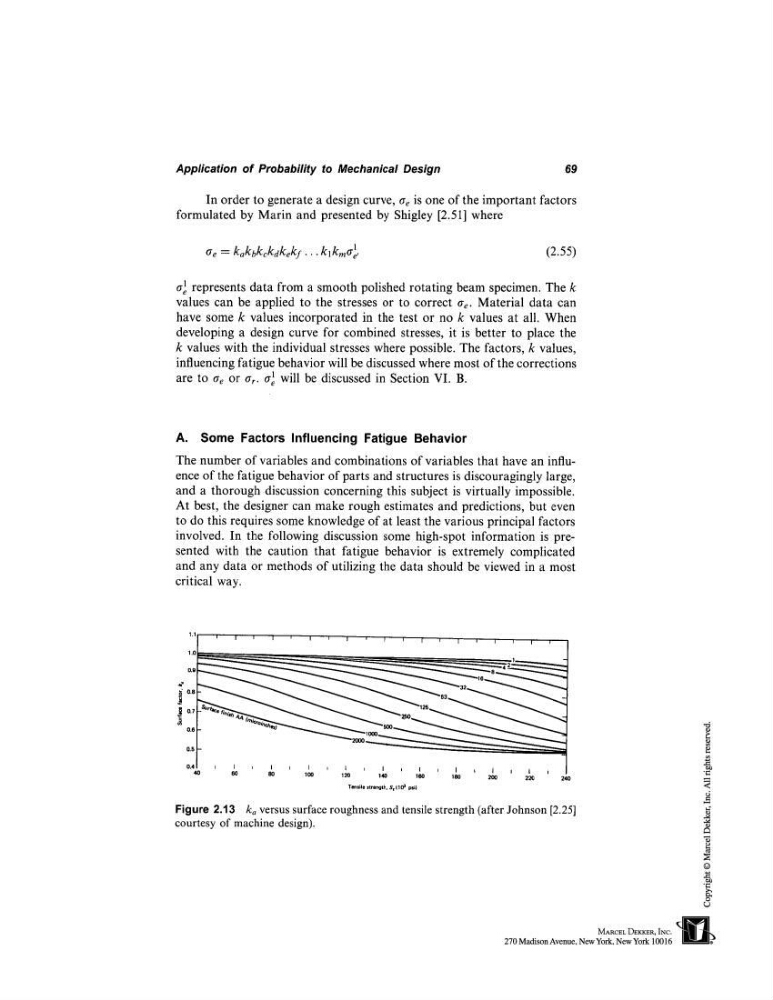
Figure 2.13 ka versus surface roughness and tensile strength (after Johnson [2.25]
courtesy of machine design).
69
In order to generate a design curve, o" e is one of the important factors
formulated by Marin and presented by Shigley [2.51] where
ae=kakbkckdkekf...klkma~,
(2.55)
ae ~ represents data from a smooth polished rotating beam specimen. The k
values can be applied to the stresses or to correct ae. Material data can
have some k values incorporated in the test or no k values at all. When
developing a design curve for combined stresses, it is better to place the
k values with the individual stresses where possible. The factors, k values,
influencing fatigue behavior will be discussed where most of the corrections
are to O" e or O" r. 0"~ will be discussed in Section VI. B.
A. Some Factors Influencing Fatigue Behavior
The number of variables and combinations of variables that have an influence of the fatigue behavior of parts and structures is discouragingly large,
and a thorough discussion concerning this subject is virtually impossible.
At best, the designer can make rough estimates and predictions, but even
to do this requires some knowledge of at least the various principal factors
involved. In the following discussion some high-spot information is presented with the caution that fatigue behavior is extremely complicated
and any data or methods of utilizing the data should be viewed in a most
critical way.
Figure 2.13 ka versus surface roughness and tensile strength (after Johnson [2.25]
courtesy of machine design).