

40
Chapter 2
arrows in the bullseye and the large area is N or number of arrows shot hence
the total number of events. For probability problems where two events or
more occur there is more complexity. Take two events A and B
P(A + B) = P(A) = P(B) -
(2.2)
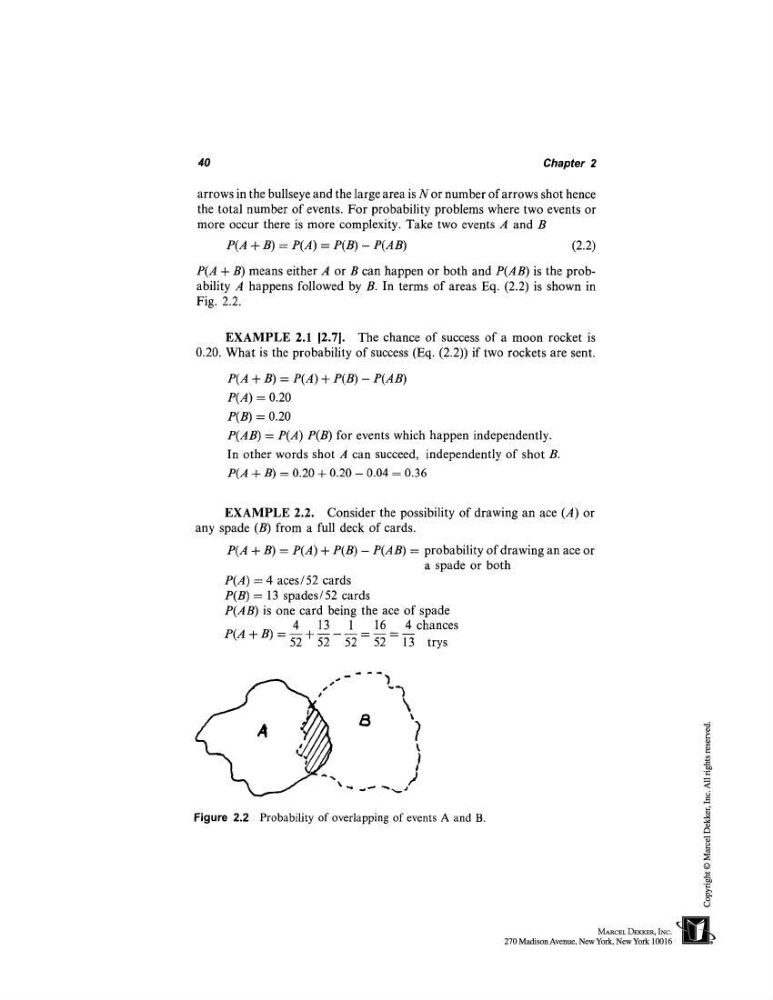
P(A + B) means either A or B can happen or both and P(AB) is the probability A happens followed by B. In terms of areas Eq. (2.2) is shown
Fig. 2.2.
0.20.
EXAMPLE 2.1 12.7]. The chance of success of a moon rocket is
What is the probability of success (Eq. (2.2)) if two rockets are sent.
P(A + B) = P(A) + P(B) -
P(A) = 0.20
P(B) = 0.20
P(AB) = P(A) P(B) for events which happen independently.
In other words shot A can succeed, independently of shot B.
P(A + B) = 0.20 + 0.20 - 0.04 = 0.36
EXAMPLE 2.2. Consider the possibility
of drawing an ace (A)
any spade (B) from a full deck of cards.
P(A + B) = P(A) + P(B) - = probability of dra wing an ace or
a spade or both
P(A) = 4 aces/52 cards
P(B) = 13 spades/52 cards
P(AB) is one card being the ace of spade
4 13 1 16 4 chances
P(A+B)=~+52
52--52--13
trys
Figure 2.2 Probability of overlapping of events A and B.
Chapter 2
arrows in the bullseye and the large area is N or number of arrows shot hence
the total number of events. For probability problems where two events or
more occur there is more complexity. Take two events A and B
P(A + B) = P(A) = P(B) -
(2.2)
P(A + B) means either A or B can happen or both and P(AB) is the probability A happens followed by B. In terms of areas Eq. (2.2) is shown
Fig. 2.2.
0.20.
EXAMPLE 2.1 12.7]. The chance of success of a moon rocket is
What is the probability of success (Eq. (2.2)) if two rockets are sent.
P(A + B) = P(A) + P(B) -
P(A) = 0.20
P(B) = 0.20
P(AB) = P(A) P(B) for events which happen independently.
In other words shot A can succeed, independently of shot B.
P(A + B) = 0.20 + 0.20 - 0.04 = 0.36
EXAMPLE 2.2. Consider the possibility
of drawing an ace (A)
any spade (B) from a full deck of cards.
P(A + B) = P(A) + P(B) - = probability of dra wing an ace or
a spade or both
P(A) = 4 aces/52 cards
P(B) = 13 spades/52 cards
P(AB) is one card being the ace of spade
4 13 1 16 4 chances
P(A+B)=~+52
52--52--13
trys
Figure 2.2 Probability of overlapping of events A and B.