

204
Chapter 4
A
input
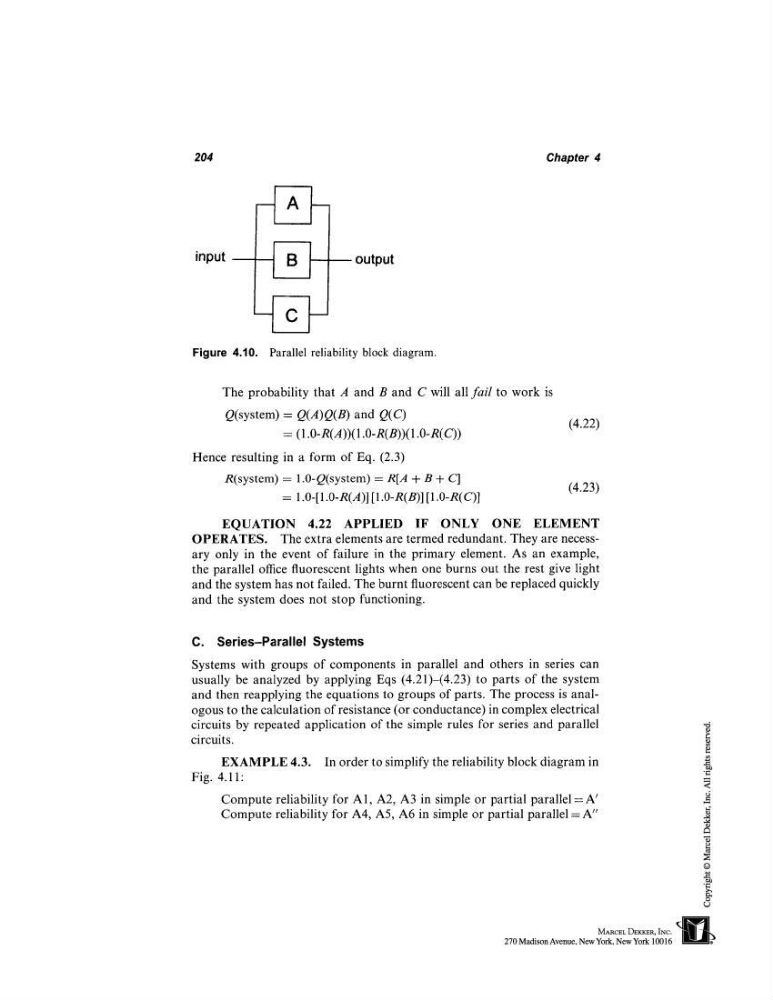
Figure 4.10.
B
output
C
Parallel reliability block diagram.
The probability that A and B and C will all fail to work is
Q(system) Q(A)Q(B) and Q(C)
(4.22)
=
Hence resulting in a form of Eq. (2.3)
R(system) = 1.0-Q(system) R[A + B + C]
(4.23)
= 1.0-[1.0-R(A)] [1.0-R(B)] [1.0-R(C)]
EQUATION 4.22
APPLIED
IF ONLY ONE ELEMENT
OPERATES. The extra elements are termed redundant. They are necessary only in the event of failure in the primary element. As an example,
the parallel office fluorescent lights when one burns out the rest give light
and the system has not failed. The burnt fluorescent can be replaced quickly
and the system does not stop functioning.
C. Series-Parallel Systems
Systems with groups of components in parallel and others in series can
usually be analyzed by applying Eqs (4.21)-(4.23) to parts of the system
and then reapplying the equations to groups of parts. The process is analogous to the calculation of resistance (or conductance) in complex electrical
circuits by repeated application of the simple rules for series and parallel
circuits.
EXAMPLE 4.3. In order to simplify the reliability
block diagram in
Fig. 4.11:
Compute reliability for A1, A2, A3 in simple or partial parallel =A’
Compute reliability for A4, A5, A6 in simple or partial parallel -- A"
Chapter 4
A
input
Figure 4.10.
B
output
C
Parallel reliability block diagram.
The probability that A and B and C will all fail to work is
Q(system) Q(A)Q(B) and Q(C)
(4.22)
=
Hence resulting in a form of Eq. (2.3)
R(system) = 1.0-Q(system) R[A + B + C]
(4.23)
= 1.0-[1.0-R(A)] [1.0-R(B)] [1.0-R(C)]
EQUATION 4.22
APPLIED
IF ONLY ONE ELEMENT
OPERATES. The extra elements are termed redundant. They are necessary only in the event of failure in the primary element. As an example,
the parallel office fluorescent lights when one burns out the rest give light
and the system has not failed. The burnt fluorescent can be replaced quickly
and the system does not stop functioning.
C. Series-Parallel Systems
Systems with groups of components in parallel and others in series can
usually be analyzed by applying Eqs (4.21)-(4.23) to parts of the system
and then reapplying the equations to groups of parts. The process is analogous to the calculation of resistance (or conductance) in complex electrical
circuits by repeated application of the simple rules for series and parallel
circuits.
EXAMPLE 4.3. In order to simplify the reliability
block diagram in
Fig. 4.11:
Compute reliability for A1, A2, A3 in simple or partial parallel =A’
Compute reliability for A4, A5, A6 in simple or partial parallel -- A"