

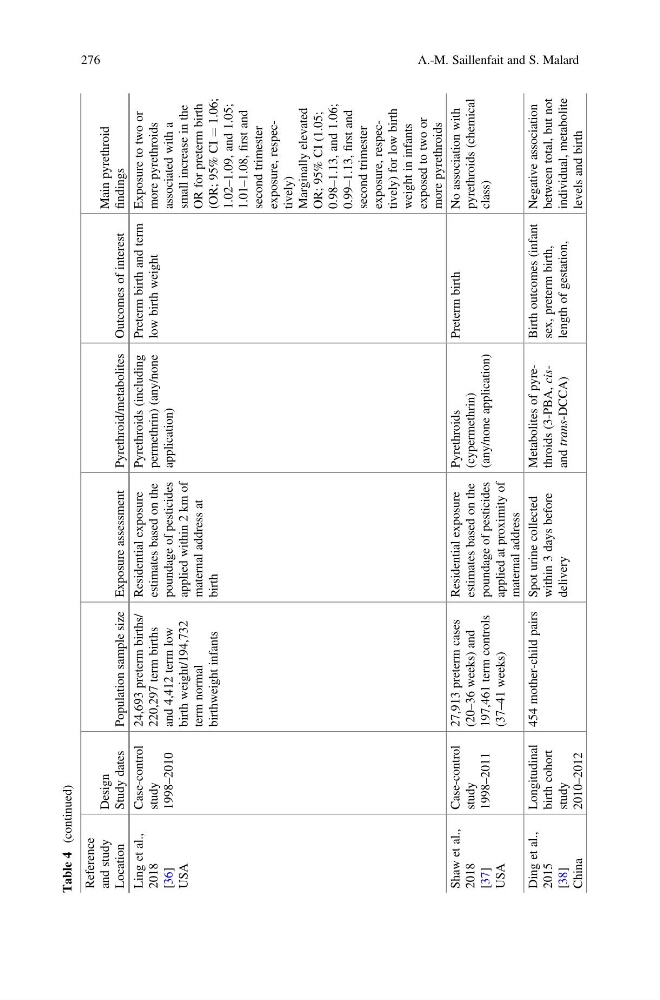
Table 4
(continued)
Reference
and study
Location
Design
Study dates
Population sample size Exposure assessment
Pyrethroid/metabolites Outcomes of interest
Main pyrethroid
findings
Ling et al.,
2018
[36]
USA
Case-control
study
1998–2010
24,693 preterm births/
220,297 term births
and 4,412 term low
birth weight/194,732
term normal
birthweight infants
Residential exposure
estimates based on the
poundage of pesticides
applied within 2 km of
maternal address at
birth
Pyrethroids (including
permethrin) (any/none
application)
Preterm birth and term
low birth weight
Exposure to two or
more pyrethroids
associated with a
small increase in the
OR for preterm birth
(OR; 95% CI
¼ 1.06;
1.02–1.09, and 1.05;
1.01–1.08,
first and
second trimester
exposure, respectively)
Marginally elevated
OR; 95% CI (1.05;
0.98–1.13, and 1.06;
0.99–1.13,
first and
second trimester
exposure, respectively) for low birth
weight in infants
exposed to two or
more pyrethroids
Shaw et al.,
2018
[37]
USA
Case-control
study
1998–2011
27,913 preterm cases
(20–36 weeks) and
197,461 term controls
(37–41 weeks)
Residential exposure
estimates based on the
poundage of pesticides
applied at proximity of
maternal address
Pyrethroids
(cypermethrin)
(any/none application)
Preterm birth
No association with
pyrethroids (chemical
class)
Ding et al.,
2015
[38]
China
Longitudinal
birth cohort
study
2010–2012
454 mother-child pairs Spot urine collected
within 3 days before
delivery
Metabolites of pyrethroids (3-PBA, cisand trans-DCCA)
Birth outcomes (infant
sex, preterm birth,
length of gestation,
Negative association
between total, but not
individual, metabolite
levels and birth
276
A.-M. Saillenfait and S. Malard
(continued)
Reference
and study
Location
Design
Study dates
Population sample size Exposure assessment
Pyrethroid/metabolites Outcomes of interest
Main pyrethroid
findings
Ling et al.,
2018
[36]
USA
Case-control
study
1998–2010
24,693 preterm births/
220,297 term births
and 4,412 term low
birth weight/194,732
term normal
birthweight infants
Residential exposure
estimates based on the
poundage of pesticides
applied within 2 km of
maternal address at
birth
Pyrethroids (including
permethrin) (any/none
application)
Preterm birth and term
low birth weight
Exposure to two or
more pyrethroids
associated with a
small increase in the
OR for preterm birth
(OR; 95% CI
¼ 1.06;
1.02–1.09, and 1.05;
1.01–1.08,
first and
second trimester
exposure, respectively)
Marginally elevated
OR; 95% CI (1.05;
0.98–1.13, and 1.06;
0.99–1.13,
first and
second trimester
exposure, respectively) for low birth
weight in infants
exposed to two or
more pyrethroids
Shaw et al.,
2018
[37]
USA
Case-control
study
1998–2011
27,913 preterm cases
(20–36 weeks) and
197,461 term controls
(37–41 weeks)
Residential exposure
estimates based on the
poundage of pesticides
applied at proximity of
maternal address
Pyrethroids
(cypermethrin)
(any/none application)
Preterm birth
No association with
pyrethroids (chemical
class)
Ding et al.,
2015
[38]
China
Longitudinal
birth cohort
study
2010–2012
454 mother-child pairs Spot urine collected
within 3 days before
delivery
Metabolites of pyrethroids (3-PBA, cisand trans-DCCA)
Birth outcomes (infant
sex, preterm birth,
length of gestation,
Negative association
between total, but not
individual, metabolite
levels and birth
276
A.-M. Saillenfait and S. Malard