

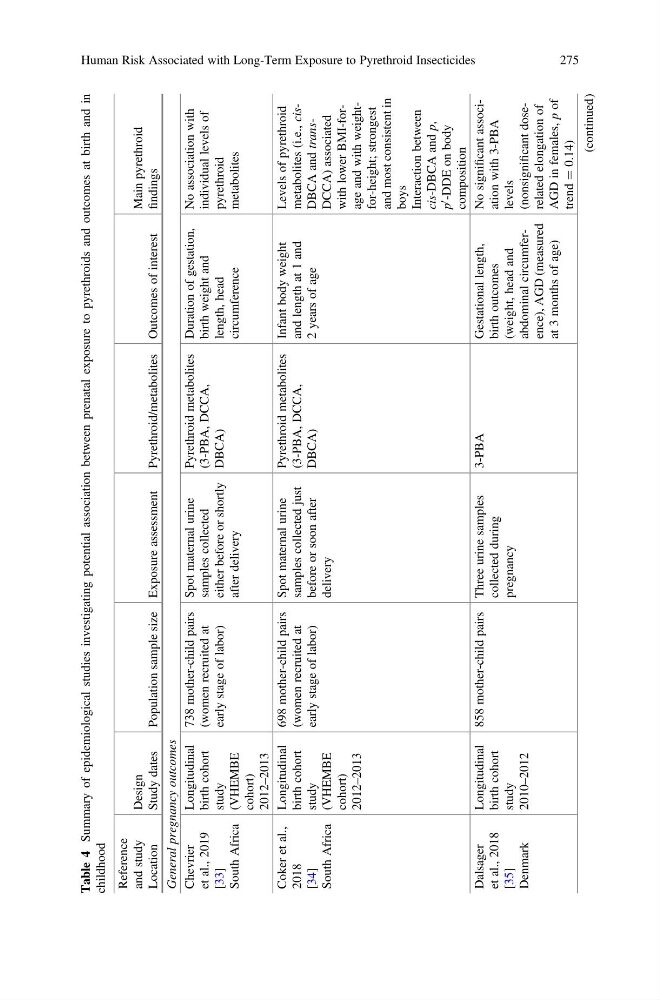
Table 4
Summary of epidemiological studies investigating potential association between prenatal exposure to pyrethroids and outcomes at birth and in
childhood
Reference
and study
Location
Design
Study dates
Population sample size Exposure assessment
Pyrethroid/metabolites Outcomes of interest
Main pyrethroid
findings
General pregnancy outcomes
Chevrier
et al., 2019
[33]
South Africa
Longitudinal
birth cohort
study
(VHEMBE
cohort)
2012–2013
738 mother-child pairs
(women recruited at
early stage of labor)
Spot maternal urine
samples collected
either before or shortly
after delivery
Pyrethroid metabolites
(3-PBA, DCCA,
DBCA)
Duration of gestation,
birth weight and
length, head
circumference
No association with
individual levels of
pyrethroid
metabolites
Coker et al.,
2018
[34]
South Africa
Longitudinal
birth cohort
study
(VHEMBE
cohort)
2012–2013
698 mother-child pairs
(women recruited at
early stage of labor)
Spot maternal urine
samples collected just
before or soon after
delivery
Pyrethroid metabolites
(3-PBA, DCCA,
DBCA)
Infant body weight
and length at 1 and
2 years of age
Levels of pyrethroid
metabolites (i.e., cisDBCA and transDCCA) associated
with lower BMI-forage and with weightfor-height; strongest
and most consistent in
boys
Interaction between
cis-DBCA
and p,
p
0
-DDE on body
composition
Dalsager
et al., 2018
[35]
Denmark
Longitudinal
birth cohort
study
2010–2012
858 mother-child pairs Three urine samples
collected during
pregnancy
3-PBA
Gestational length,
birth outcomes
(weight, head and
abdominal circumference), AGD (measured
at 3 months of age)
No significant association with 3-PBA
levels
(nonsignificant doserelated elongation of
AGD in females, p
of
trend
¼ 0.14)
(continued)
Human Risk Associated with Long-Term Exposure to Pyrethroid Insecticides
275
Summary of epidemiological studies investigating potential association between prenatal exposure to pyrethroids and outcomes at birth and in
childhood
Reference
and study
Location
Design
Study dates
Population sample size Exposure assessment
Pyrethroid/metabolites Outcomes of interest
Main pyrethroid
findings
General pregnancy outcomes
Chevrier
et al., 2019
[33]
South Africa
Longitudinal
birth cohort
study
(VHEMBE
cohort)
2012–2013
738 mother-child pairs
(women recruited at
early stage of labor)
Spot maternal urine
samples collected
either before or shortly
after delivery
Pyrethroid metabolites
(3-PBA, DCCA,
DBCA)
Duration of gestation,
birth weight and
length, head
circumference
No association with
individual levels of
pyrethroid
metabolites
Coker et al.,
2018
[34]
South Africa
Longitudinal
birth cohort
study
(VHEMBE
cohort)
2012–2013
698 mother-child pairs
(women recruited at
early stage of labor)
Spot maternal urine
samples collected just
before or soon after
delivery
Pyrethroid metabolites
(3-PBA, DCCA,
DBCA)
Infant body weight
and length at 1 and
2 years of age
Levels of pyrethroid
metabolites (i.e., cisDBCA and transDCCA) associated
with lower BMI-forage and with weightfor-height; strongest
and most consistent in
boys
Interaction between
cis-DBCA
and p,
p
0
-DDE on body
composition
Dalsager
et al., 2018
[35]
Denmark
Longitudinal
birth cohort
study
2010–2012
858 mother-child pairs Three urine samples
collected during
pregnancy
3-PBA
Gestational length,
birth outcomes
(weight, head and
abdominal circumference), AGD (measured
at 3 months of age)
No significant association with 3-PBA
levels
(nonsignificant doserelated elongation of
AGD in females, p
of
trend
¼ 0.14)
(continued)
Human Risk Associated with Long-Term Exposure to Pyrethroid Insecticides
275