

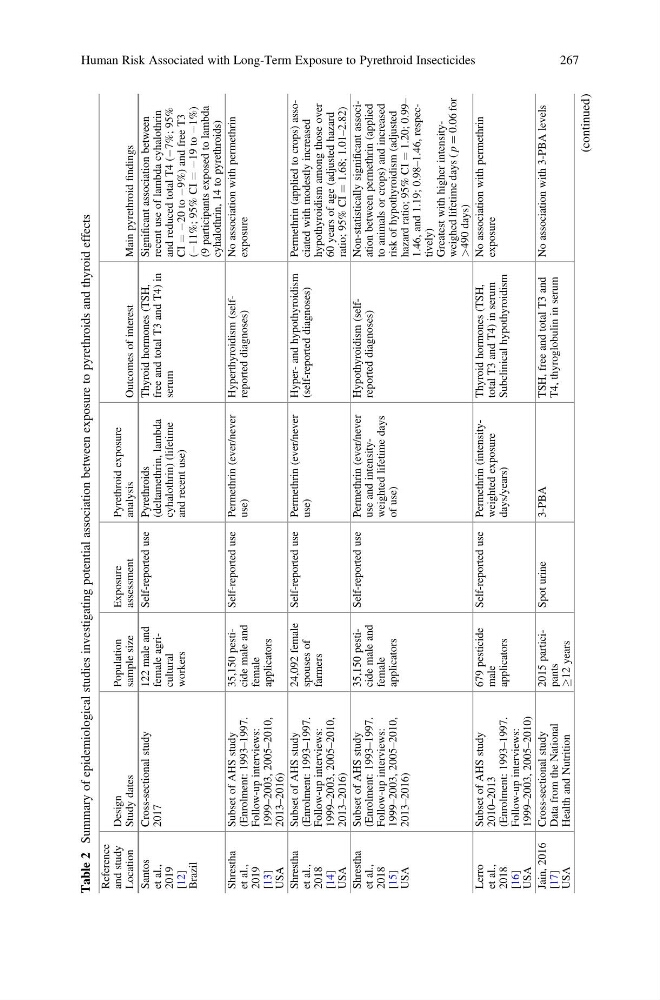
Table 2
Summary of epidemiological studies investigating potential association between exposure to pyrethroids and thyroid effects
Reference
and study
Location
Design
Study dates
Population
sample size
Exposure
assessment
Pyrethroid exposure
analysis
Outcomes of interest
Main pyrethroid
findings
Santos
et al.,
2019
[12]
Brazil
Cross-sectional study
2017
122 male and
female agricultural
workers
Self-reported use Pyrethroids
(deltamethrin, lambda
cyhalothrin) (lifetime
and recent use)
Thyroid hormones (TSH,
free and total T3 and T4) in
serum
Significant association between
recent use of lambda cyhalothrin
and reduced total T4 (À7%; 95%
CI
¼ À20 to
À9%) and free T3
(À11%; 95% CI
¼ À19 to
À1%)
(9 participants exposed to lambda
cyhalothrin, 14 to pyrethroids)
Shrestha
et al.,
2019
[13]
USA
Subset of AHS study
(Enrolment: 1993–1997.
Follow-up interviews:
1999–2003, 2005–2010,
2013–2016)
35,150 pesticide male and
female
applicators
Self-reported use Permethrin (ever/never
use)
Hyperthyroidism (selfreported diagnoses)
No association with permethrin
exposure
Shrestha
et al.,
2018
[14]
USA
Subset of AHS study
(Enrolment: 1993–1997.
Follow-up interviews:
1999–2003, 2005–2010,
2013–2016)
24,092 female
spouses of
farmers
Self-reported use Permethrin (ever/never
use)
Hyper- and hypothyroidism
(self-reported diagnoses)
Permethrin (applied to crops) associated with modestly increased
hypothyroidism among those over
60 years of age (adjusted hazard
ratio; 95% CI
¼ 1.68; 1.01–2.82)
Shrestha
et al.,
2018
[15]
USA
Subset of AHS study
(Enrolment: 1993–1997.
Follow-up interviews:
1999–2003, 2005–2010,
2013–2016)
35,150 pesticide male and
female
applicators
Self-reported use Permethrin (ever/never
use and intensityweighted lifetime days
of use)
Hypothyroidism (selfreported diagnoses)
Non-statistically significant association between permethrin (applied
to animals or crops) and increased
risk of hypothyroidism (adjusted
hazard ratio; 95% CI
¼ 1.20; 0.99–
1.46, and 1.19; 0.98–1.46, respectively)
Greatest with higher intensityweighed lifetime days ( p
¼ 0.06 for
>490 days)
Lerro
et al.,
2018
[16]
USA
Subset of AHS study
2010–2013
(Enrolment: 1993–1997.
Follow-up interviews:
1999–2003, 2005–2010)
679 pesticide
male
applicators
Self-reported use Permethrin (intensityweighted exposure
days/years)
Thyroid hormones (TSH,
total T3 and T4) in serum
Subclinical hypothyroidism
No association with permethrin
exposure
Jain, 2016
[17]
USA
Cross-sectional study
Data from the National
Health and Nutrition
2015 participants
!12 years
Spot urine
3-PBA
TSH, free and total T3 and
T4, thyroglobulin in serum
No association with 3-PBA levels
(continued)
Human Risk Associated with Long-Term Exposure to Pyrethroid Insecticides
267
Summary of epidemiological studies investigating potential association between exposure to pyrethroids and thyroid effects
Reference
and study
Location
Design
Study dates
Population
sample size
Exposure
assessment
Pyrethroid exposure
analysis
Outcomes of interest
Main pyrethroid
findings
Santos
et al.,
2019
[12]
Brazil
Cross-sectional study
2017
122 male and
female agricultural
workers
Self-reported use Pyrethroids
(deltamethrin, lambda
cyhalothrin) (lifetime
and recent use)
Thyroid hormones (TSH,
free and total T3 and T4) in
serum
Significant association between
recent use of lambda cyhalothrin
and reduced total T4 (À7%; 95%
CI
¼ À20 to
À9%) and free T3
(À11%; 95% CI
¼ À19 to
À1%)
(9 participants exposed to lambda
cyhalothrin, 14 to pyrethroids)
Shrestha
et al.,
2019
[13]
USA
Subset of AHS study
(Enrolment: 1993–1997.
Follow-up interviews:
1999–2003, 2005–2010,
2013–2016)
35,150 pesticide male and
female
applicators
Self-reported use Permethrin (ever/never
use)
Hyperthyroidism (selfreported diagnoses)
No association with permethrin
exposure
Shrestha
et al.,
2018
[14]
USA
Subset of AHS study
(Enrolment: 1993–1997.
Follow-up interviews:
1999–2003, 2005–2010,
2013–2016)
24,092 female
spouses of
farmers
Self-reported use Permethrin (ever/never
use)
Hyper- and hypothyroidism
(self-reported diagnoses)
Permethrin (applied to crops) associated with modestly increased
hypothyroidism among those over
60 years of age (adjusted hazard
ratio; 95% CI
¼ 1.68; 1.01–2.82)
Shrestha
et al.,
2018
[15]
USA
Subset of AHS study
(Enrolment: 1993–1997.
Follow-up interviews:
1999–2003, 2005–2010,
2013–2016)
35,150 pesticide male and
female
applicators
Self-reported use Permethrin (ever/never
use and intensityweighted lifetime days
of use)
Hypothyroidism (selfreported diagnoses)
Non-statistically significant association between permethrin (applied
to animals or crops) and increased
risk of hypothyroidism (adjusted
hazard ratio; 95% CI
¼ 1.20; 0.99–
1.46, and 1.19; 0.98–1.46, respectively)
Greatest with higher intensityweighed lifetime days ( p
¼ 0.06 for
>490 days)
Lerro
et al.,
2018
[16]
USA
Subset of AHS study
2010–2013
(Enrolment: 1993–1997.
Follow-up interviews:
1999–2003, 2005–2010)
679 pesticide
male
applicators
Self-reported use Permethrin (intensityweighted exposure
days/years)
Thyroid hormones (TSH,
total T3 and T4) in serum
Subclinical hypothyroidism
No association with permethrin
exposure
Jain, 2016
[17]
USA
Cross-sectional study
Data from the National
Health and Nutrition
2015 participants
!12 years
Spot urine
3-PBA
TSH, free and total T3 and
T4, thyroglobulin in serum
No association with 3-PBA levels
(continued)
Human Risk Associated with Long-Term Exposure to Pyrethroid Insecticides
267