

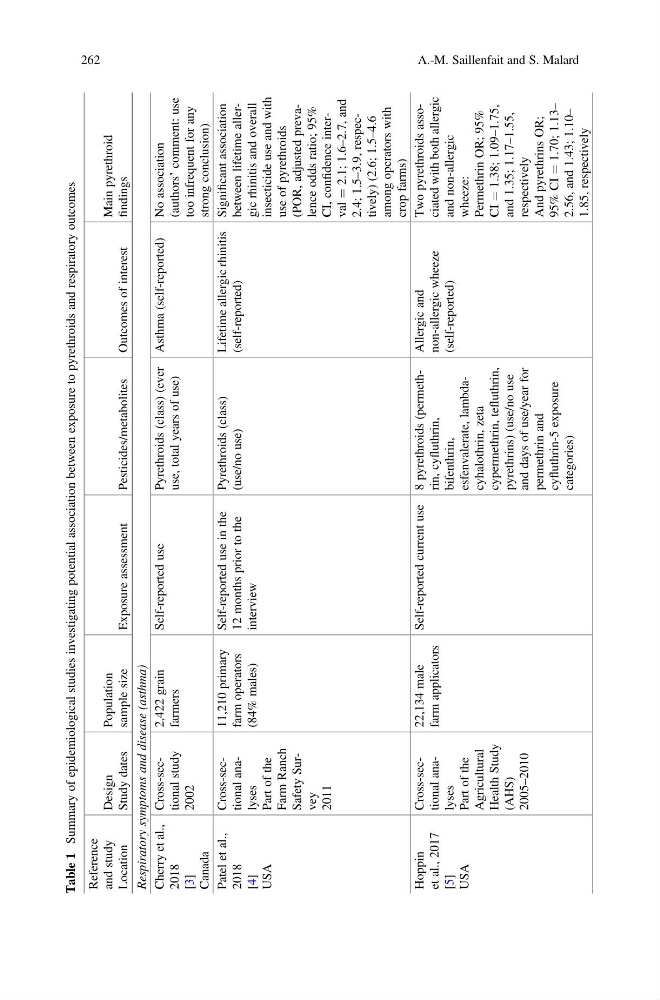
Table 1
Summary of epidemiological studies investigating potential association between exposure to pyrethroids and respiratory outcomes
Reference
and study
Location
Design
Study dates
Population
sample size
Exposure assessment
Pesticides/metabolites
Outcomes of interest
Main pyrethroid
findings
Respiratory symptoms and disease (asthma)
Cherry et al.,
2018
[3]
Canada
Cross-sectional study
2002
2,422 grain
farmers
Self-reported use
Pyrethroids (class) (ever
use, total years of use)
Asthma (self-reported)
No association
(authors’ comment: use
too infrequent for any
strong conclusion)
Patel et al.,
2018
[4]
USA
Cross-sectional analyses
Part of the
Farm Ranch
Safety Survey
2011
11,210 primary
farm operators
(84% males)
Self-reported use in the
12 months prior to the
interview
Pyrethroids (class)
(use/no use)
Lifetime allergic rhinitis
(self-reported)
Significant association
between lifetime allergic rhinitis and overall
insecticide use and with
use of pyrethroids
(POR, adjusted prevalence odds ratio; 95%
CI, confidence interval
¼ 2.1; 1.6–2.7, and
2.4; 1.5–3.9, respectively) (2.6; 1.5–4.6
among operators with
crop farms)
Hoppin
et al., 2017
[5]
USA
Cross-sectional analyses
Part of the
Agricultural
Health Study
(AHS)
2005–2010
22,134 male
farm applicators
Self-reported current use 8 pyrethroids (permethrin, cyfluthrin,
bifenthrin,
esfenvalerate, lambdacyhalothrin, zeta
cypermethrin, tefluthrin,
pyrethrins) (use/no use
and days of use/year for
permethrin and
cyfluthrin-5 exposure
categories)
Allergic and
non-allergic wheeze
(self-reported)
Two pyrethroids associated with both allergic
and non-allergic
wheeze:
Permethrin OR; 95%
CI
¼ 1.38; 1.09–1.75,
and 1.35; 1.17–1.55,
respectively
And pyrethrins OR;
95% CI
¼ 1.70; 1.13–
2.56, and 1.43; 1.10–
1.85, respectively
262
A.-M. Saillenfait and S. Malard
Summary of epidemiological studies investigating potential association between exposure to pyrethroids and respiratory outcomes
Reference
and study
Location
Design
Study dates
Population
sample size
Exposure assessment
Pesticides/metabolites
Outcomes of interest
Main pyrethroid
findings
Respiratory symptoms and disease (asthma)
Cherry et al.,
2018
[3]
Canada
Cross-sectional study
2002
2,422 grain
farmers
Self-reported use
Pyrethroids (class) (ever
use, total years of use)
Asthma (self-reported)
No association
(authors’ comment: use
too infrequent for any
strong conclusion)
Patel et al.,
2018
[4]
USA
Cross-sectional analyses
Part of the
Farm Ranch
Safety Survey
2011
11,210 primary
farm operators
(84% males)
Self-reported use in the
12 months prior to the
interview
Pyrethroids (class)
(use/no use)
Lifetime allergic rhinitis
(self-reported)
Significant association
between lifetime allergic rhinitis and overall
insecticide use and with
use of pyrethroids
(POR, adjusted prevalence odds ratio; 95%
CI, confidence interval
¼ 2.1; 1.6–2.7, and
2.4; 1.5–3.9, respectively) (2.6; 1.5–4.6
among operators with
crop farms)
Hoppin
et al., 2017
[5]
USA
Cross-sectional analyses
Part of the
Agricultural
Health Study
(AHS)
2005–2010
22,134 male
farm applicators
Self-reported current use 8 pyrethroids (permethrin, cyfluthrin,
bifenthrin,
esfenvalerate, lambdacyhalothrin, zeta
cypermethrin, tefluthrin,
pyrethrins) (use/no use
and days of use/year for
permethrin and
cyfluthrin-5 exposure
categories)
Allergic and
non-allergic wheeze
(self-reported)
Two pyrethroids associated with both allergic
and non-allergic
wheeze:
Permethrin OR; 95%
CI
¼ 1.38; 1.09–1.75,
and 1.35; 1.17–1.55,
respectively
And pyrethrins OR;
95% CI
¼ 1.70; 1.13–
2.56, and 1.43; 1.10–
1.85, respectively
262
A.-M. Saillenfait and S. Malard