

hydrophobic organic pollutants are often hardly detected with conventional methods
such as grab sampling, making it difficult to detect trace levels of pollutants. Robust
data obtained from PSDs, with previous calibration and analytic methods performed
in the laboratory, allows trace levels to be determined. These procedures allow the
passive sampling method to be validated and increase confidence in the field
sampling.
In theory, passive samplers are devices that are based on the initial uptake of
dissolved pollutants (dissolved free fraction) to the receiver medium (passive sampler), given the different concentrations in the water and sampler, called the kinetic
phase. The linear uptake continues until the curvilinear phase is reached. Finally, as
exposure time increases, the net flow of analytes from the water to the sampler
continues until equilibrium – called the equilibrium phase – is reached.
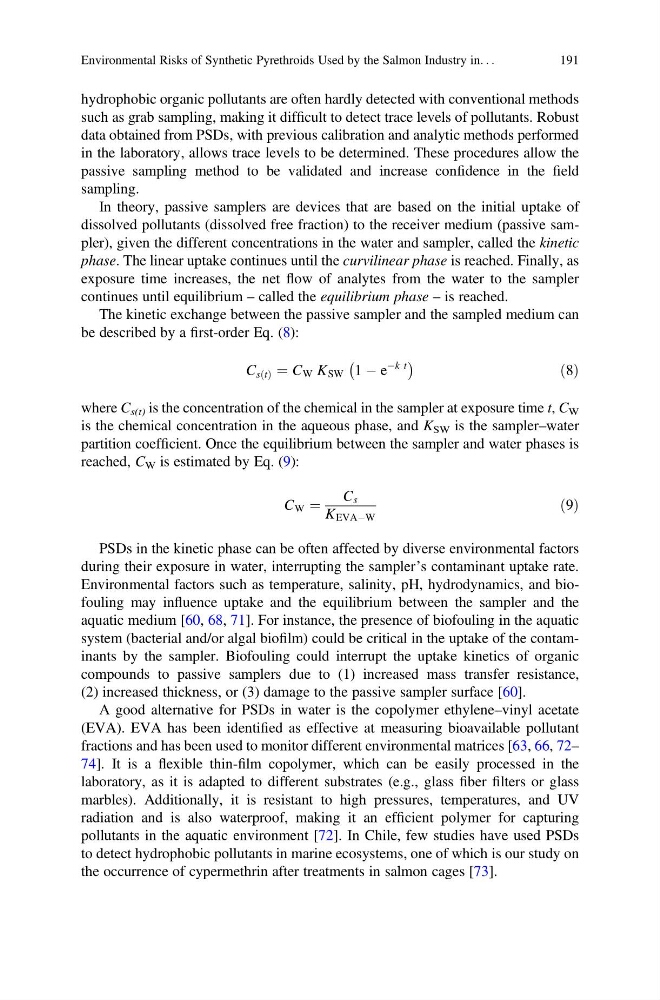
The kinetic exchange between the passive sampler and the sampled medium can
be described by a first-order Eq. (8):
C s t
ð Þ ¼ C W K SW 1 À e
Àk t
À
Á
ð8Þ
where C s(t) is the concentration of the chemical in the sampler at exposure time t, C W
is the chemical concentration in the aqueous phase, and K SW is the sampler–water
partition coefficient. Once the equilibrium between the sampler and water phases is
reached, C W is estimated by Eq. (9):
C W ¼
C s
K EVAÀW
ð9Þ
PSDs in the kinetic phase can be often affected by diverse environmental factors
during their exposure in water, interrupting the sampler’s contaminant uptake rate.
Environmental factors such as temperature, salinity, pH, hydrodynamics, and biofouling may influence uptake and the equilibrium between the sampler and the
aquatic medium [60, 68, 71]. For instance, the presence of biofouling in the aquatic
system (bacterial and/or algal biofilm) could be critical in the uptake of the contaminants by the sampler. Biofouling could interrupt the uptake kinetics of organic
compounds to passive samplers due to (1) increased mass transfer resistance,
(2) increased thickness, or (3) damage to the passive sampler surface [60].
A good alternative for PSDs in water is the copolymer ethylene–vinyl acetate
(EVA). EVA has been identified as effective at measuring bioavailable pollutant
fractions and has been used to monitor different environmental matrices [63, 66, 72–
74]. It is a flexible thin-film copolymer, which can be easily processed in the
laboratory, as it is adapted to different substrates (e.g., glass fiber filters or glass
marbles). Additionally, it is resistant to high pressures, temperatures, and UV
radiation and is also waterproof, making it an efficient polymer for capturing
pollutants in the aquatic environment [72]. In Chile, few studies have used PSDs
to detect hydrophobic pollutants in marine ecosystems, one of which is our study on
the occurrence of cypermethrin after treatments in salmon cages [73].
Environmental Risks of Synthetic Pyrethroids Used by the Salmon Industry in. . .
191
such as grab sampling, making it difficult to detect trace levels of pollutants. Robust
data obtained from PSDs, with previous calibration and analytic methods performed
in the laboratory, allows trace levels to be determined. These procedures allow the
passive sampling method to be validated and increase confidence in the field
sampling.
In theory, passive samplers are devices that are based on the initial uptake of
dissolved pollutants (dissolved free fraction) to the receiver medium (passive sampler), given the different concentrations in the water and sampler, called the kinetic
phase. The linear uptake continues until the curvilinear phase is reached. Finally, as
exposure time increases, the net flow of analytes from the water to the sampler
continues until equilibrium – called the equilibrium phase – is reached.
The kinetic exchange between the passive sampler and the sampled medium can
be described by a first-order Eq. (8):
C s t
ð Þ ¼ C W K SW 1 À e
Àk t
À
Á
ð8Þ
where C s(t) is the concentration of the chemical in the sampler at exposure time t, C W
is the chemical concentration in the aqueous phase, and K SW is the sampler–water
partition coefficient. Once the equilibrium between the sampler and water phases is
reached, C W is estimated by Eq. (9):
C W ¼
C s
K EVAÀW
ð9Þ
PSDs in the kinetic phase can be often affected by diverse environmental factors
during their exposure in water, interrupting the sampler’s contaminant uptake rate.
Environmental factors such as temperature, salinity, pH, hydrodynamics, and biofouling may influence uptake and the equilibrium between the sampler and the
aquatic medium [60, 68, 71]. For instance, the presence of biofouling in the aquatic
system (bacterial and/or algal biofilm) could be critical in the uptake of the contaminants by the sampler. Biofouling could interrupt the uptake kinetics of organic
compounds to passive samplers due to (1) increased mass transfer resistance,
(2) increased thickness, or (3) damage to the passive sampler surface [60].
A good alternative for PSDs in water is the copolymer ethylene–vinyl acetate
(EVA). EVA has been identified as effective at measuring bioavailable pollutant
fractions and has been used to monitor different environmental matrices [63, 66, 72–
74]. It is a flexible thin-film copolymer, which can be easily processed in the
laboratory, as it is adapted to different substrates (e.g., glass fiber filters or glass
marbles). Additionally, it is resistant to high pressures, temperatures, and UV
radiation and is also waterproof, making it an efficient polymer for capturing
pollutants in the aquatic environment [72]. In Chile, few studies have used PSDs
to detect hydrophobic pollutants in marine ecosystems, one of which is our study on
the occurrence of cypermethrin after treatments in salmon cages [73].
Environmental Risks of Synthetic Pyrethroids Used by the Salmon Industry in. . .
191