

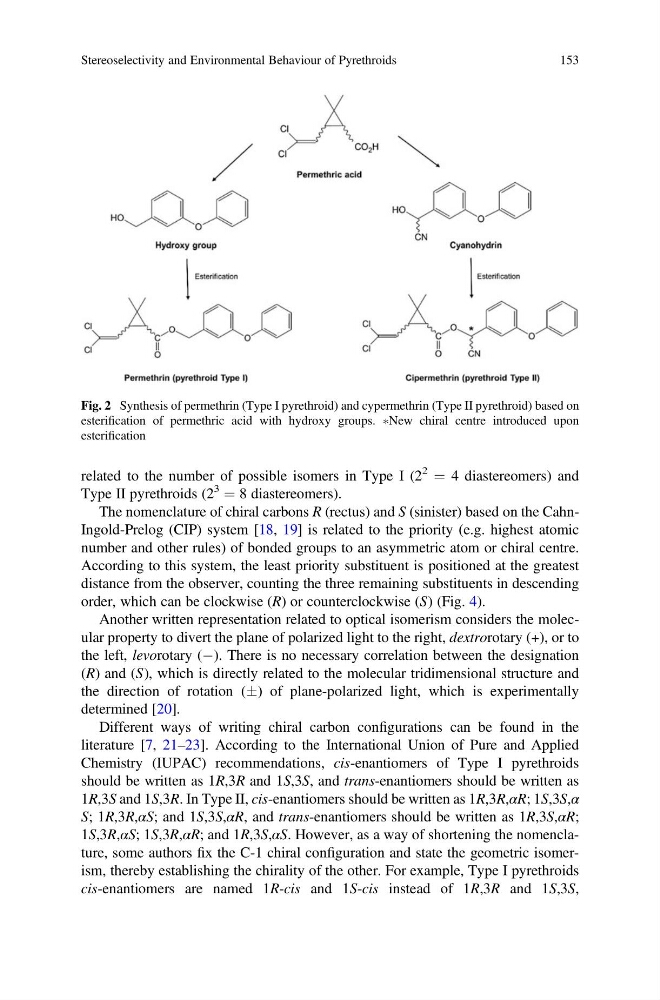
related to the number of possible isomers in Type I (2
2
¼ 4 diastereomers) and
Type II pyrethroids (2
3
¼ 8 diastereomers).
The nomenclature of chiral carbons R (rectus) and S (sinister) based on the CahnIngold-Prelog (CIP) system [18, 19] is related to the priority (e.g. highest atomic
number and other rules) of bonded groups to an asymmetric atom or chiral centre.
According to this system, the least priority substituent is positioned at the greatest
distance from the observer, counting the three remaining substituents in descending
order, which can be clockwise (R) or counterclockwise (S) (Fig. 4).
Another written representation related to optical isomerism considers the molecular property to divert the plane of polarized light to the right, dextrorotary (+), or to
the left, levorotary (À). There is no necessary correlation between the designation
(R) and (S), which is directly related to the molecular tridimensional structure and
the direction of rotation (Æ) of plane-polarized light, which is experimentally
determined [20].
Different ways of writing chiral carbon configurations can be found in the
literature [7, 21–23]. According to the International Union of Pure and Applied
Chemistry (IUPAC) recommendations, cis-enantiomers of Type I pyrethroids
should be written as 1R,3R and 1S,3S, and trans-enantiomers should be written as
1R,3S and 1S,3R. In Type II, cis-enantiomers should be written as 1R,3R,αR; 1S,3S,α
S; 1R,3R,αS; and 1S,3S,αR, and trans-enantiomers should be written as 1R,3S,αR;
1S,3R,αS; 1S,3R,αR; and 1R,3S,αS. However, as a way of shortening the nomenclature, some authors fix the C-1 chiral configuration and state the geometric isomerism, thereby establishing the chirality of the other. For example, Type I pyrethroids
cis-enantiomers are named 1R-cis and 1S-cis instead of 1R,3R and 1S,3S,
Fig. 2 Synthesis of permethrin (Type I pyrethroid) and cypermethrin (Type II pyrethroid) based on
esterification of permethric acid with hydroxy groups. ÃNew chiral centre introduced upon
esterification
Stereoselectivity and Environmental Behaviour of Pyrethroids
153
2
¼ 4 diastereomers) and
Type II pyrethroids (2
3
¼ 8 diastereomers).
The nomenclature of chiral carbons R (rectus) and S (sinister) based on the CahnIngold-Prelog (CIP) system [18, 19] is related to the priority (e.g. highest atomic
number and other rules) of bonded groups to an asymmetric atom or chiral centre.
According to this system, the least priority substituent is positioned at the greatest
distance from the observer, counting the three remaining substituents in descending
order, which can be clockwise (R) or counterclockwise (S) (Fig. 4).
Another written representation related to optical isomerism considers the molecular property to divert the plane of polarized light to the right, dextrorotary (+), or to
the left, levorotary (À). There is no necessary correlation between the designation
(R) and (S), which is directly related to the molecular tridimensional structure and
the direction of rotation (Æ) of plane-polarized light, which is experimentally
determined [20].
Different ways of writing chiral carbon configurations can be found in the
literature [7, 21–23]. According to the International Union of Pure and Applied
Chemistry (IUPAC) recommendations, cis-enantiomers of Type I pyrethroids
should be written as 1R,3R and 1S,3S, and trans-enantiomers should be written as
1R,3S and 1S,3R. In Type II, cis-enantiomers should be written as 1R,3R,αR; 1S,3S,α
S; 1R,3R,αS; and 1S,3S,αR, and trans-enantiomers should be written as 1R,3S,αR;
1S,3R,αS; 1S,3R,αR; and 1R,3S,αS. However, as a way of shortening the nomenclature, some authors fix the C-1 chiral configuration and state the geometric isomerism, thereby establishing the chirality of the other. For example, Type I pyrethroids
cis-enantiomers are named 1R-cis and 1S-cis instead of 1R,3R and 1S,3S,
Fig. 2 Synthesis of permethrin (Type I pyrethroid) and cypermethrin (Type II pyrethroid) based on
esterification of permethric acid with hydroxy groups. ÃNew chiral centre introduced upon
esterification
Stereoselectivity and Environmental Behaviour of Pyrethroids
153