

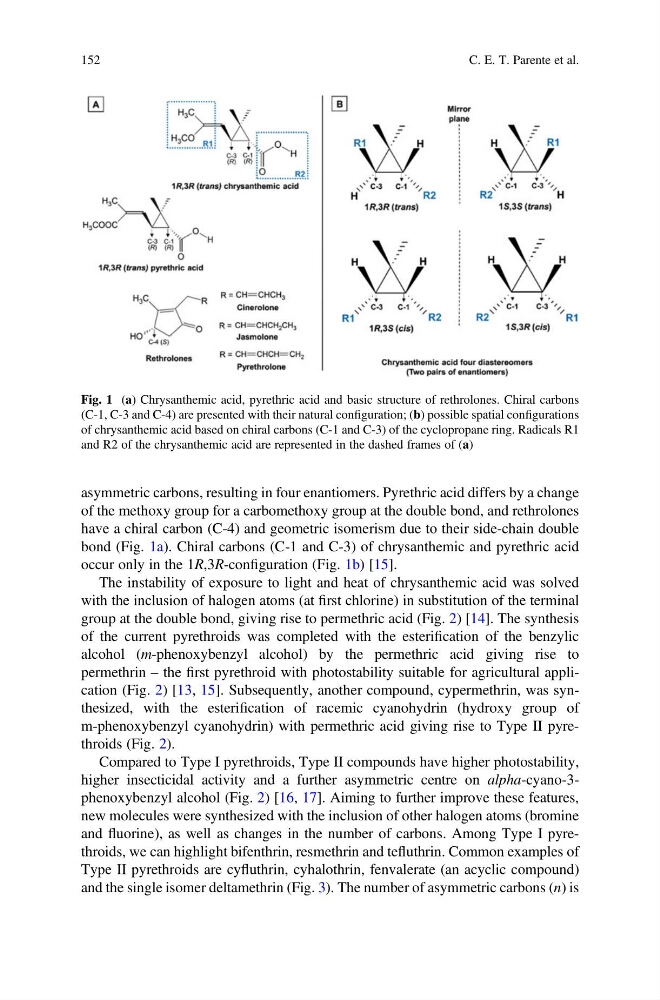
asymmetric carbons, resulting in four enantiomers. Pyrethric acid differs by a change
of the methoxy group for a carbomethoxy group at the double bond, and rethrolones
have a chiral carbon (C-4) and geometric isomerism due to their side-chain double
bond (Fig. 1a). Chiral carbons (C-1 and C-3) of chrysanthemic and pyrethric acid
occur only in the 1R,3R-configuration (Fig. 1b) [15].
The instability of exposure to light and heat of chrysanthemic acid was solved
with the inclusion of halogen atoms (at first chlorine) in substitution of the terminal
group at the double bond, giving rise to permethric acid (Fig. 2) [14]. The synthesis
of the current pyrethroids was completed with the esterification of the benzylic
alcohol (m-phenoxybenzyl alcohol) by the permethric acid giving rise to
permethrin – the first pyrethroid with photostability suitable for agricultural application (Fig. 2) [13, 15]. Subsequently, another compound, cypermethrin, was synthesized, with the esterification of racemic cyanohydrin (hydroxy group of
m-phenoxybenzyl cyanohydrin) with permethric acid giving rise to Type II pyrethroids (Fig. 2).
Compared to Type I pyrethroids, Type II compounds have higher photostability,
higher insecticidal activity and a further asymmetric centre on alpha-cyano-3phenoxybenzyl alcohol (Fig. 2) [16, 17]. Aiming to further improve these features,
new molecules were synthesized with the inclusion of other halogen atoms (bromine
and fluorine), as well as changes in the number of carbons. Among Type I pyrethroids, we can highlight bifenthrin, resmethrin and tefluthrin. Common examples of
Type II pyrethroids are cyfluthrin, cyhalothrin, fenvalerate (an acyclic compound)
and the single isomer deltamethrin (Fig. 3). The number of asymmetric carbons (n) is
Fig. 1 (a) Chrysanthemic acid, pyrethric acid and basic structure of rethrolones. Chiral carbons
(C-1, C-3 and C-4) are presented with their natural configuration; (b) possible spatial configurations
of chrysanthemic acid based on chiral carbons (C-1 and C-3) of the cyclopropane ring. Radicals R1
and R2 of the chrysanthemic acid are represented in the dashed frames of (a)
152
C. E. T. Parente et al.
of the methoxy group for a carbomethoxy group at the double bond, and rethrolones
have a chiral carbon (C-4) and geometric isomerism due to their side-chain double
bond (Fig. 1a). Chiral carbons (C-1 and C-3) of chrysanthemic and pyrethric acid
occur only in the 1R,3R-configuration (Fig. 1b) [15].
The instability of exposure to light and heat of chrysanthemic acid was solved
with the inclusion of halogen atoms (at first chlorine) in substitution of the terminal
group at the double bond, giving rise to permethric acid (Fig. 2) [14]. The synthesis
of the current pyrethroids was completed with the esterification of the benzylic
alcohol (m-phenoxybenzyl alcohol) by the permethric acid giving rise to
permethrin – the first pyrethroid with photostability suitable for agricultural application (Fig. 2) [13, 15]. Subsequently, another compound, cypermethrin, was synthesized, with the esterification of racemic cyanohydrin (hydroxy group of
m-phenoxybenzyl cyanohydrin) with permethric acid giving rise to Type II pyrethroids (Fig. 2).
Compared to Type I pyrethroids, Type II compounds have higher photostability,
higher insecticidal activity and a further asymmetric centre on alpha-cyano-3phenoxybenzyl alcohol (Fig. 2) [16, 17]. Aiming to further improve these features,
new molecules were synthesized with the inclusion of other halogen atoms (bromine
and fluorine), as well as changes in the number of carbons. Among Type I pyrethroids, we can highlight bifenthrin, resmethrin and tefluthrin. Common examples of
Type II pyrethroids are cyfluthrin, cyhalothrin, fenvalerate (an acyclic compound)
and the single isomer deltamethrin (Fig. 3). The number of asymmetric carbons (n) is
Fig. 1 (a) Chrysanthemic acid, pyrethric acid and basic structure of rethrolones. Chiral carbons
(C-1, C-3 and C-4) are presented with their natural configuration; (b) possible spatial configurations
of chrysanthemic acid based on chiral carbons (C-1 and C-3) of the cyclopropane ring. Radicals R1
and R2 of the chrysanthemic acid are represented in the dashed frames of (a)
152
C. E. T. Parente et al.