

3 Sublethal Effects
In addition to being acutely toxic at environmentally relevant concentrations, pyrethroids cause a myriad of sublethal impacts in nontarget aquatic invertebrates
[6, 72]. Effects on invertebrate behavior are widely documented, including impaired
movement, resulting in the inability to respond to a simulated predator by swimming
away or by taking shelter [26, 43, 73]. Increased predation risk caused by sublethal
pyrethroid exposure can affect entire food webs or assemblages of lower trophic
level organisms integral to the diet of fishes and birds [28, 31]. Other commonly
observed effects include changes in the rate of development and growth, or effects
on reproduction [74–76], indicating that pyrethroids act as endocrine disruptors in
invertebrates. For example, midges (Chironomus riparius) exposed to cypermethrin
developed more slowly than controls, and the effect on male development was
more severe [75]. The aquatic oligochaete Lumbriculus variegatus had lowered
reproductive output following exposure to part per billion concentrations of
esfenvalerate [77]. Pyrethroids act as immunotoxicants in invertebrates, such as
mollusks [78], and cause oxidative stress in a wide variety of species including
crayfish, tiger shrimp, and the model invertebrate Daphnia magna [79–81]. More
sensitive sublethal endpoints, such as swimming performance, are exacerbated by
alterations in salinity and temperature [70]. The magnitude of fluctuations in these
abiotic parameters is expected to increase in magnitude as global climate change
1e+7
1e+6
1e+5
1e+4
1e+3
1e+2
1e+1
1e+0
1e–1
crustacean insect
fish
amphibian mollusk
LC50 (Hyalella equivalents)
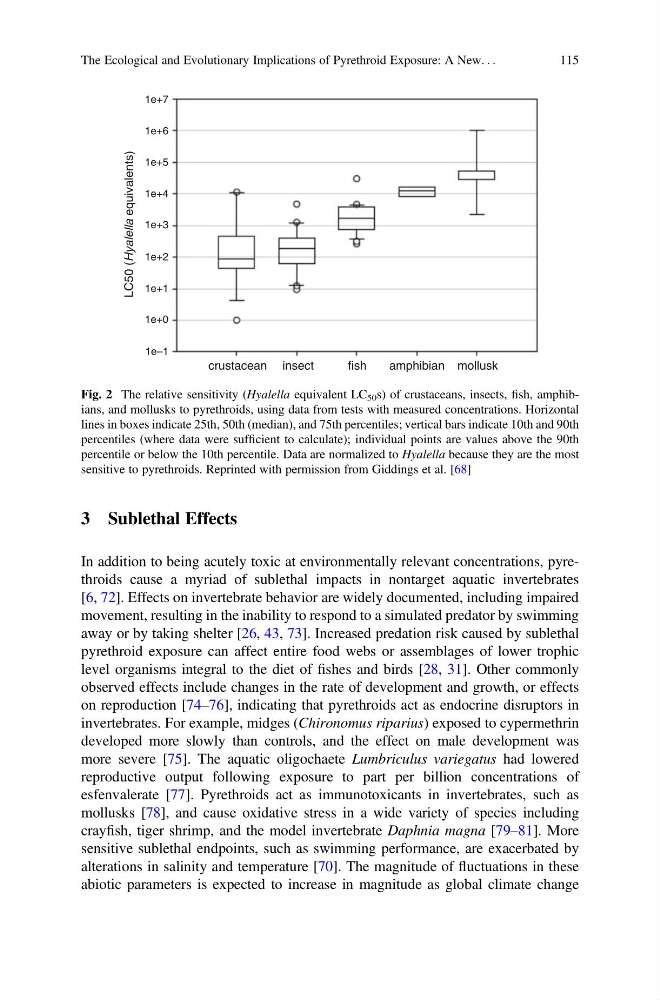
Fig. 2 The relative sensitivity (Hyalella equivalent LC 50 s) of crustaceans, insects, fish, amphibians, and mollusks to pyrethroids, using data from tests with measured concentrations. Horizontal
lines in boxes indicate 25th, 50th (median), and 75th percentiles; vertical bars indicate 10th and 90th
percentiles (where data were sufficient to calculate); individual points are values above the 90th
percentile or below the 10th percentile. Data are normalized to Hyalella because they are the most
sensitive to pyrethroids. Reprinted with permission from Giddings et al. [68]
The Ecological and Evolutionary Implications of Pyrethroid Exposure: A New. . .
115
In addition to being acutely toxic at environmentally relevant concentrations, pyrethroids cause a myriad of sublethal impacts in nontarget aquatic invertebrates
[6, 72]. Effects on invertebrate behavior are widely documented, including impaired
movement, resulting in the inability to respond to a simulated predator by swimming
away or by taking shelter [26, 43, 73]. Increased predation risk caused by sublethal
pyrethroid exposure can affect entire food webs or assemblages of lower trophic
level organisms integral to the diet of fishes and birds [28, 31]. Other commonly
observed effects include changes in the rate of development and growth, or effects
on reproduction [74–76], indicating that pyrethroids act as endocrine disruptors in
invertebrates. For example, midges (Chironomus riparius) exposed to cypermethrin
developed more slowly than controls, and the effect on male development was
more severe [75]. The aquatic oligochaete Lumbriculus variegatus had lowered
reproductive output following exposure to part per billion concentrations of
esfenvalerate [77]. Pyrethroids act as immunotoxicants in invertebrates, such as
mollusks [78], and cause oxidative stress in a wide variety of species including
crayfish, tiger shrimp, and the model invertebrate Daphnia magna [79–81]. More
sensitive sublethal endpoints, such as swimming performance, are exacerbated by
alterations in salinity and temperature [70]. The magnitude of fluctuations in these
abiotic parameters is expected to increase in magnitude as global climate change
1e+7
1e+6
1e+5
1e+4
1e+3
1e+2
1e+1
1e+0
1e–1
crustacean insect
fish
amphibian mollusk
LC50 (Hyalella equivalents)
Fig. 2 The relative sensitivity (Hyalella equivalent LC 50 s) of crustaceans, insects, fish, amphibians, and mollusks to pyrethroids, using data from tests with measured concentrations. Horizontal
lines in boxes indicate 25th, 50th (median), and 75th percentiles; vertical bars indicate 10th and 90th
percentiles (where data were sufficient to calculate); individual points are values above the 90th
percentile or below the 10th percentile. Data are normalized to Hyalella because they are the most
sensitive to pyrethroids. Reprinted with permission from Giddings et al. [68]
The Ecological and Evolutionary Implications of Pyrethroid Exposure: A New. . .
115