

abundances in water, suspended particles, sediments, atmospheric gas, and aerosols
phases from regional to a global scales. Scientific efforts addressing pollutant
detection in several environmental compartments brought quantitative appraisals
and understanding of transport fluxes between air, seawater, soils, etc. This holds
true for PCBs [76] and PAHs [77] but also for pesticides like lindane [78]. In contrast
to legacy pollutants, pyrethroids are current-use pesticides, and they have been used
and emitted to the environment for only the last few decades, and scientists have
been able to quantify pyrethroids at environmental levels only for a decade [79]. As a
consequence, the occurrence of pyrethroids in environmental phases relevant to the
understanding of their biogeochemical cycle is still incompletely understood.
A comprehensive assessment of pyrethroid cycle in an urban area of Southern
China used a fugacity-based model coupled to concentrations measured in different
environment phases to calculate the diffusive and advective fluxes [25]. Sinking of
suspended particles accounted for the higher fluxes, and resulted in water bed
sediments fluxes 1 or 2 order of magnitude higher than air-water diffusive exchange.
The higher fugacity of pyrethroid in water than in the gaseous atmosphere drove
volatilization fluxes from the water to the air, permethrin, and cypermethrin having
the higher fluxes. Despite this work, pyrethroids have received less attention in terms
of their fate, transport, and biogeochemistry, and how these processes ought to be
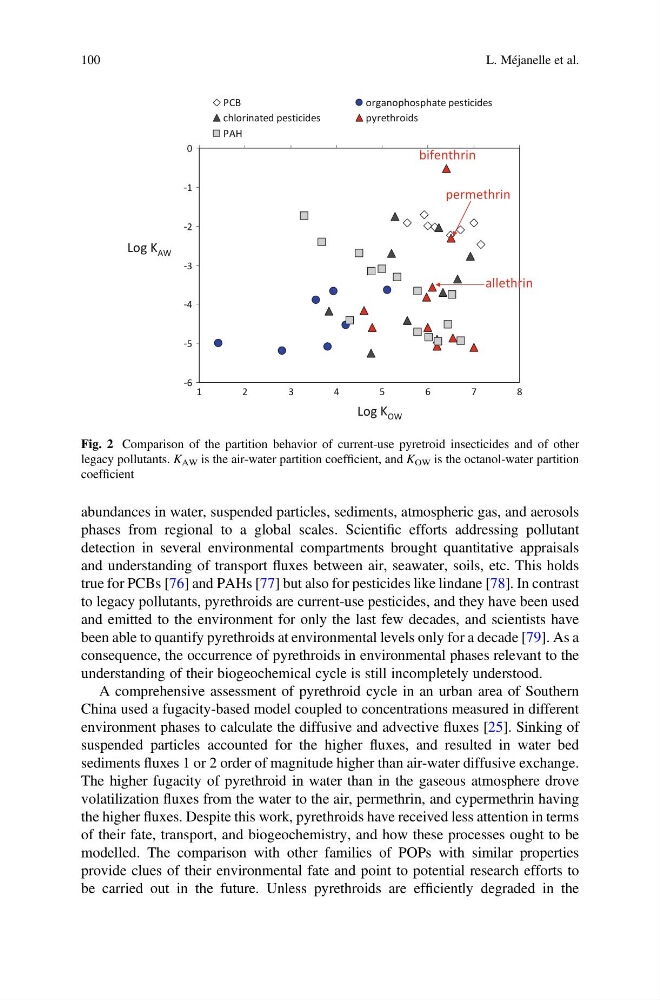
modelled. The comparison with other families of POPs with similar properties
provide clues of their environmental fate and point to potential research efforts to
be carried out in the future. Unless pyrethroids are efficiently degraded in the
‐6
‐5
‐4
‐3
‐2
‐1
0
1
2
3
4
5
6
7
8
PCB
organophosphate pesticides
chlorinated pesticides
pyrethroids
PAH
Log K OW
Log K AW
bifenthrin
permethrin
allethrin
Fig. 2 Comparison of the partition behavior of current-use pyretroid insecticides and of other
legacy pollutants. K AW is the air-water partition coefficient, and K OW is the octanol-water partition
coefficient
100
L. Méjanelle et al.
phases from regional to a global scales. Scientific efforts addressing pollutant
detection in several environmental compartments brought quantitative appraisals
and understanding of transport fluxes between air, seawater, soils, etc. This holds
true for PCBs [76] and PAHs [77] but also for pesticides like lindane [78]. In contrast
to legacy pollutants, pyrethroids are current-use pesticides, and they have been used
and emitted to the environment for only the last few decades, and scientists have
been able to quantify pyrethroids at environmental levels only for a decade [79]. As a
consequence, the occurrence of pyrethroids in environmental phases relevant to the
understanding of their biogeochemical cycle is still incompletely understood.
A comprehensive assessment of pyrethroid cycle in an urban area of Southern
China used a fugacity-based model coupled to concentrations measured in different
environment phases to calculate the diffusive and advective fluxes [25]. Sinking of
suspended particles accounted for the higher fluxes, and resulted in water bed
sediments fluxes 1 or 2 order of magnitude higher than air-water diffusive exchange.
The higher fugacity of pyrethroid in water than in the gaseous atmosphere drove
volatilization fluxes from the water to the air, permethrin, and cypermethrin having
the higher fluxes. Despite this work, pyrethroids have received less attention in terms
of their fate, transport, and biogeochemistry, and how these processes ought to be
modelled. The comparison with other families of POPs with similar properties
provide clues of their environmental fate and point to potential research efforts to
be carried out in the future. Unless pyrethroids are efficiently degraded in the
‐6
‐5
‐4
‐3
‐2
‐1
0
1
2
3
4
5
6
7
8
PCB
organophosphate pesticides
chlorinated pesticides
pyrethroids
PAH
Log K OW
Log K AW
bifenthrin
permethrin
allethrin
Fig. 2 Comparison of the partition behavior of current-use pyretroid insecticides and of other
legacy pollutants. K AW is the air-water partition coefficient, and K OW is the octanol-water partition
coefficient
100
L. Méjanelle et al.