

42
R. Mathur et al.
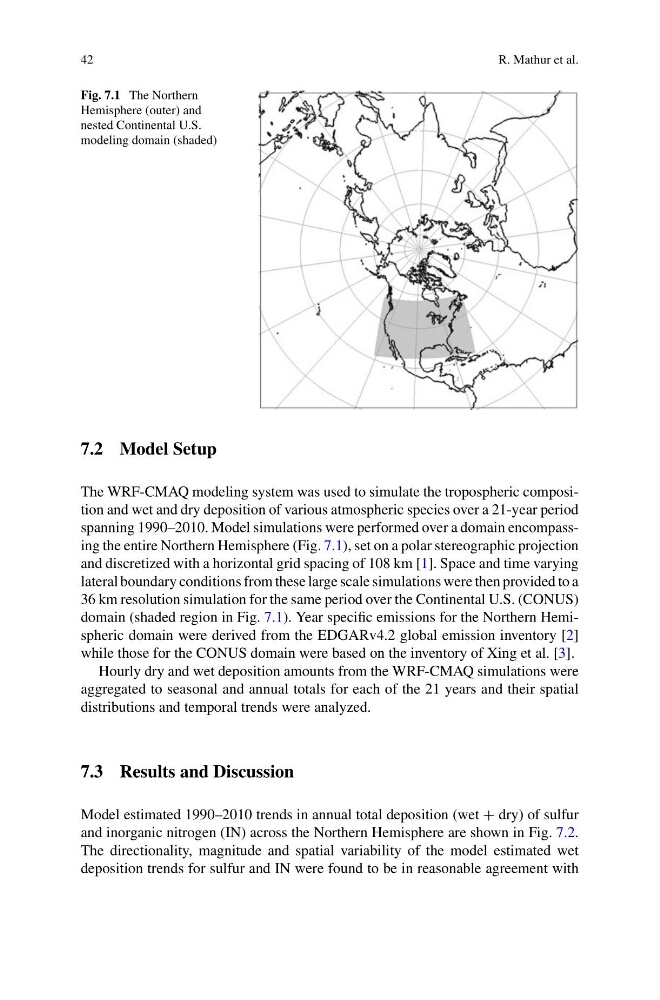
Fig. 7.1 The Northern
Hemisphere (outer) and
nested Continental U.S.
modeling domain (shaded)
7.2 Model Setup
The WRF-CMAQ modeling system was used to simulate the tropospheric composition and wet and dry deposition of various atmospheric species over a 21-year period
spanning 1990–2010. Model simulations were performed over a domain encompassing the entire Northern Hemisphere (Fig. 7.1), set on a polar stereographic projection
and discretized with a horizontal grid spacing of 108 km [1]. Space and time varying
lateral boundary conditions from these large scale simulations were then provided to a
36 km resolution simulation for the same period over the Continental U.S. (CONUS)
domain (shaded region in Fig. 7.1). Year specific emissions for the Northern Hemispheric domain were derived from the EDGARv4.2 global emission inventory [2]
while those for the CONUS domain were based on the inventory of Xing et al. [3].
Hourly dry and wet deposition amounts from the WRF-CMAQ simulations were
aggregated to seasonal and annual totals for each of the 21 years and their spatial
distributions and temporal trends were analyzed.
7.3 Results and Discussion
Model estimated 1990–2010 trends in annual total deposition (wet + dry) of sulfur
and inorganic nitrogen (IN) across the Northern Hemisphere are shown in Fig. 7.2.
The directionality, magnitude and spatial variability of the model estimated wet
deposition trends for sulfur and IN were found to be in reasonable agreement with
R. Mathur et al.
Fig. 7.1 The Northern
Hemisphere (outer) and
nested Continental U.S.
modeling domain (shaded)
7.2 Model Setup
The WRF-CMAQ modeling system was used to simulate the tropospheric composition and wet and dry deposition of various atmospheric species over a 21-year period
spanning 1990–2010. Model simulations were performed over a domain encompassing the entire Northern Hemisphere (Fig. 7.1), set on a polar stereographic projection
and discretized with a horizontal grid spacing of 108 km [1]. Space and time varying
lateral boundary conditions from these large scale simulations were then provided to a
36 km resolution simulation for the same period over the Continental U.S. (CONUS)
domain (shaded region in Fig. 7.1). Year specific emissions for the Northern Hemispheric domain were derived from the EDGARv4.2 global emission inventory [2]
while those for the CONUS domain were based on the inventory of Xing et al. [3].
Hourly dry and wet deposition amounts from the WRF-CMAQ simulations were
aggregated to seasonal and annual totals for each of the 21 years and their spatial
distributions and temporal trends were analyzed.
7.3 Results and Discussion
Model estimated 1990–2010 trends in annual total deposition (wet + dry) of sulfur
and inorganic nitrogen (IN) across the Northern Hemisphere are shown in Fig. 7.2.
The directionality, magnitude and spatial variability of the model estimated wet
deposition trends for sulfur and IN were found to be in reasonable agreement with