

6 A Proof-of-Concept for Linking the Global Meteorological Model …
39
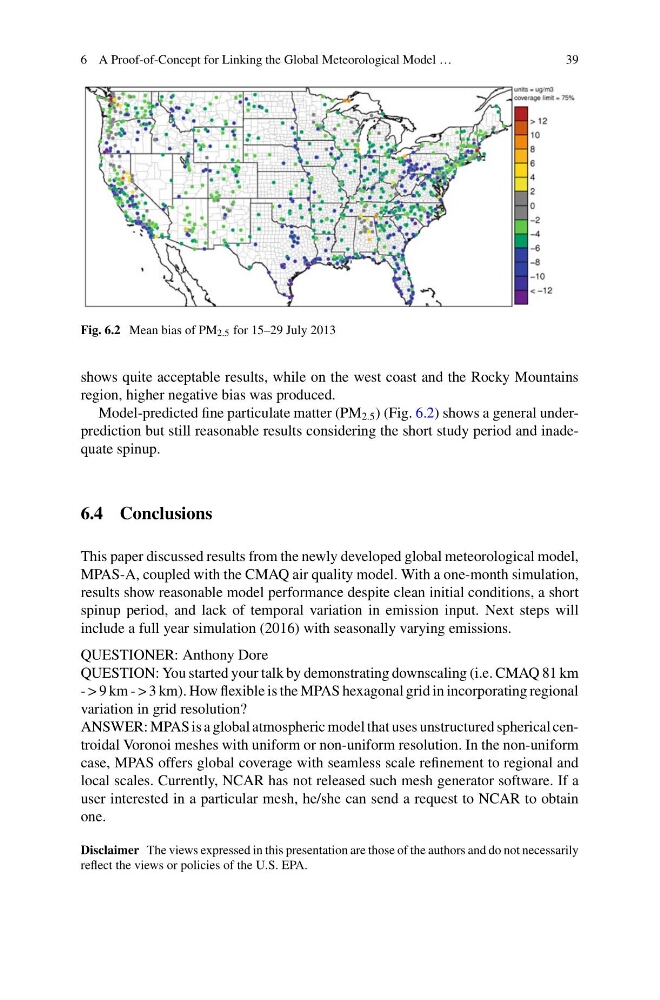
Fig. 6.2 Mean bias of PM 2.5 for 15–29 July 2013
shows quite acceptable results, while on the west coast and the Rocky Mountains
region, higher negative bias was produced.
Model-predicted fine particulate matter (PM 2.5 ) (Fig. 6.2) shows a general underprediction but still reasonable results considering the short study period and inadequate spinup.
6.4 Conclusions
This paper discussed results from the newly developed global meteorological model,
MPAS-A, coupled with the CMAQ air quality model. With a one-month simulation,
results show reasonable model performance despite clean initial conditions, a short
spinup period, and lack of temporal variation in emission input. Next steps will
include a full year simulation (2016) with seasonally varying emissions.
QUESTIONER: Anthony Dore
QUESTION: You started your talk by demonstrating downscaling (i.e. CMAQ 81 km
- > 9 km - > 3 km). How flexible is the MPAS hexagonal grid in incorporating regional
variation in grid resolution?
ANSWER: MPAS is a global atmospheric model that uses unstructured spherical centroidal Voronoi meshes with uniform or non-uniform resolution. In the non-uniform
case, MPAS offers global coverage with seamless scale refinement to regional and
local scales. Currently, NCAR has not released such mesh generator software. If a
user interested in a particular mesh, he/she can send a request to NCAR to obtain
one.
Disclaimer The views expressed in this presentation are those of the authors and do not necessarily
reflect the views or policies of the U.S. EPA.
39
Fig. 6.2 Mean bias of PM 2.5 for 15–29 July 2013
shows quite acceptable results, while on the west coast and the Rocky Mountains
region, higher negative bias was produced.
Model-predicted fine particulate matter (PM 2.5 ) (Fig. 6.2) shows a general underprediction but still reasonable results considering the short study period and inadequate spinup.
6.4 Conclusions
This paper discussed results from the newly developed global meteorological model,
MPAS-A, coupled with the CMAQ air quality model. With a one-month simulation,
results show reasonable model performance despite clean initial conditions, a short
spinup period, and lack of temporal variation in emission input. Next steps will
include a full year simulation (2016) with seasonally varying emissions.
QUESTIONER: Anthony Dore
QUESTION: You started your talk by demonstrating downscaling (i.e. CMAQ 81 km
- > 9 km - > 3 km). How flexible is the MPAS hexagonal grid in incorporating regional
variation in grid resolution?
ANSWER: MPAS is a global atmospheric model that uses unstructured spherical centroidal Voronoi meshes with uniform or non-uniform resolution. In the non-uniform
case, MPAS offers global coverage with seamless scale refinement to regional and
local scales. Currently, NCAR has not released such mesh generator software. If a
user interested in a particular mesh, he/she can send a request to NCAR to obtain
one.
Disclaimer The views expressed in this presentation are those of the authors and do not necessarily
reflect the views or policies of the U.S. EPA.