

466
U. Im et al.
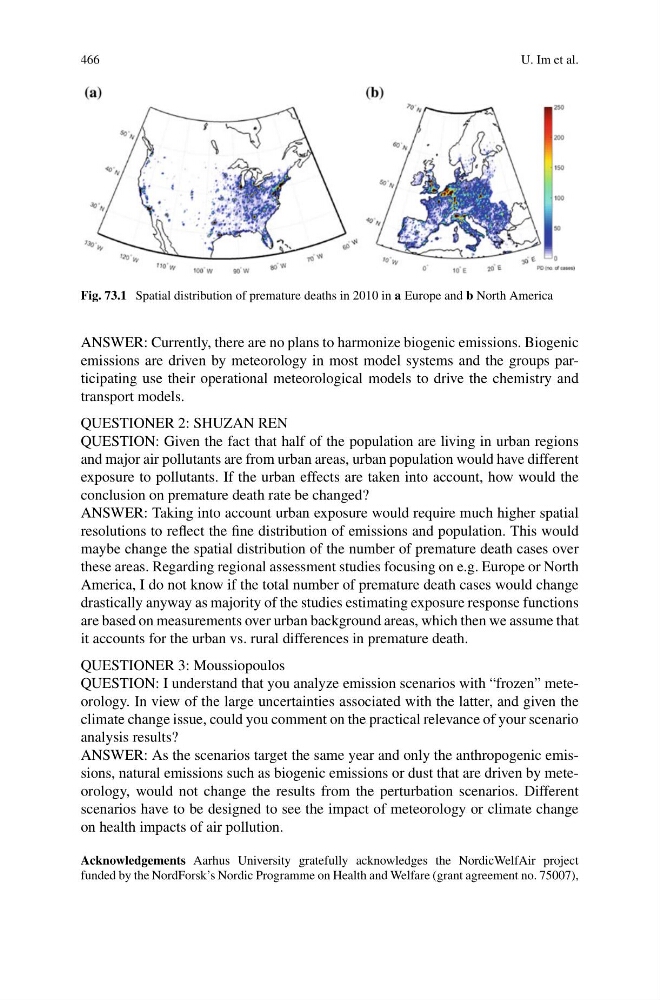
Fig. 73.1 Spatial distribution of premature deaths in 2010 in a Europe and b North America
ANSWER: Currently, there are no plans to harmonize biogenic emissions. Biogenic
emissions are driven by meteorology in most model systems and the groups participating use their operational meteorological models to drive the chemistry and
transport models.
QUESTIONER 2: SHUZAN REN
QUESTION: Given the fact that half of the population are living in urban regions
and major air pollutants are from urban areas, urban population would have different
exposure to pollutants. If the urban effects are taken into account, how would the
conclusion on premature death rate be changed?
ANSWER: Taking into account urban exposure would require much higher spatial
resolutions to reflect the fine distribution of emissions and population. This would
maybe change the spatial distribution of the number of premature death cases over
these areas. Regarding regional assessment studies focusing on e.g. Europe or North
America, I do not know if the total number of premature death cases would change
drastically anyway as majority of the studies estimating exposure response functions
are based on measurements over urban background areas, which then we assume that
it accounts for the urban vs. rural differences in premature death.
QUESTIONER 3: Moussiopoulos
QUESTION: I understand that you analyze emission scenarios with “frozen” meteorology. In view of the large uncertainties associated with the latter, and given the
climate change issue, could you comment on the practical relevance of your scenario
analysis results?
ANSWER: As the scenarios target the same year and only the anthropogenic emissions, natural emissions such as biogenic emissions or dust that are driven by meteorology, would not change the results from the perturbation scenarios. Different
scenarios have to be designed to see the impact of meteorology or climate change
on health impacts of air pollution.
Acknowledgements Aarhus University gratefully acknowledges the NordicWelfAir project
funded by the NordForsk’s Nordic Programme on Health and Welfare (grant agreement no. 75007),
U. Im et al.
Fig. 73.1 Spatial distribution of premature deaths in 2010 in a Europe and b North America
ANSWER: Currently, there are no plans to harmonize biogenic emissions. Biogenic
emissions are driven by meteorology in most model systems and the groups participating use their operational meteorological models to drive the chemistry and
transport models.
QUESTIONER 2: SHUZAN REN
QUESTION: Given the fact that half of the population are living in urban regions
and major air pollutants are from urban areas, urban population would have different
exposure to pollutants. If the urban effects are taken into account, how would the
conclusion on premature death rate be changed?
ANSWER: Taking into account urban exposure would require much higher spatial
resolutions to reflect the fine distribution of emissions and population. This would
maybe change the spatial distribution of the number of premature death cases over
these areas. Regarding regional assessment studies focusing on e.g. Europe or North
America, I do not know if the total number of premature death cases would change
drastically anyway as majority of the studies estimating exposure response functions
are based on measurements over urban background areas, which then we assume that
it accounts for the urban vs. rural differences in premature death.
QUESTIONER 3: Moussiopoulos
QUESTION: I understand that you analyze emission scenarios with “frozen” meteorology. In view of the large uncertainties associated with the latter, and given the
climate change issue, could you comment on the practical relevance of your scenario
analysis results?
ANSWER: As the scenarios target the same year and only the anthropogenic emissions, natural emissions such as biogenic emissions or dust that are driven by meteorology, would not change the results from the perturbation scenarios. Different
scenarios have to be designed to see the impact of meteorology or climate change
on health impacts of air pollution.
Acknowledgements Aarhus University gratefully acknowledges the NordicWelfAir project
funded by the NordForsk’s Nordic Programme on Health and Welfare (grant agreement no. 75007),