

442
A. I. Miranda et al.
Present
Long-termfuture
(with present emissions)
Long-termfuture
(with future emissions)
AOT40
(μg m
-3
h)
Produtivity loss
(%)
Quality loss
(%)
O
3 dry
deposition
(g cm
-2
)
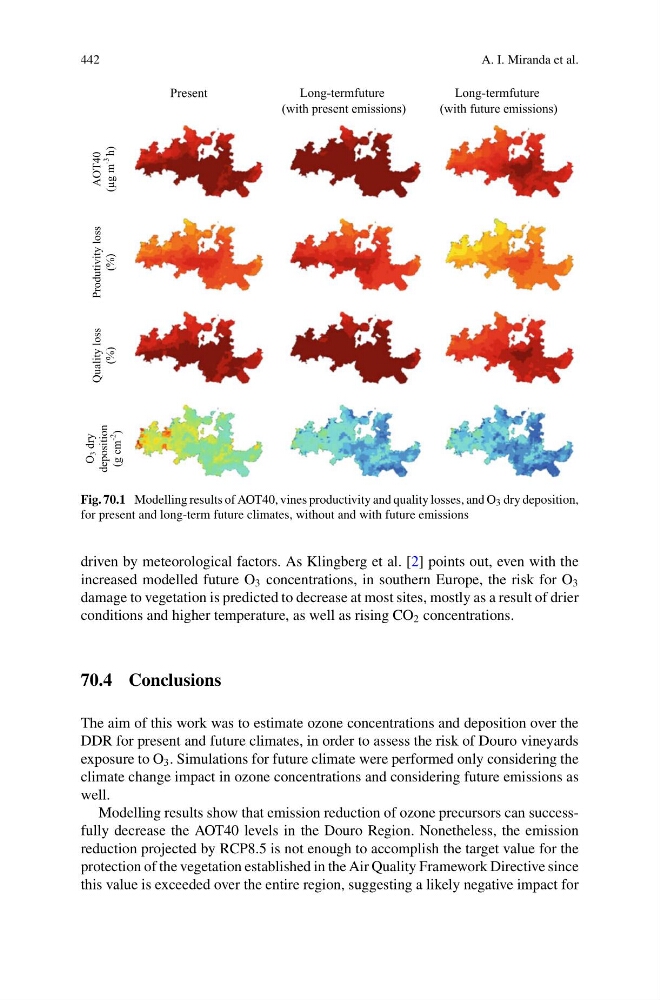
Fig. 70.1 Modelling results of AOT40, vines productivity and quality losses, and O 3 dry deposition,
for present and long-term future climates, without and with future emissions
driven by meteorological factors. As Klingberg et al. [2] points out, even with the
increased modelled future O 3 concentrations, in southern Europe, the risk for O 3
damage to vegetation is predicted to decrease at most sites, mostly as a result of drier
conditions and higher temperature, as well as rising CO 2 concentrations.
70.4 Conclusions
The aim of this work was to estimate ozone concentrations and deposition over the
DDR for present and future climates, in order to assess the risk of Douro vineyards
exposure to O 3 . Simulations for future climate were performed only considering the
climate change impact in ozone concentrations and considering future emissions as
well.
Modelling results show that emission reduction of ozone precursors can successfully decrease the AOT40 levels in the Douro Region. Nonetheless, the emission
reduction projected by RCP8.5 is not enough to accomplish the target value for the
protection of the vegetation established in the Air Quality Framework Directive since
this value is exceeded over the entire region, suggesting a likely negative impact for
A. I. Miranda et al.
Present
Long-termfuture
(with present emissions)
Long-termfuture
(with future emissions)
AOT40
(μg m
-3
h)
Produtivity loss
(%)
Quality loss
(%)
O
3 dry
deposition
(g cm
-2
)
Fig. 70.1 Modelling results of AOT40, vines productivity and quality losses, and O 3 dry deposition,
for present and long-term future climates, without and with future emissions
driven by meteorological factors. As Klingberg et al. [2] points out, even with the
increased modelled future O 3 concentrations, in southern Europe, the risk for O 3
damage to vegetation is predicted to decrease at most sites, mostly as a result of drier
conditions and higher temperature, as well as rising CO 2 concentrations.
70.4 Conclusions
The aim of this work was to estimate ozone concentrations and deposition over the
DDR for present and future climates, in order to assess the risk of Douro vineyards
exposure to O 3 . Simulations for future climate were performed only considering the
climate change impact in ozone concentrations and considering future emissions as
well.
Modelling results show that emission reduction of ozone precursors can successfully decrease the AOT40 levels in the Douro Region. Nonetheless, the emission
reduction projected by RCP8.5 is not enough to accomplish the target value for the
protection of the vegetation established in the Air Quality Framework Directive since
this value is exceeded over the entire region, suggesting a likely negative impact for