

69 Climate Model Response Uncertainty in Projections of Climate …
435
69.3 Results
We explore the impacts of climate change on O 3 and PM 2.5 in the U.S. under 3 climate
sensitivities representing lower (2.0 °C), middle (3.0 °C), and upper (4.5 °C) estimates of the high confidence range reported by Fifth Assessment Report of the United
Nations Intergovernmental Panel on Climate Change (IPCC). Our ensemble-mean
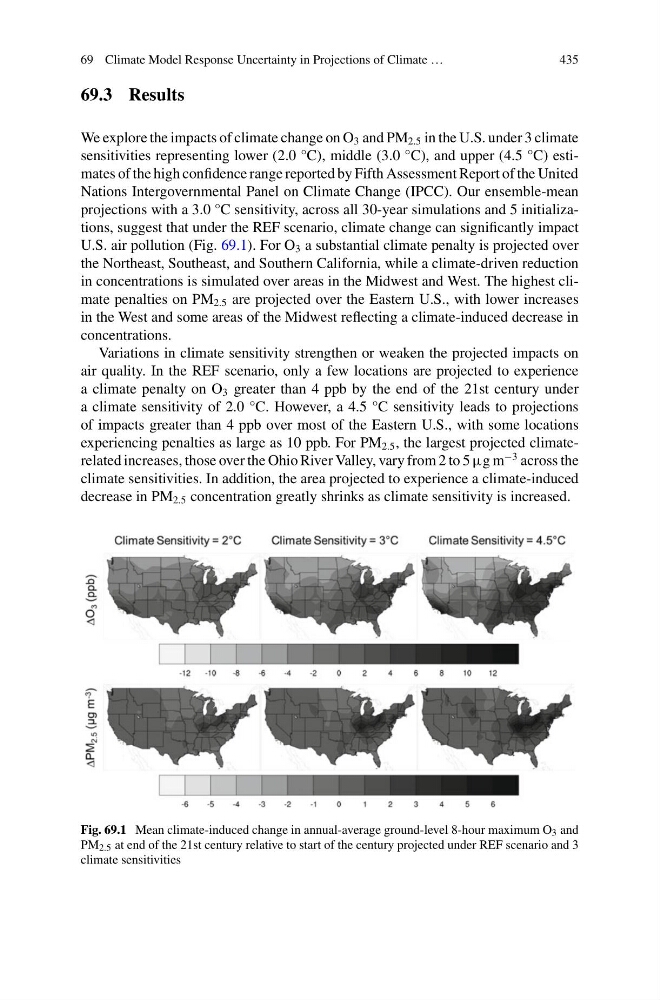
projections with a 3.0 °C sensitivity, across all 30-year simulations and 5 initializations, suggest that under the REF scenario, climate change can significantly impact
U.S. air pollution (Fig. 69.1). For O 3 a substantial climate penalty is projected over
the Northeast, Southeast, and Southern California, while a climate-driven reduction
in concentrations is simulated over areas in the Midwest and West. The highest climate penalties on PM 2.5 are projected over the Eastern U.S., with lower increases
in the West and some areas of the Midwest reflecting a climate-induced decrease in
concentrations.
Variations in climate sensitivity strengthen or weaken the projected impacts on
air quality. In the REF scenario, only a few locations are projected to experience
a climate penalty on O 3 greater than 4 ppb by the end of the 21st century under
a climate sensitivity of 2.0 °C. However, a 4.5 °C sensitivity leads to projections
of impacts greater than 4 ppb over most of the Eastern U.S., with some locations
experiencing penalties as large as 10 ppb. For PM 2.5 , the largest projected climaterelated increases, those over the Ohio River Valley, vary from 2 to 5 µg m
−3 across the
climate sensitivities. In addition, the area projected to experience a climate-induced
decrease in PM 2.5 concentration greatly shrinks as climate sensitivity is increased.
Fig. 69.1 Mean climate-induced change in annual-average ground-level 8-hour maximum O 3 and
PM 2.5 at end of the 21st century relative to start of the century projected under REF scenario and 3
climate sensitivities
435
69.3 Results
We explore the impacts of climate change on O 3 and PM 2.5 in the U.S. under 3 climate
sensitivities representing lower (2.0 °C), middle (3.0 °C), and upper (4.5 °C) estimates of the high confidence range reported by Fifth Assessment Report of the United
Nations Intergovernmental Panel on Climate Change (IPCC). Our ensemble-mean
projections with a 3.0 °C sensitivity, across all 30-year simulations and 5 initializations, suggest that under the REF scenario, climate change can significantly impact
U.S. air pollution (Fig. 69.1). For O 3 a substantial climate penalty is projected over
the Northeast, Southeast, and Southern California, while a climate-driven reduction
in concentrations is simulated over areas in the Midwest and West. The highest climate penalties on PM 2.5 are projected over the Eastern U.S., with lower increases
in the West and some areas of the Midwest reflecting a climate-induced decrease in
concentrations.
Variations in climate sensitivity strengthen or weaken the projected impacts on
air quality. In the REF scenario, only a few locations are projected to experience
a climate penalty on O 3 greater than 4 ppb by the end of the 21st century under
a climate sensitivity of 2.0 °C. However, a 4.5 °C sensitivity leads to projections
of impacts greater than 4 ppb over most of the Eastern U.S., with some locations
experiencing penalties as large as 10 ppb. For PM 2.5 , the largest projected climaterelated increases, those over the Ohio River Valley, vary from 2 to 5 µg m
−3 across the
climate sensitivities. In addition, the area projected to experience a climate-induced
decrease in PM 2.5 concentration greatly shrinks as climate sensitivity is increased.
Fig. 69.1 Mean climate-induced change in annual-average ground-level 8-hour maximum O 3 and
PM 2.5 at end of the 21st century relative to start of the century projected under REF scenario and 3
climate sensitivities