

65 Aerosol Indirect Effect on Air Pollution-Meteorology …
411
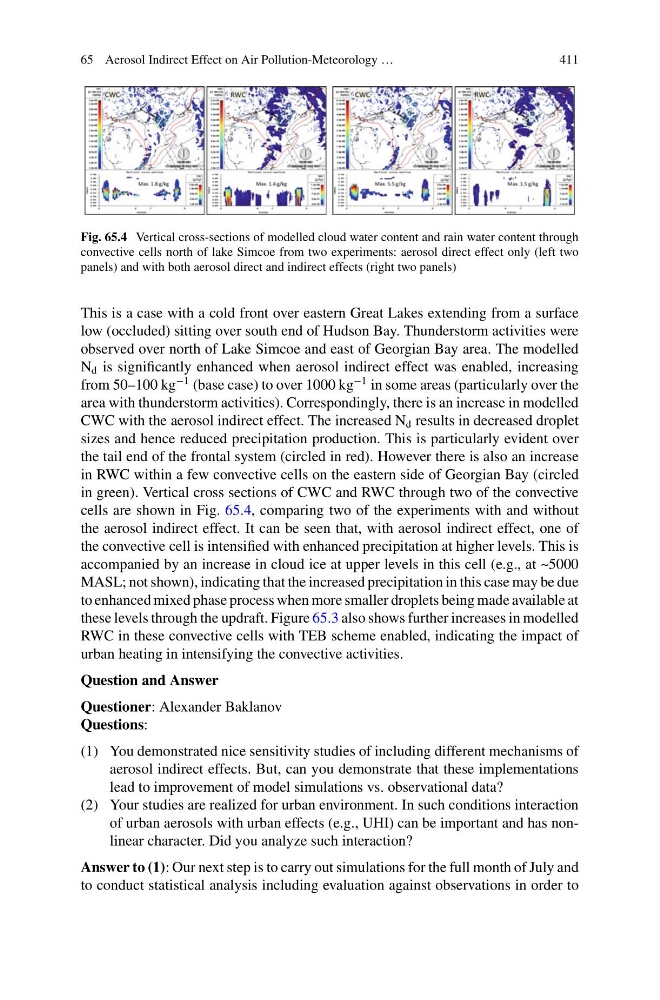
Fig. 65.4 Vertical cross-sections of modelled cloud water content and rain water content through
convective cells north of lake Simcoe from two experiments: aerosol direct effect only (left two
panels) and with both aerosol direct and indirect effects (right two panels)
This is a case with a cold front over eastern Great Lakes extending from a surface
low (occluded) sitting over south end of Hudson Bay. Thunderstorm activities were
observed over north of Lake Simcoe and east of Georgian Bay area. The modelled
N d is significantly enhanced when aerosol indirect effect was enabled, increasing
from 50–100 kg
−1 (base case) to over 1000 kg
−1 in some areas (particularly over the
area with thunderstorm activities). Correspondingly, there is an increase in modelled
CWC with the aerosol indirect effect. The increased N d results in decreased droplet
sizes and hence reduced precipitation production. This is particularly evident over
the tail end of the frontal system (circled in red). However there is also an increase
in RWC within a few convective cells on the eastern side of Georgian Bay (circled
in green). Vertical cross sections of CWC and RWC through two of the convective
cells are shown in Fig. 65.4, comparing two of the experiments with and without
the aerosol indirect effect. It can be seen that, with aerosol indirect effect, one of
the convective cell is intensified with enhanced precipitation at higher levels. This is
accompanied by an increase in cloud ice at upper levels in this cell (e.g., at ~5000
MASL; not shown), indicating that the increased precipitation in this case may be due
to enhanced mixed phase process when more smaller droplets being made available at
these levels through the updraft. Figure 65.3 also shows further increases in modelled
RWC in these convective cells with TEB scheme enabled, indicating the impact of
urban heating in intensifying the convective activities.
Question and Answer
Questioner: Alexander Baklanov
Questions:
(1) You demonstrated nice sensitivity studies of including different mechanisms of
aerosol indirect effects. But, can you demonstrate that these implementations
lead to improvement of model simulations vs. observational data?
(2) Your studies are realized for urban environment. In such conditions interaction
of urban aerosols with urban effects (e.g., UHI) can be important and has nonlinear character. Did you analyze such interaction?
Answer to (1): Our next step is to carry out simulations for the full month of July and
to conduct statistical analysis including evaluation against observations in order to
411
Fig. 65.4 Vertical cross-sections of modelled cloud water content and rain water content through
convective cells north of lake Simcoe from two experiments: aerosol direct effect only (left two
panels) and with both aerosol direct and indirect effects (right two panels)
This is a case with a cold front over eastern Great Lakes extending from a surface
low (occluded) sitting over south end of Hudson Bay. Thunderstorm activities were
observed over north of Lake Simcoe and east of Georgian Bay area. The modelled
N d is significantly enhanced when aerosol indirect effect was enabled, increasing
from 50–100 kg
−1 (base case) to over 1000 kg
−1 in some areas (particularly over the
area with thunderstorm activities). Correspondingly, there is an increase in modelled
CWC with the aerosol indirect effect. The increased N d results in decreased droplet
sizes and hence reduced precipitation production. This is particularly evident over
the tail end of the frontal system (circled in red). However there is also an increase
in RWC within a few convective cells on the eastern side of Georgian Bay (circled
in green). Vertical cross sections of CWC and RWC through two of the convective
cells are shown in Fig. 65.4, comparing two of the experiments with and without
the aerosol indirect effect. It can be seen that, with aerosol indirect effect, one of
the convective cell is intensified with enhanced precipitation at higher levels. This is
accompanied by an increase in cloud ice at upper levels in this cell (e.g., at ~5000
MASL; not shown), indicating that the increased precipitation in this case may be due
to enhanced mixed phase process when more smaller droplets being made available at
these levels through the updraft. Figure 65.3 also shows further increases in modelled
RWC in these convective cells with TEB scheme enabled, indicating the impact of
urban heating in intensifying the convective activities.
Question and Answer
Questioner: Alexander Baklanov
Questions:
(1) You demonstrated nice sensitivity studies of including different mechanisms of
aerosol indirect effects. But, can you demonstrate that these implementations
lead to improvement of model simulations vs. observational data?
(2) Your studies are realized for urban environment. In such conditions interaction
of urban aerosols with urban effects (e.g., UHI) can be important and has nonlinear character. Did you analyze such interaction?
Answer to (1): Our next step is to carry out simulations for the full month of July and
to conduct statistical analysis including evaluation against observations in order to