

65 Aerosol Indirect Effect on Air Pollution-Meteorology …
409
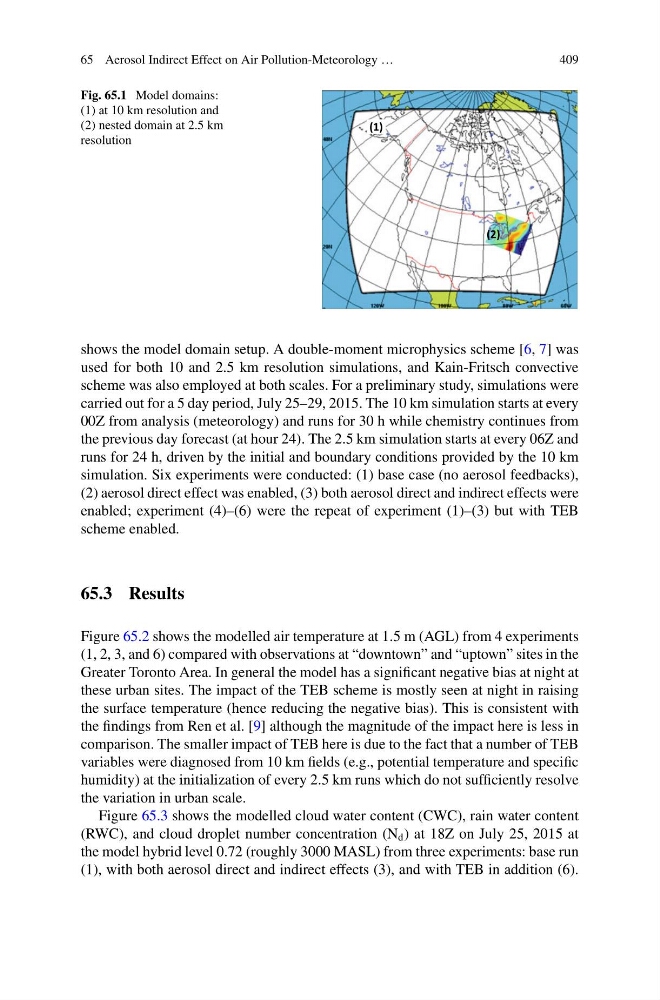
Fig. 65.1 Model domains:
(1) at 10 km resolution and
(2) nested domain at 2.5 km
resolution
(1)
(2)
shows the model domain setup. A double-moment microphysics scheme [6, 7] was
used for both 10 and 2.5 km resolution simulations, and Kain-Fritsch convective
scheme was also employed at both scales. For a preliminary study, simulations were
carried out for a 5 day period, July 25–29, 2015. The 10 km simulation starts at every
00Z from analysis (meteorology) and runs for 30 h while chemistry continues from
the previous day forecast (at hour 24). The 2.5 km simulation starts at every 06Z and
runs for 24 h, driven by the initial and boundary conditions provided by the 10 km
simulation. Six experiments were conducted: (1) base case (no aerosol feedbacks),
(2) aerosol direct effect was enabled, (3) both aerosol direct and indirect effects were
enabled; experiment (4)–(6) were the repeat of experiment (1)–(3) but with TEB
scheme enabled.
65.3 Results
Figure 65.2 shows the modelled air temperature at 1.5 m (AGL) from 4 experiments
(1, 2, 3, and 6) compared with observations at “downtown” and “uptown” sites in the
Greater Toronto Area. In general the model has a significant negative bias at night at
these urban sites. The impact of the TEB scheme is mostly seen at night in raising
the surface temperature (hence reducing the negative bias). This is consistent with
the findings from Ren et al. [9] although the magnitude of the impact here is less in
comparison. The smaller impact of TEB here is due to the fact that a number of TEB
variables were diagnosed from 10 km fields (e.g., potential temperature and specific
humidity) at the initialization of every 2.5 km runs which do not sufficiently resolve
the variation in urban scale.
Figure 65.3 shows the modelled cloud water content (CWC), rain water content
(RWC), and cloud droplet number concentration (N d ) at 18Z on July 25, 2015 at
the model hybrid level 0.72 (roughly 3000 MASL) from three experiments: base run
(1), with both aerosol direct and indirect effects (3), and with TEB in addition (6).
409
Fig. 65.1 Model domains:
(1) at 10 km resolution and
(2) nested domain at 2.5 km
resolution
(1)
(2)
shows the model domain setup. A double-moment microphysics scheme [6, 7] was
used for both 10 and 2.5 km resolution simulations, and Kain-Fritsch convective
scheme was also employed at both scales. For a preliminary study, simulations were
carried out for a 5 day period, July 25–29, 2015. The 10 km simulation starts at every
00Z from analysis (meteorology) and runs for 30 h while chemistry continues from
the previous day forecast (at hour 24). The 2.5 km simulation starts at every 06Z and
runs for 24 h, driven by the initial and boundary conditions provided by the 10 km
simulation. Six experiments were conducted: (1) base case (no aerosol feedbacks),
(2) aerosol direct effect was enabled, (3) both aerosol direct and indirect effects were
enabled; experiment (4)–(6) were the repeat of experiment (1)–(3) but with TEB
scheme enabled.
65.3 Results
Figure 65.2 shows the modelled air temperature at 1.5 m (AGL) from 4 experiments
(1, 2, 3, and 6) compared with observations at “downtown” and “uptown” sites in the
Greater Toronto Area. In general the model has a significant negative bias at night at
these urban sites. The impact of the TEB scheme is mostly seen at night in raising
the surface temperature (hence reducing the negative bias). This is consistent with
the findings from Ren et al. [9] although the magnitude of the impact here is less in
comparison. The smaller impact of TEB here is due to the fact that a number of TEB
variables were diagnosed from 10 km fields (e.g., potential temperature and specific
humidity) at the initialization of every 2.5 km runs which do not sufficiently resolve
the variation in urban scale.
Figure 65.3 shows the modelled cloud water content (CWC), rain water content
(RWC), and cloud droplet number concentration (N d ) at 18Z on July 25, 2015 at
the model hybrid level 0.72 (roughly 3000 MASL) from three experiments: base run
(1), with both aerosol direct and indirect effects (3), and with TEB in addition (6).