

404
L. Deguillaume et al.
0
10
20
30
40
50
60
70
80
90
100
day
night
day
night 0
10
20
30
40
50
60
70
80
90
100
Formic acid summer
Formic acid winter
Sources
Sources
Sinks
Sinks
H 2 O 2 summer
Sources
0
20
40
60
80
100
H 2 O 2 winter
Sources
Sinks
Sinks
0
10
20
30
40
50
60
70
80
90
100
day
night
day
night
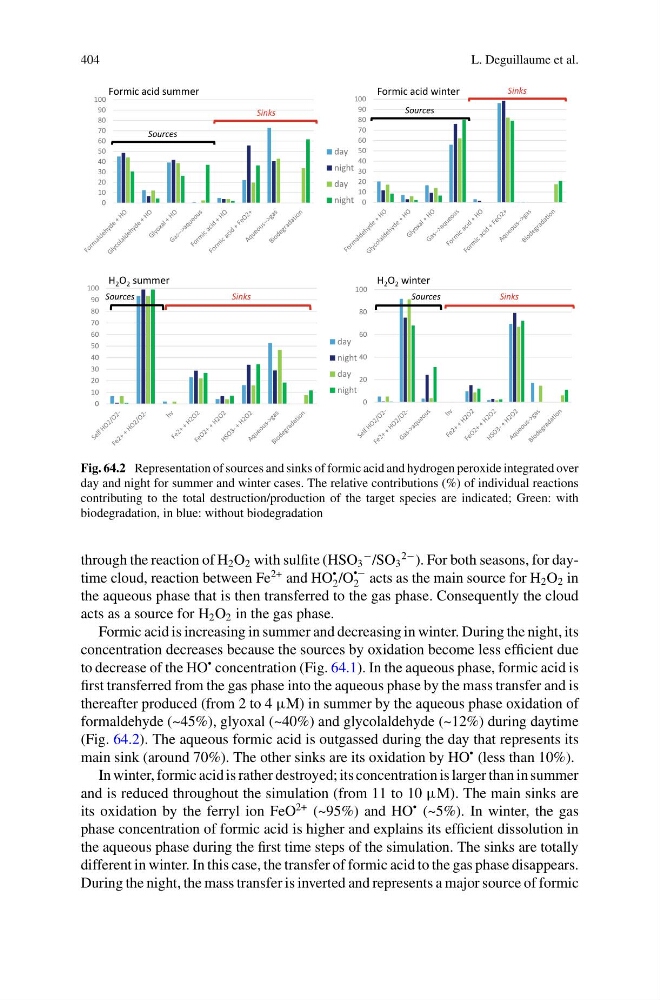
Fig. 64.2 Representation of sources and sinks of formic acid and hydrogen peroxide integrated over
day and night for summer and winter cases. The relative contributions (%) of individual reactions
contributing to the total destruction/production of the target species are indicated; Green: with
biodegradation, in blue: without biodegradation
through the reaction of H 2 O 2 with sulfite (HSO 3
− /SO 3
2− ). For both seasons, for daytime cloud, reaction between Fe
2+ and HO
•
2 /O
•−
2 acts as the main source for H 2 O 2 in
the aqueous phase that is then transferred to the gas phase. Consequently the cloud
acts as a source for H 2 O 2 in the gas phase.
Formic acid is increasing in summer and decreasing in winter. During the night, its
concentration decreases because the sources by oxidation become less efficient due
to decrease of the HO
• concentration (Fig. 64.1). In the aqueous phase, formic acid is
first transferred from the gas phase into the aqueous phase by the mass transfer and is
thereafter produced (from 2 to 4 µM) in summer by the aqueous phase oxidation of
formaldehyde (~45%), glyoxal (~40%) and glycolaldehyde (~12%) during daytime
(Fig. 64.2). The aqueous formic acid is outgassed during the day that represents its
main sink (around 70%). The other sinks are its oxidation by HO
• (less than 10%).
In winter, formic acid is rather destroyed; its concentration is larger than in summer
and is reduced throughout the simulation (from 11 to 10 µM). The main sinks are
its oxidation by the ferryl ion FeO
2+ (~95%) and HO
• (~5%). In winter, the gas
phase concentration of formic acid is higher and explains its efficient dissolution in
the aqueous phase during the first time steps of the simulation. The sinks are totally
different in winter. In this case, the transfer of formic acid to the gas phase disappears.
During the night, the mass transfer is inverted and represents a major source of formic
L. Deguillaume et al.
0
10
20
30
40
50
60
70
80
90
100
day
night
day
night 0
10
20
30
40
50
60
70
80
90
100
Formic acid summer
Formic acid winter
Sources
Sources
Sinks
Sinks
H 2 O 2 summer
Sources
0
20
40
60
80
100
H 2 O 2 winter
Sources
Sinks
Sinks
0
10
20
30
40
50
60
70
80
90
100
day
night
day
night
Fig. 64.2 Representation of sources and sinks of formic acid and hydrogen peroxide integrated over
day and night for summer and winter cases. The relative contributions (%) of individual reactions
contributing to the total destruction/production of the target species are indicated; Green: with
biodegradation, in blue: without biodegradation
through the reaction of H 2 O 2 with sulfite (HSO 3
− /SO 3
2− ). For both seasons, for daytime cloud, reaction between Fe
2+ and HO
•
2 /O
•−
2 acts as the main source for H 2 O 2 in
the aqueous phase that is then transferred to the gas phase. Consequently the cloud
acts as a source for H 2 O 2 in the gas phase.
Formic acid is increasing in summer and decreasing in winter. During the night, its
concentration decreases because the sources by oxidation become less efficient due
to decrease of the HO
• concentration (Fig. 64.1). In the aqueous phase, formic acid is
first transferred from the gas phase into the aqueous phase by the mass transfer and is
thereafter produced (from 2 to 4 µM) in summer by the aqueous phase oxidation of
formaldehyde (~45%), glyoxal (~40%) and glycolaldehyde (~12%) during daytime
(Fig. 64.2). The aqueous formic acid is outgassed during the day that represents its
main sink (around 70%). The other sinks are its oxidation by HO
• (less than 10%).
In winter, formic acid is rather destroyed; its concentration is larger than in summer
and is reduced throughout the simulation (from 11 to 10 µM). The main sinks are
its oxidation by the ferryl ion FeO
2+ (~95%) and HO
• (~5%). In winter, the gas
phase concentration of formic acid is higher and explains its efficient dissolution in
the aqueous phase during the first time steps of the simulation. The sinks are totally
different in winter. In this case, the transfer of formic acid to the gas phase disappears.
During the night, the mass transfer is inverted and represents a major source of formic