

64 Biological Activity in Clouds: From the Laboratory to the Model
403
the temperature is set at 5 °C. These two temperatures are similar to the temperature
maintained in the lab to evaluate the biodegradation rates. For the wintertime, the
isoprene emissions are decreased from 7.5 × 10
6 to 4.5 × 10
6 molec cm
−3 s
−1 , and
the deposition rate of the secondary organic products is decreased from 5 × 10
−5 to
1 × 10
−5 s
−1 .
Clouds are known to be oxidative reactors where chemicals are transformed by
free radicals, mainly HO
• during the day. In this context, the dissolved organic matter
is efficiently transformed where the molecules can be fragmented and/or more functionalized. Initially, these organic compounds results from the mass transfer from
the gas phase or from the dissolution of the soluble fraction of the particle that acts
as CCN. In this context, a major source of formic, acetic acids and formaldehyde in
cloud droplets are their transfers from the gas phase. The oxidation in the aqueous
phase of precursors, such as glyoxal, methyglyoxal, glycolaldehyde, pyruvic acid,
etc., is also a significant source.
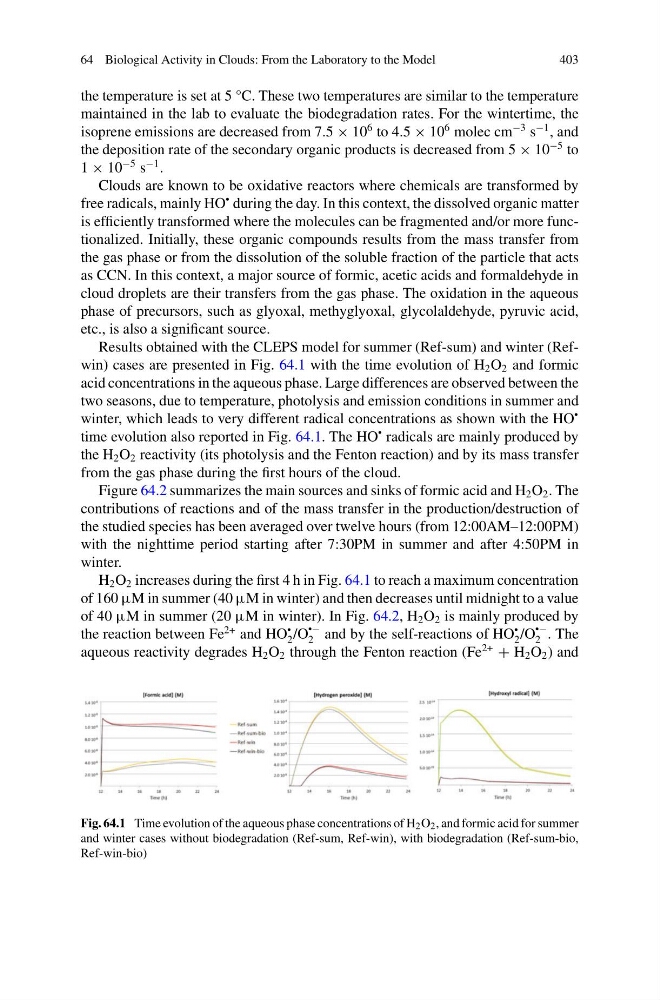
Results obtained with the CLEPS model for summer (Ref-sum) and winter (Refwin) cases are presented in Fig. 64.1 with the time evolution of H 2 O 2 and formic
acid concentrations in the aqueous phase. Large differences are observed between the
two seasons, due to temperature, photolysis and emission conditions in summer and
winter, which leads to very different radical concentrations as shown with the HO
•
time evolution also reported in Fig. 64.1. The HO
• radicals are mainly produced by
the H 2 O 2 reactivity (its photolysis and the Fenton reaction) and by its mass transfer
from the gas phase during the first hours of the cloud.
Figure 64.2 summarizes the main sources and sinks of formic acid and H 2 O 2 . The
contributions of reactions and of the mass transfer in the production/destruction of
the studied species has been averaged over twelve hours (from 12:00AM–12:00PM)
with the nighttime period starting after 7:30PM in summer and after 4:50PM in
winter.
H 2 O 2 increases during the first 4 h in Fig. 64.1 to reach a maximum concentration
of 160 µM in summer (40 µM in winter) and then decreases until midnight to a value
of 40 µM in summer (20 µM in winter). In Fig. 64.2, H 2 O 2 is mainly produced by
the reaction between Fe
2+ and HO
•
2 /O
•−
2 and by the self-reactions of HO
•
2 /O
•−
2 . The
aqueous reactivity degrades H 2 O 2 through the Fenton reaction (Fe
2+
+ H 2 O 2 ) and
Fig. 64.1 Time evolution of the aqueous phase concentrations of H 2 O 2 , and formic acid for summer
and winter cases without biodegradation (Ref-sum, Ref-win), with biodegradation (Ref-sum-bio,
Ref-win-bio)
403
the temperature is set at 5 °C. These two temperatures are similar to the temperature
maintained in the lab to evaluate the biodegradation rates. For the wintertime, the
isoprene emissions are decreased from 7.5 × 10
6 to 4.5 × 10
6 molec cm
−3 s
−1 , and
the deposition rate of the secondary organic products is decreased from 5 × 10
−5 to
1 × 10
−5 s
−1 .
Clouds are known to be oxidative reactors where chemicals are transformed by
free radicals, mainly HO
• during the day. In this context, the dissolved organic matter
is efficiently transformed where the molecules can be fragmented and/or more functionalized. Initially, these organic compounds results from the mass transfer from
the gas phase or from the dissolution of the soluble fraction of the particle that acts
as CCN. In this context, a major source of formic, acetic acids and formaldehyde in
cloud droplets are their transfers from the gas phase. The oxidation in the aqueous
phase of precursors, such as glyoxal, methyglyoxal, glycolaldehyde, pyruvic acid,
etc., is also a significant source.
Results obtained with the CLEPS model for summer (Ref-sum) and winter (Refwin) cases are presented in Fig. 64.1 with the time evolution of H 2 O 2 and formic
acid concentrations in the aqueous phase. Large differences are observed between the
two seasons, due to temperature, photolysis and emission conditions in summer and
winter, which leads to very different radical concentrations as shown with the HO
•
time evolution also reported in Fig. 64.1. The HO
• radicals are mainly produced by
the H 2 O 2 reactivity (its photolysis and the Fenton reaction) and by its mass transfer
from the gas phase during the first hours of the cloud.
Figure 64.2 summarizes the main sources and sinks of formic acid and H 2 O 2 . The
contributions of reactions and of the mass transfer in the production/destruction of
the studied species has been averaged over twelve hours (from 12:00AM–12:00PM)
with the nighttime period starting after 7:30PM in summer and after 4:50PM in
winter.
H 2 O 2 increases during the first 4 h in Fig. 64.1 to reach a maximum concentration
of 160 µM in summer (40 µM in winter) and then decreases until midnight to a value
of 40 µM in summer (20 µM in winter). In Fig. 64.2, H 2 O 2 is mainly produced by
the reaction between Fe
2+ and HO
•
2 /O
•−
2 and by the self-reactions of HO
•
2 /O
•−
2 . The
aqueous reactivity degrades H 2 O 2 through the Fenton reaction (Fe
2+
+ H 2 O 2 ) and
Fig. 64.1 Time evolution of the aqueous phase concentrations of H 2 O 2 , and formic acid for summer
and winter cases without biodegradation (Ref-sum, Ref-win), with biodegradation (Ref-sum-bio,
Ref-win-bio)