

60 A Parameterization of Heterogeneous Hydrolysis of N 2 O 5 …
379
The formation of secondary inorganic particulate matter is through reactions of
ammonia with sulfuric acid and nitric acid, which are produced from gaseous precursors SO 2 and NO x [7]. The applied particle–gas partitioning depends on temperature
and humidity. By using the equilibrium approach of [9], the partitioning scheme was
comparable to [6]. For the description of SOA an updated version of SORGAM [12]
is implemented.
Parameterization of heterogeneous hydrolysis of N 2 O 5 . Based on the first-order
reaction rate, Chang et al. [3] proposed
k N 2 O 5 =
1
600 exp
− (
R H
28
) 2.8
+ a
(60.2)
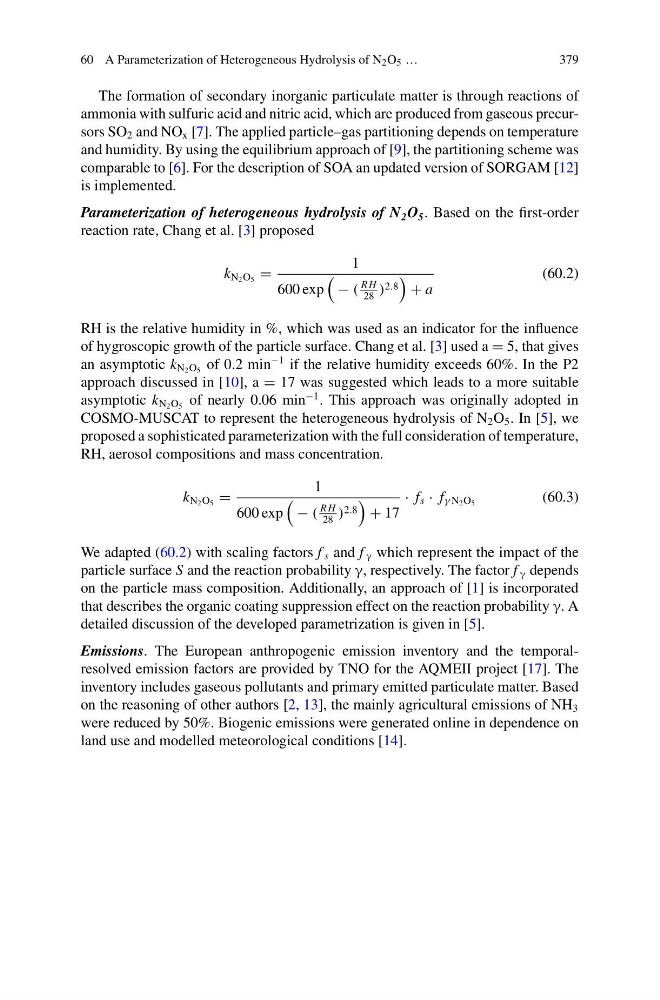
RH is the relative humidity in %, which was used as an indicator for the influence
of hygroscopic growth of the particle surface. Chang et al. [3] used a = 5, that gives
an asymptotic k N 2 O 5 of 0.2 min
−1 if the relative humidity exceeds 60%. In the P2
approach discussed in [10], a = 17 was suggested which leads to a more suitable
asymptotic k N 2 O 5 of nearly 0.06 min
−1 . This approach was originally adopted in
COSMO-MUSCAT to represent the heterogeneous hydrolysis of N 2 O 5 . In [5], we
proposed a sophisticated parameterization with the full consideration of temperature,
RH, aerosol compositions and mass concentration.
k N 2 O 5 =
1
600 exp
− (
R H
28
) 2.8
+ 17
· f s · f γ N 2 O 5
(60.3)
We adapted (60.2) with scaling factors f s and f γ which represent the impact of the
particle surface S and the reaction probability γ, respectively. The factor f γ depends
on the particle mass composition. Additionally, an approach of [1] is incorporated
that describes the organic coating suppression effect on the reaction probability γ. A
detailed discussion of the developed parametrization is given in [5].
Emissions. The European anthropogenic emission inventory and the temporalresolved emission factors are provided by TNO for the AQMEII project [17]. The
inventory includes gaseous pollutants and primary emitted particulate matter. Based
on the reasoning of other authors [2, 13], the mainly agricultural emissions of NH 3
were reduced by 50%. Biogenic emissions were generated online in dependence on
land use and modelled meteorological conditions [14].
379
The formation of secondary inorganic particulate matter is through reactions of
ammonia with sulfuric acid and nitric acid, which are produced from gaseous precursors SO 2 and NO x [7]. The applied particle–gas partitioning depends on temperature
and humidity. By using the equilibrium approach of [9], the partitioning scheme was
comparable to [6]. For the description of SOA an updated version of SORGAM [12]
is implemented.
Parameterization of heterogeneous hydrolysis of N 2 O 5 . Based on the first-order
reaction rate, Chang et al. [3] proposed
k N 2 O 5 =
1
600 exp
− (
R H
28
) 2.8
+ a
(60.2)
RH is the relative humidity in %, which was used as an indicator for the influence
of hygroscopic growth of the particle surface. Chang et al. [3] used a = 5, that gives
an asymptotic k N 2 O 5 of 0.2 min
−1 if the relative humidity exceeds 60%. In the P2
approach discussed in [10], a = 17 was suggested which leads to a more suitable
asymptotic k N 2 O 5 of nearly 0.06 min
−1 . This approach was originally adopted in
COSMO-MUSCAT to represent the heterogeneous hydrolysis of N 2 O 5 . In [5], we
proposed a sophisticated parameterization with the full consideration of temperature,
RH, aerosol compositions and mass concentration.
k N 2 O 5 =
1
600 exp
− (
R H
28
) 2.8
+ 17
· f s · f γ N 2 O 5
(60.3)
We adapted (60.2) with scaling factors f s and f γ which represent the impact of the
particle surface S and the reaction probability γ, respectively. The factor f γ depends
on the particle mass composition. Additionally, an approach of [1] is incorporated
that describes the organic coating suppression effect on the reaction probability γ. A
detailed discussion of the developed parametrization is given in [5].
Emissions. The European anthropogenic emission inventory and the temporalresolved emission factors are provided by TNO for the AQMEII project [17]. The
inventory includes gaseous pollutants and primary emitted particulate matter. Based
on the reasoning of other authors [2, 13], the mainly agricultural emissions of NH 3
were reduced by 50%. Biogenic emissions were generated online in dependence on
land use and modelled meteorological conditions [14].