

59 Evaluation of Seven Chemical Aging Modeling Schemes …
373
Table 59.1 Parameters of the 7 optimized 2D-VBS schemes used in the simulations
Functionalization
scheme
bSOA increase
during aging
Fragmentation
probability
Parameterization
name
1-bin
No
b = 0
1-bin
1-bin
Yes
b = 0.15
1-bin/bSOA/b = 0.15
2-bin
No
b = 0
2-bin
2-bin
No
b = 0.1
2-bin/b = 0.1
2-bin
Yes
b = 0.4
2-bin/bSOA/b = 0.4
Det
No
b = 0.3
Det/b = 0.3
Det
Yes
b = 0.7
Det/bSOA/b = 0.7
59.3 Results
59.3.1 Simple Functionalization (1-bin Case)
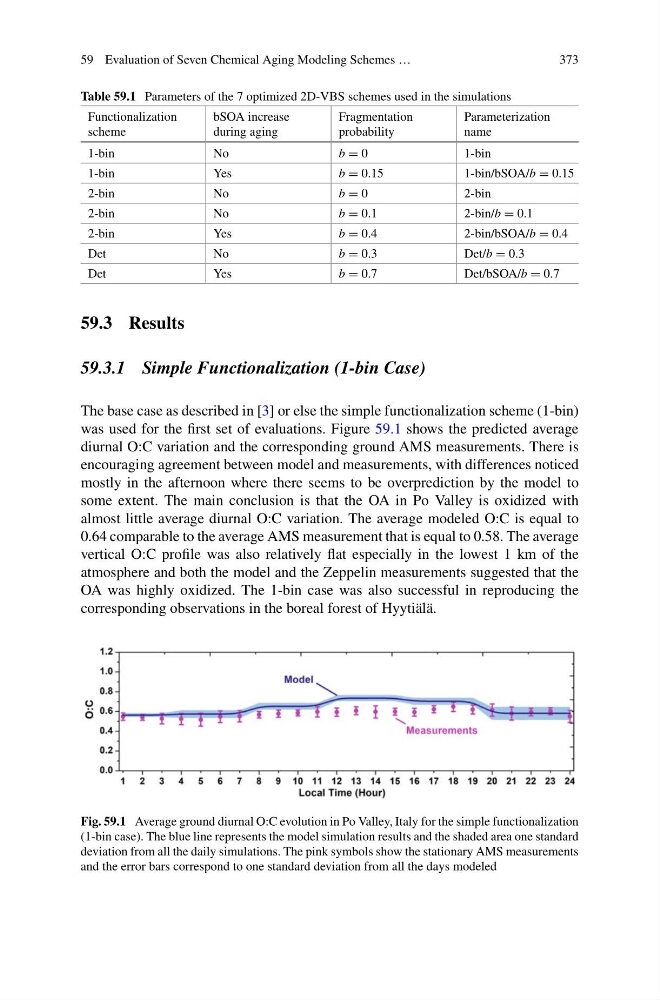
The base case as described in [3] or else the simple functionalization scheme (1-bin)
was used for the first set of evaluations. Figure 59.1 shows the predicted average
diurnal O:C variation and the corresponding ground AMS measurements. There is
encouraging agreement between model and measurements, with differences noticed
mostly in the afternoon where there seems to be overprediction by the model to
some extent. The main conclusion is that the OA in Po Valley is oxidized with
almost little average diurnal O:C variation. The average modeled O:C is equal to
0.64 comparable to the average AMS measurement that is equal to 0.58. The average
vertical O:C profile was also relatively flat especially in the lowest 1 km of the
atmosphere and both the model and the Zeppelin measurements suggested that the
OA was highly oxidized. The 1-bin case was also successful in reproducing the
corresponding observations in the boreal forest of Hyytiälä.
Fig. 59.1 Average ground diurnal O:C evolution in Po Valley, Italy for the simple functionalization
(1-bin case). The blue line represents the model simulation results and the shaded area one standard
deviation from all the daily simulations. The pink symbols show the stationary AMS measurements
and the error bars correspond to one standard deviation from all the days modeled
373
Table 59.1 Parameters of the 7 optimized 2D-VBS schemes used in the simulations
Functionalization
scheme
bSOA increase
during aging
Fragmentation
probability
Parameterization
name
1-bin
No
b = 0
1-bin
1-bin
Yes
b = 0.15
1-bin/bSOA/b = 0.15
2-bin
No
b = 0
2-bin
2-bin
No
b = 0.1
2-bin/b = 0.1
2-bin
Yes
b = 0.4
2-bin/bSOA/b = 0.4
Det
No
b = 0.3
Det/b = 0.3
Det
Yes
b = 0.7
Det/bSOA/b = 0.7
59.3 Results
59.3.1 Simple Functionalization (1-bin Case)
The base case as described in [3] or else the simple functionalization scheme (1-bin)
was used for the first set of evaluations. Figure 59.1 shows the predicted average
diurnal O:C variation and the corresponding ground AMS measurements. There is
encouraging agreement between model and measurements, with differences noticed
mostly in the afternoon where there seems to be overprediction by the model to
some extent. The main conclusion is that the OA in Po Valley is oxidized with
almost little average diurnal O:C variation. The average modeled O:C is equal to
0.64 comparable to the average AMS measurement that is equal to 0.58. The average
vertical O:C profile was also relatively flat especially in the lowest 1 km of the
atmosphere and both the model and the Zeppelin measurements suggested that the
OA was highly oxidized. The 1-bin case was also successful in reproducing the
corresponding observations in the boreal forest of Hyytiälä.
Fig. 59.1 Average ground diurnal O:C evolution in Po Valley, Italy for the simple functionalization
(1-bin case). The blue line represents the model simulation results and the shaded area one standard
deviation from all the daily simulations. The pink symbols show the stationary AMS measurements
and the error bars correspond to one standard deviation from all the days modeled