

56 Detailed Assessment of a Smog Situation Detected …
355
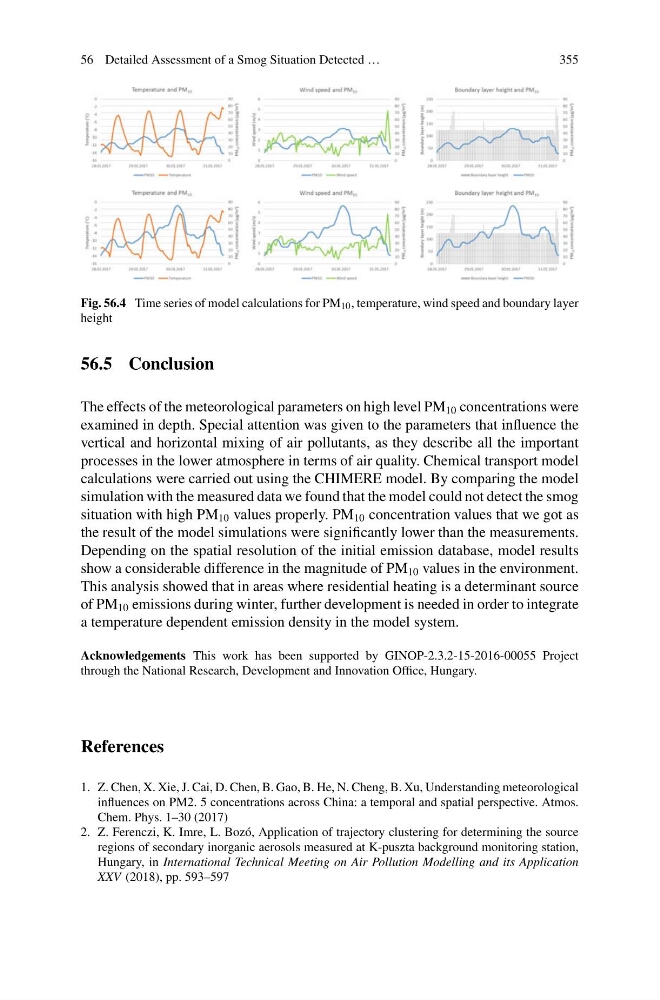
Fig. 56.4 Time series of model calculations for PM 10 , temperature, wind speed and boundary layer
height
56.5 Conclusion
The effects of the meteorological parameters on high level PM 10 concentrations were
examined in depth. Special attention was given to the parameters that influence the
vertical and horizontal mixing of air pollutants, as they describe all the important
processes in the lower atmosphere in terms of air quality. Chemical transport model
calculations were carried out using the CHIMERE model. By comparing the model
simulation with the measured data we found that the model could not detect the smog
situation with high PM 10 values properly. PM 10 concentration values that we got as
the result of the model simulations were significantly lower than the measurements.
Depending on the spatial resolution of the initial emission database, model results
show a considerable difference in the magnitude of PM 10 values in the environment.
This analysis showed that in areas where residential heating is a determinant source
of PM 10 emissions during winter, further development is needed in order to integrate
a temperature dependent emission density in the model system.
Acknowledgements This work has been supported by GINOP-2.3.2-15-2016-00055 Project
through the National Research, Development and Innovation Office, Hungary.
References
1. Z. Chen, X. Xie, J. Cai, D. Chen, B. Gao, B. He, N. Cheng, B. Xu, Understanding meteorological
influences on PM2. 5 concentrations across China: a temporal and spatial perspective. Atmos.
Chem. Phys. 1–30 (2017)
2. Z. Ferenczi, K. Imre, L. Bozó, Application of trajectory clustering for determining the source
regions of secondary inorganic aerosols measured at K-puszta background monitoring station,
Hungary, in International Technical Meeting on Air Pollution Modelling and its Application
XXV (2018), pp. 593–597
355
Fig. 56.4 Time series of model calculations for PM 10 , temperature, wind speed and boundary layer
height
56.5 Conclusion
The effects of the meteorological parameters on high level PM 10 concentrations were
examined in depth. Special attention was given to the parameters that influence the
vertical and horizontal mixing of air pollutants, as they describe all the important
processes in the lower atmosphere in terms of air quality. Chemical transport model
calculations were carried out using the CHIMERE model. By comparing the model
simulation with the measured data we found that the model could not detect the smog
situation with high PM 10 values properly. PM 10 concentration values that we got as
the result of the model simulations were significantly lower than the measurements.
Depending on the spatial resolution of the initial emission database, model results
show a considerable difference in the magnitude of PM 10 values in the environment.
This analysis showed that in areas where residential heating is a determinant source
of PM 10 emissions during winter, further development is needed in order to integrate
a temperature dependent emission density in the model system.
Acknowledgements This work has been supported by GINOP-2.3.2-15-2016-00055 Project
through the National Research, Development and Innovation Office, Hungary.
References
1. Z. Chen, X. Xie, J. Cai, D. Chen, B. Gao, B. He, N. Cheng, B. Xu, Understanding meteorological
influences on PM2. 5 concentrations across China: a temporal and spatial perspective. Atmos.
Chem. Phys. 1–30 (2017)
2. Z. Ferenczi, K. Imre, L. Bozó, Application of trajectory clustering for determining the source
regions of secondary inorganic aerosols measured at K-puszta background monitoring station,
Hungary, in International Technical Meeting on Air Pollution Modelling and its Application
XXV (2018), pp. 593–597