

56 Detailed Assessment of a Smog Situation Detected …
353
the month. The height of the planetary boundary layer remained below 200 m and
the winds were light throughout the same period. The stagnation-index calculated
based on model forecasts also indicated unfavourable meteorological conditions.
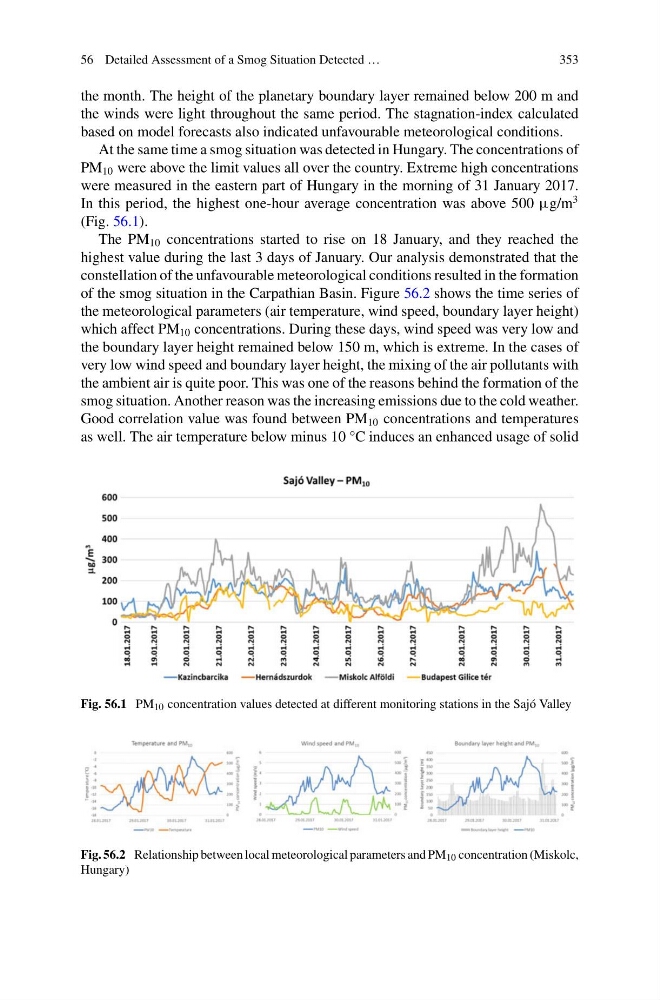
At the same time a smog situation was detected in Hungary. The concentrations of
PM 10 were above the limit values all over the country. Extreme high concentrations
were measured in the eastern part of Hungary in the morning of 31 January 2017.
In this period, the highest one-hour average concentration was above 500 µg/m
3
(Fig. 56.1).
The PM 10 concentrations started to rise on 18 January, and they reached the
highest value during the last 3 days of January. Our analysis demonstrated that the
constellation of the unfavourable meteorological conditions resulted in the formation
of the smog situation in the Carpathian Basin. Figure 56.2 shows the time series of
the meteorological parameters (air temperature, wind speed, boundary layer height)
which affect PM 10 concentrations. During these days, wind speed was very low and
the boundary layer height remained below 150 m, which is extreme. In the cases of
very low wind speed and boundary layer height, the mixing of the air pollutants with
the ambient air is quite poor. This was one of the reasons behind the formation of the
smog situation. Another reason was the increasing emissions due to the cold weather.
Good correlation value was found between PM 10 concentrations and temperatures
as well. The air temperature below minus 10 °C induces an enhanced usage of solid
Fig. 56.1 PM 10 concentration values detected at different monitoring stations in the Sajó Valley
Fig. 56.2 Relationship between local meteorological parameters and PM 10 concentration (Miskolc,
Hungary)
353
the month. The height of the planetary boundary layer remained below 200 m and
the winds were light throughout the same period. The stagnation-index calculated
based on model forecasts also indicated unfavourable meteorological conditions.
At the same time a smog situation was detected in Hungary. The concentrations of
PM 10 were above the limit values all over the country. Extreme high concentrations
were measured in the eastern part of Hungary in the morning of 31 January 2017.
In this period, the highest one-hour average concentration was above 500 µg/m
3
(Fig. 56.1).
The PM 10 concentrations started to rise on 18 January, and they reached the
highest value during the last 3 days of January. Our analysis demonstrated that the
constellation of the unfavourable meteorological conditions resulted in the formation
of the smog situation in the Carpathian Basin. Figure 56.2 shows the time series of
the meteorological parameters (air temperature, wind speed, boundary layer height)
which affect PM 10 concentrations. During these days, wind speed was very low and
the boundary layer height remained below 150 m, which is extreme. In the cases of
very low wind speed and boundary layer height, the mixing of the air pollutants with
the ambient air is quite poor. This was one of the reasons behind the formation of the
smog situation. Another reason was the increasing emissions due to the cold weather.
Good correlation value was found between PM 10 concentrations and temperatures
as well. The air temperature below minus 10 °C induces an enhanced usage of solid
Fig. 56.1 PM 10 concentration values detected at different monitoring stations in the Sajó Valley
Fig. 56.2 Relationship between local meteorological parameters and PM 10 concentration (Miskolc,
Hungary)