

340
D. G. Amanatidis et al.
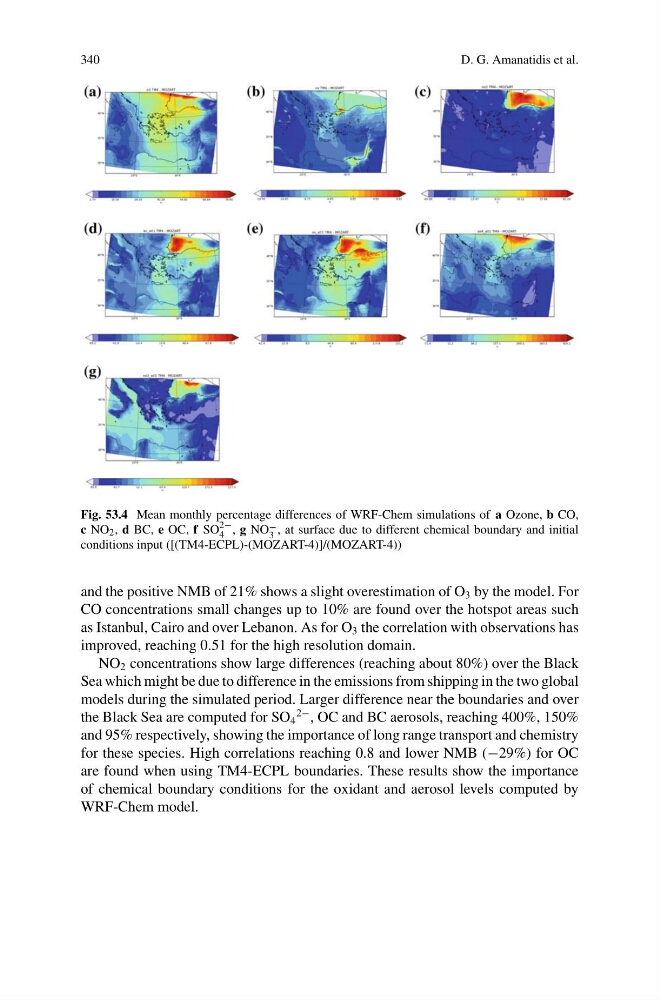
Fig. 53.4 Mean monthly percentage differences of WRF-Chem simulations of a Ozone, b CO,
c NO 2 , d BC, e OC, f SO
2−
4 , g NO −
3 , at surface due to different chemical boundary and initial
conditions input ([(TM4-ECPL)-(MOZART-4)]/(MOZART-4))
and the positive NMB of 21% shows a slight overestimation of O 3 by the model. For
CO concentrations small changes up to 10% are found over the hotspot areas such
as Istanbul, Cairo and over Lebanon. As for O 3 the correlation with observations has
improved, reaching 0.51 for the high resolution domain.
NO 2 concentrations show large differences (reaching about 80%) over the Black
Sea which might be due to difference in the emissions from shipping in the two global
models during the simulated period. Larger difference near the boundaries and over
the Black Sea are computed for SO 4
2− , OC and BC aerosols, reaching 400%, 150%
and 95% respectively, showing the importance of long range transport and chemistry
for these species. High correlations reaching 0.8 and lower NMB (−29%) for OC
are found when using TM4-ECPL boundaries. These results show the importance
of chemical boundary conditions for the oxidant and aerosol levels computed by
WRF-Chem model.
D. G. Amanatidis et al.
Fig. 53.4 Mean monthly percentage differences of WRF-Chem simulations of a Ozone, b CO,
c NO 2 , d BC, e OC, f SO
2−
4 , g NO −
3 , at surface due to different chemical boundary and initial
conditions input ([(TM4-ECPL)-(MOZART-4)]/(MOZART-4))
and the positive NMB of 21% shows a slight overestimation of O 3 by the model. For
CO concentrations small changes up to 10% are found over the hotspot areas such
as Istanbul, Cairo and over Lebanon. As for O 3 the correlation with observations has
improved, reaching 0.51 for the high resolution domain.
NO 2 concentrations show large differences (reaching about 80%) over the Black
Sea which might be due to difference in the emissions from shipping in the two global
models during the simulated period. Larger difference near the boundaries and over
the Black Sea are computed for SO 4
2− , OC and BC aerosols, reaching 400%, 150%
and 95% respectively, showing the importance of long range transport and chemistry
for these species. High correlations reaching 0.8 and lower NMB (−29%) for OC
are found when using TM4-ECPL boundaries. These results show the importance
of chemical boundary conditions for the oxidant and aerosol levels computed by
WRF-Chem model.