

53 Sensitivity of Atmospheric Composition Mesoscale …
337
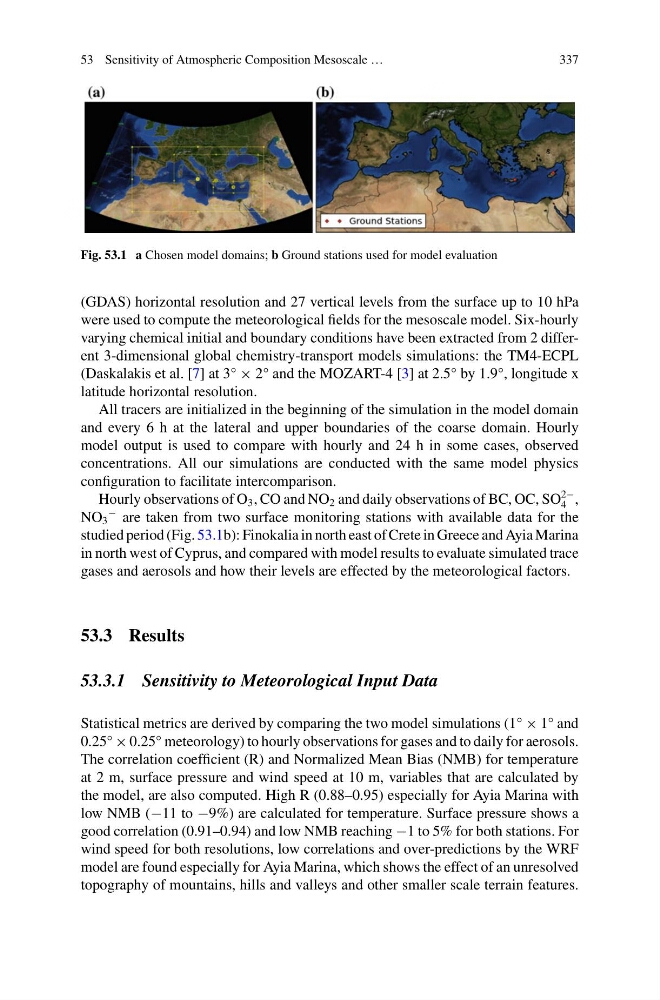
Fig. 53.1 a Chosen model domains; b Ground stations used for model evaluation
(GDAS) horizontal resolution and 27 vertical levels from the surface up to 10 hPa
were used to compute the meteorological fields for the mesoscale model. Six-hourly
varying chemical initial and boundary conditions have been extracted from 2 different 3-dimensional global chemistry-transport models simulations: the TM4-ECPL
(Daskalakis et al. [7] at 3° × 2° and the MOZART-4 [3] at 2.5° by 1.9°, longitude x
latitude horizontal resolution.
All tracers are initialized in the beginning of the simulation in the model domain
and every 6 h at the lateral and upper boundaries of the coarse domain. Hourly
model output is used to compare with hourly and 24 h in some cases, observed
concentrations. All our simulations are conducted with the same model physics
configuration to facilitate intercomparison.
Hourly observations of O 3 , CO and NO 2 and daily observations of BC, OC, SO
2−
4 ,
NO 3
− are taken from two surface monitoring stations with available data for the
studied period (Fig. 53.1b): Finokalia in north east of Crete in Greece and Ayia Marina
in north west of Cyprus, and compared with model results to evaluate simulated trace
gases and aerosols and how their levels are effected by the meteorological factors.
53.3 Results
53.3.1 Sensitivity to Meteorological Input Data
Statistical metrics are derived by comparing the two model simulations (1° × 1° and
0.25° × 0.25° meteorology) to hourly observations for gases and to daily for aerosols.
The correlation coefficient (R) and Normalized Mean Bias (NMB) for temperature
at 2 m, surface pressure and wind speed at 10 m, variables that are calculated by
the model, are also computed. High R (0.88–0.95) especially for Ayia Marina with
low NMB (−11 to −9%) are calculated for temperature. Surface pressure shows a
good correlation (0.91–0.94) and low NMB reaching −1 to 5% for both stations. For
wind speed for both resolutions, low correlations and over-predictions by the WRF
model are found especially for Ayia Marina, which shows the effect of an unresolved
topography of mountains, hills and valleys and other smaller scale terrain features.
337
Fig. 53.1 a Chosen model domains; b Ground stations used for model evaluation
(GDAS) horizontal resolution and 27 vertical levels from the surface up to 10 hPa
were used to compute the meteorological fields for the mesoscale model. Six-hourly
varying chemical initial and boundary conditions have been extracted from 2 different 3-dimensional global chemistry-transport models simulations: the TM4-ECPL
(Daskalakis et al. [7] at 3° × 2° and the MOZART-4 [3] at 2.5° by 1.9°, longitude x
latitude horizontal resolution.
All tracers are initialized in the beginning of the simulation in the model domain
and every 6 h at the lateral and upper boundaries of the coarse domain. Hourly
model output is used to compare with hourly and 24 h in some cases, observed
concentrations. All our simulations are conducted with the same model physics
configuration to facilitate intercomparison.
Hourly observations of O 3 , CO and NO 2 and daily observations of BC, OC, SO
2−
4 ,
NO 3
− are taken from two surface monitoring stations with available data for the
studied period (Fig. 53.1b): Finokalia in north east of Crete in Greece and Ayia Marina
in north west of Cyprus, and compared with model results to evaluate simulated trace
gases and aerosols and how their levels are effected by the meteorological factors.
53.3 Results
53.3.1 Sensitivity to Meteorological Input Data
Statistical metrics are derived by comparing the two model simulations (1° × 1° and
0.25° × 0.25° meteorology) to hourly observations for gases and to daily for aerosols.
The correlation coefficient (R) and Normalized Mean Bias (NMB) for temperature
at 2 m, surface pressure and wind speed at 10 m, variables that are calculated by
the model, are also computed. High R (0.88–0.95) especially for Ayia Marina with
low NMB (−11 to −9%) are calculated for temperature. Surface pressure shows a
good correlation (0.91–0.94) and low NMB reaching −1 to 5% for both stations. For
wind speed for both resolutions, low correlations and over-predictions by the WRF
model are found especially for Ayia Marina, which shows the effect of an unresolved
topography of mountains, hills and valleys and other smaller scale terrain features.